


Measure in Centimetres, Round Up: Cap Fit Guide to Avoid Returns
The one move that fixes most cap-fit problems: measure your head with a soft tape about 0.5–1 cm above your eyebrows and ears, write down the number in centimetres, and treat that as your true size. If your measurement lands between two sizes, always go with the larger one. Everything else in this guide builds on that single habit.
TL;DR:
- Measuring your head in centimeters at the end of the day ensures the most accurate size and helps avoid fitting errors.
- Caps generally fit best within the 54 to 59.5 cm range, with adjustable styles recommended for border sizes or outside that spectrum.
- Crown profile and material significantly influence fit and comfort, with unstructured crowns and stretch fabrics offering more flexibility.
- Proper fit is confirmed through resistance in the two-finger test, alignment with eyebrows and ears, and no deep red marks after wearing.
- Rounding up when between sizes and choosing adjustable caps for border measurements prevents discomfort and fit issues.
Table of Contents
- Cap fit guide: quick size reference chart
- How to measure your head for a cap, step by step
- How should a cap fit? The tests that actually tell you
- Converting your measurement and handling border sizes
- How crown profile and material change the way a cap fits
- Common cap sizing mistakes and easy in-home fixes
- Urban Caps’ approach: measurement first, always
- Caring for your cap so it keeps fitting properly
- Does cap style change how fit should feel?
- Does head shape affect which cap size and style to buy?
- Author perspective: measure once, wear it right for years
- Ready to find your size? Start with a tape measure
- Sources
- FAQ
Cap fit guide: quick size reference chart
Centimetres are the number that matters most, and every other sizing system on a cap label is really just a translation of that one figure. Once you know your circumference in cm, converting to fitted fractions or alpha sizes takes seconds.
Here’s how the common ranges line up, based on the fitted cap size conversions used across the industry:
-
54–55 cm — roughly fitted 6 3/4–6 7/8, alpha size XS/S
-
56–57 cm — fitted 7–7 1/8, alpha size S/M
-
58–59 cm — fitted 7 1/4–7 3/8, alpha size M/L
-
60 cm and above — fitted sizes above 7 1/2, alpha size L/XL
Most one-size-fits-all (OSFA) caps are built to cover roughly 21.5 to 23.5 inches, or about 54.5 to 59.5 cm, which explains why some people find “one size” caps sit fine and others find them tight from the first wear. If your head measures outside that band, an adjustable strap or a stretch-fit style will serve you far better than a rigid OSFA crown. Extended sizes above 61 cm or below 54 cm aren’t always stocked across every style, so it pays to check the exact cm range listed on the individual product page before you commit.
How to measure your head for a cap, step by step
A cap fit guide is only as good as the measurement behind it, and getting that number right takes about two minutes.
Pro Tip: Do this measurement at the end of the day rather than first thing in the morning. Heads swell very slightly through the day, and an evening measurement gives you a more realistic everyday fit.
- Grab a soft tailor’s tape. No tape on hand? A piece of string and a ruler works just as well.
- Wrap it around your head roughly 0.5–1 cm above your eyebrows and above the tops of your ears.
- Run it around the widest part of the back of your skull, not just straight around at ear level.
- Keep the tape level all the way around and snug against your head, without pressing into your hair.
- Note the number in centimetres, then measure a second time to confirm.
- If the two readings differ, take the more consistent of the two as your working number.
- Convert to inches only if a product page requires it. Divide your cm figure by 2.54.
This placement matters more than people expect. Industry sizing standards point to a poor initial measurement as the leading cause of returns, and most of those errors come down to the tape sitting too high, too low, or too loose.
How should a cap fit? The tests that actually tell you
Numbers get you close, but your hands and a mirror confirm the rest. A cap that fits properly passes a few simple checks without any guesswork.
- The two-finger test. Slide two fingers between the sweatband and your temple. You should feel gentle resistance, not a gap and not a squeeze.
- Brim alignment. The front brim should sit level with your eyebrows, and the sides should rest just above your ears.
- Movement test. Turn your head, nod, look up. The cap should stay put without you needing to hold it.
- No red marks. Take it off after ten minutes. Faint pressure lines are normal; deep red welts or a headache are not.
If a cap passes the size check but fails the movement or pressure test, the problem usually isn’t the circumference. It’s the crown profile or the material, which we’ll get to next.
Converting your measurement and handling border sizes
Centimetres stay constant no matter which brand or country made the cap, which is why they’re the most reliable figure to anchor a purchase on. Fitted fractions and alpha sizes are just regional shorthand layered on top.
- Convert cm to fitted fractions using a chart like the one above, never by eyeballing it.
- If your measurement sits exactly between two sizes, round up. Structured fitted crowns have almost no give, so a size too small will never break in.
- Stretch-fit or adjustable styles are the better call if your measurement falls right on a boundary, since they absorb small margins of error that a fitted crown can’t.
- Worked example: 58 cm converts to roughly fitted 7 1/4 and sits comfortably in the M/L alpha bracket.
How crown profile and material change the way a cap fits
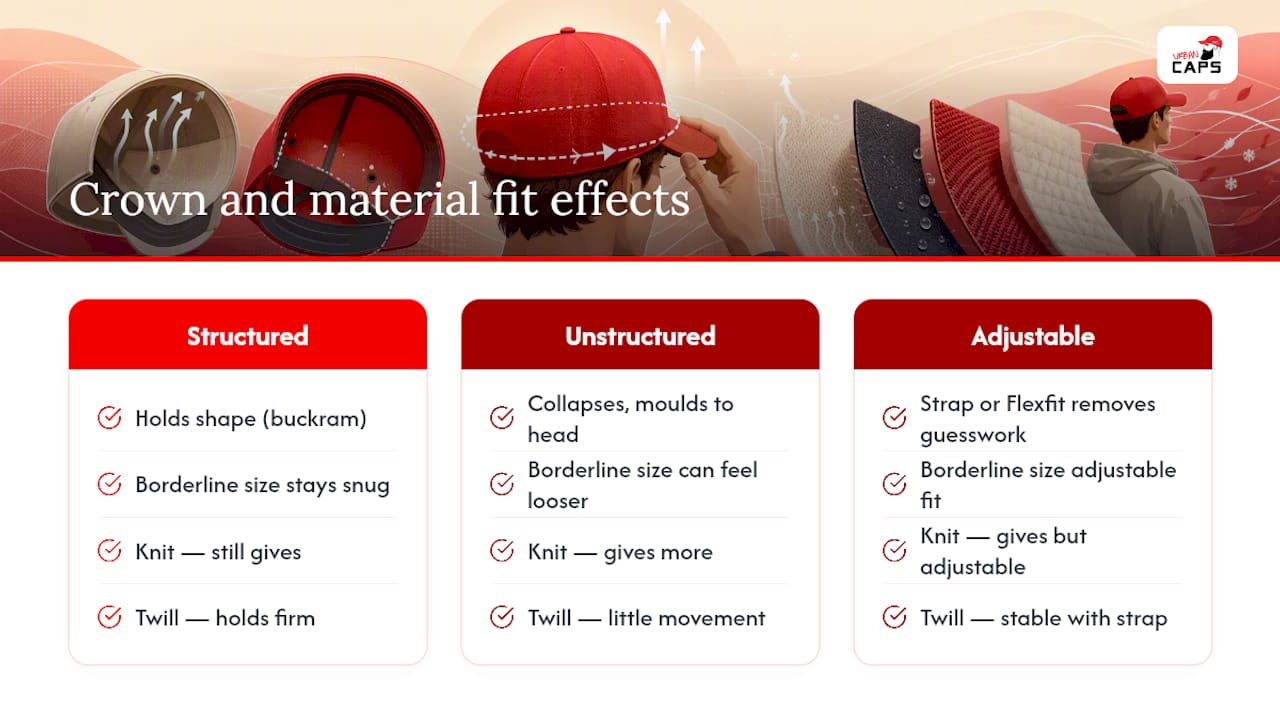
Two caps with the identical 58 cm label can feel completely different on your head, and the reason is almost always crown construction. Structured crowns hold their shape with an internal buckram lining, so a snug measurement stays snug. Unstructured crowns collapse and mould to your head shape, which can make an identical size feel looser day to day.
Crown height changes the visual proportion too. Low-profile crowns sit close and suit rounder faces, mid-profile is the safest all-rounder, and high-profile crowns add height that flatters longer faces but can look oversized on smaller heads.
Material stretch is the other variable worth checking before you buy. Knit fabric gives noticeably, twill holds firm with very little movement, and felt barely stretches at all. If your measurement sits right on a size line, a flat cap in a wool blend behaves very differently to a knit beanie at the same number. When in doubt, an adjustable strap or Flexfit band removes the guesswork entirely.
Common cap sizing mistakes and easy in-home fixes
Most fit complaints trace back to three habits: measuring too high on the forehead, taking only one reading, or trusting a generic “one size” label without checking the actual cm range on the product page.
The good news is that minor misfits rarely need a return.
- Too loose? A sweatband reducer or a thin foam liner pad tightens things up without altering the cap itself.
- Too tight at the crown? Switching to a higher or unstructured profile in the same circumference often solves it.
- Genuinely the wrong size? That’s when a proper exchange for a larger or smaller size is the right call, not a workaround.
Pro Tip: If you’re consistently between two standard sizes across several brands, that’s a sign to prioritise adjustable or stretch-fit caps over structured fitted ones.
Urban Caps’ approach: measurement first, always
Several brands list centimetre ranges as the primary sizing figure on product pages, with fitted fractions and alpha sizes shown as a secondary reference. If your measurement sits on a border, our advice mirrors the wider industry standard: size up rather than down.
Structured styles such as the Churchill Heritage Homburg suit readers with a firm, exact cm reading, while adjustable pieces like the Heritage Herringbone Ivy Cap work better for anyone landing between sizes. Every product page lists its cm range, crown profile, and exchange terms up front, so you can check fit before checkout rather than after.
Caring for your cap so it keeps fitting properly
A cap that fits perfectly on day one won’t stay that way if it’s cared for badly, and the fixes here are simple.
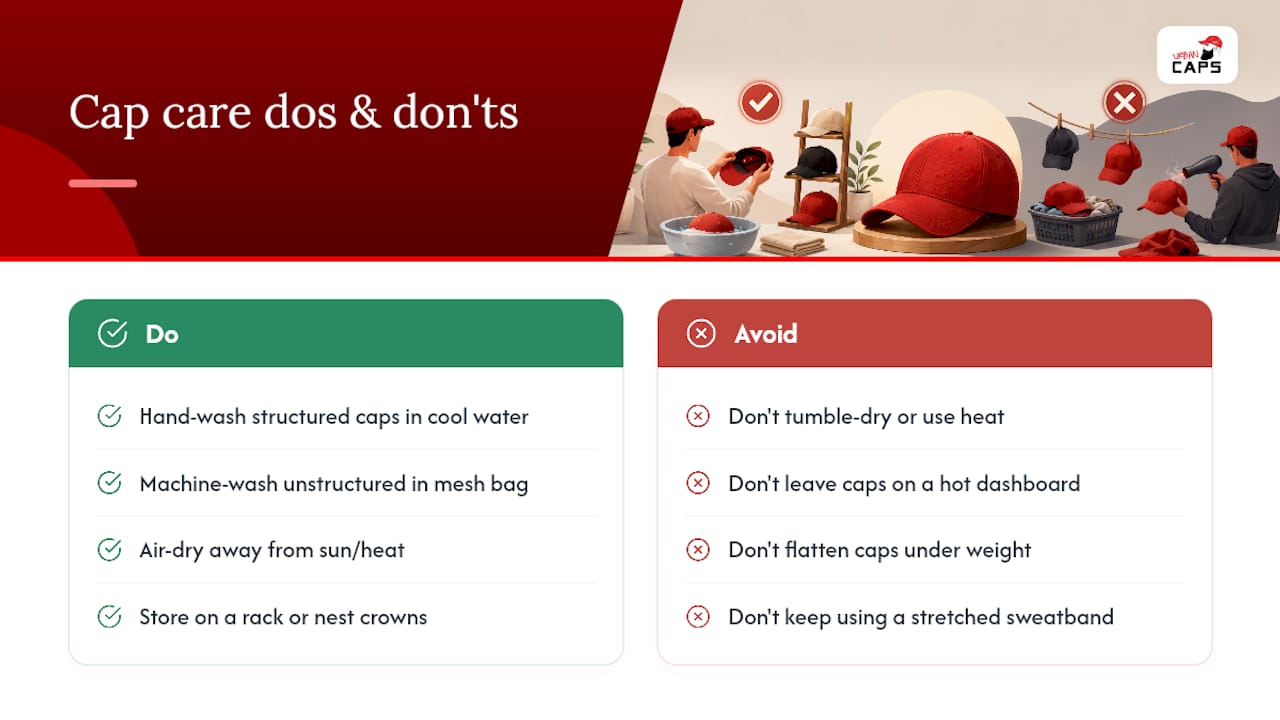
Heat is the biggest threat to fit. Tumble drying or leaving a structured cap on a car dashboard in summer can shrink the sweatband or warp the brim, tightening the crown by more than a size in some cases. Hand wash structured caps in cool water with a soft brush, and let them air dry away from direct sun and heat sources. Unstructured and knit styles are more forgiving in a gentle machine cycle inside a mesh bag, but check the care label first.
Storage matters just as much as washing. A cap stored crushed in a bag or drawer will lose its shape at the brim and crown over months, which changes how it sits even though the circumference hasn’t moved. A cap rack, a shelf, or stacking with the crowns nested (never flattened under weight) keeps the structure intact. For felt and wool styles specifically, a cedar block or breathable dust bag protects against moisture and pests without trapping odour.
Sweatbands wear out before the rest of the cap usually does, and a stretched or thinning sweatband changes fit even when the shell looks fine. Wipe the interior band after heavy wear, especially in warmer months, and let it fully dry before the next wear. If the band has visibly stretched or lost its snap, that’s a fit problem no amount of careful washing will reverse. At that point, a replacement or a different cap is the more sensible fix than trying to nurse the old one back to shape.
Does cap style change how fit should feel?
Yes. A snapback, a dad hat, and a structured baseball cap all fit differently even at the same circumference, because the closure and crown depth change what “correct” feels like.
Snapbacks use an adjustable plastic closure at the back, which means the printed size is really a maximum, not a fixed point. That flexibility is useful if your measurement sits between sizes, but it also means a snapback can feel loose at the crown even when the band is tightened to its smallest setting. Check crown depth on the product listing if you have a smaller head shape, since some snapback crowns run deep regardless of the adjustable band.
Dad hats are deliberately unstructured and relaxed, with a curved brim and a soft, low crown that’s meant to sit slightly looser than a structured fitted cap. That relaxed fit is the style. Don’t judge a dad hat against the two-finger test the same way you would a rigid fitted crown; a bit of extra room at the temple is normal and expected here.
Structured baseball caps, particularly fitted ones without any strap, behave the way this whole guide describes: fixed circumference, minimal stretch, and no room for sizing error. This is where getting your cm measurement right before buying matters most, because there’s no adjustable strap to bail you out if you guess wrong. Flat caps and ivy styles sit closer to the head than baseball caps and rely more on crown depth than brim size, so measuring the same way you would for any structured cap still applies.
Does head shape affect which cap size and style to buy?
Circumference gets you most of the way there, but head shape decides how that measurement actually feels once the cap is on. Two people with an identical 58 cm reading can have very different experiences with the same cap if their head shapes differ.
Round heads, where width and depth are similar, tend to suit most crown profiles without much fuss, since the cap has an even surface to sit against. Oval heads, longer front to back than side to side, generally do well in mid to high crown profiles that give a bit of extra room lengthwise rather than a low profile that can feel tight at the temples.
Long-oval head shapes are the trickiest case, and the one most likely to cause a fit complaint despite a correct cm reading. Because these heads are noticeably longer than they are wide, a standard fitted crown can measure correctly around the circumference yet still pinch at the temples. It’s common practice among fitters to add roughly an eighth of a size for long-oval cases, or to favour an unstructured or stretch-fit crown that flexes into the shape rather than forcing a round mould onto an oval head.
If you’ve measured accurately, tried the two-finger test, and a cap still feels off at the sides specifically, head shape rather than a wrong size is very likely the cause. Swapping crown profile before swapping size is usually the smarter fix.
Author perspective: measure once, wear it right for years
The verdict hasn’t changed since the top of this guide: measure in centimetres, round up at the border, and the rest of the fit sorts itself out. My honest tip after looking at how much return traffic sizing errors cause? Measure at night, not in the morning. Your head sits at its true size then, not its slightly compressed morning size. For deeper detail on specific styles, our hat selection guide is worth a look before you buy.
— Urban
Ready to find your size? Start with a tape measure
Many hat retailers build product pages around the same rule this guide just walked you through: centimetres first, alpha and fitted conversions second. That’s the difference between guessing off a generic “M/L” label and buying a cap that actually matches your head the first time.
If your measurement landed in the mid-to-upper 50s, the Premium American Twill Snapback gives you adjustable room to fine-tune on the day it arrives. Heading into colder months, the Fashion Knit Beanie stretches comfortably across a wide range of circumferences without needing an exact match. Prefer a structured, heritage-style shape? The Fedora Hat Jazz Style Fedoras Hat is built to the cm ranges listed on its product page, so check yours against the chart before ordering. Every listing spells out its size range and our exchange guidance in plain terms, so measure your head now and match it against the product page before you add anything to your cart.
Sources
For the measuring method and cm-first approach, see Urbancaps’ own wool hat sizing guide. For fitted fraction conversions, check UnfashionableMale’s fitted cap guide. For OSFA ranges and specs, see MFGMerch’s hat size chart. For measurement standards, see AceAccessory’s sizing guide.
- Men’s fitted cap size guide — UnfashionableMale
- Hat size chart: every hat type with measurements & specs — MFGMerch
- What are the industry standards for measuring hat sizes accurately? — AceAccessory
FAQ
How do you know what cap fits you?
Measure your head circumference with a soft tape about 0.5–1 cm above your eyebrows and ears, then match that centimetre figure against the product’s stated size range rather than guessing from S/M/L labels alone.
How do I know what fitted cap size I am?
Take your circumference in centimetres and convert it using a fitted fraction chart. A reading of 58 cm typically converts to fitted 7 1/4, sitting in the M/L alpha bracket.
How should my fitted cap fit?
It should feel snug with slight resistance when you slide two fingers under the sweatband, sit level with your eyebrows at the front, and stay in place when you move your head without leaving deep red marks.
How do you know your cap size?
Use a soft tape or a piece of string and a ruler, measure twice around the widest point of your head, and take the more consistent reading in centimetres as your true size.