

How Gender and Craft Shaped Fedora History in New Zealand Since 1882
A fedora is a soft felt hat with an indented crown, a centre crease and a snapped brim, and it takes its name from Sarah Bernhardt’s 1882 stage role in Fédora. What started as a women’s fashion statement became 1920s men’s business wear, then a shorthand for gangsters and detectives, and today it sits somewhere between costume-party punchline and considered heritage piece.
TL;DR:
- Fedoras originally appeared as a women’s theatrical accessory before becoming a staple of men’s fashion in the 1920s, boosted by royal and celebrity endorsement.
- High-quality fedoras use fur-felt materials like nutria and beaver, with features such as a snap brim and reblocking ability that determine their longevity and value.
- The hat’s cultural associations shifted from suffragist symbolism to gangster, jazz, and subcultural identity, then to a vintage style through Hollywood and meme culture.
- Mainstream use declined after the 1950s as casual dress replaced hats, but heritage craftsmanship keeps the style alive for collectors and enthusiasts.
- When buying a fedora, focus on material quality, proper construction with a structured brim, and reblocking capability to ensure a durable, authentic piece.
Table of Contents
- The origin of fedora style: theatrical roots and early female wear
- How the fedora took over men’s fashion in the 1920s
- What are fedoras made from, and why does felt quality matter?
- Why is the fedora linked to gangsters and jazz?
- When did fedoras become uncool, and why?
- Religious and subcultural uses that never went away
- How do you choose and care for a fedora?
- Urban’s take on heritage hat craft
- Why heritage craft still matters in a fedora
- Shop fedora styles built on that history
- Sources
- FAQ
The origin of fedora style: theatrical roots and early female wear
The fedora didn’t start on a man’s head, and it certainly didn’t start as a symbol of Prohibition-era menace. It began on a Paris stage.
Playwright Victorien Sardou wrote Fédora in 1882 as a vehicle for Sarah Bernhardt, casting her as Princess Fédora Romanoff. Bernhardt wore a soft, center-creased hat with a moderately wide brim throughout the production, and the style caught on with audiences almost immediately. Within a few years, the term “fedora” had entered common use, tied directly to her name and her character.
That timing matters more than it first appears. Women’s fashion in the 1880s and 1890s was shifting away from restrictive Victorian silhouettes, and Bernhardt’s stage hat offered something genuinely new: a masculine-cut accessory a woman could wear without irony. It had structure. It had a brim you could tilt for shade or attitude. It didn’t require a hatpin the size of a knitting needle to stay on.
Suffragists picked it up for exactly those reasons. The Te Ara encyclopedia’s account of clothing history frames the fedora’s early adoption as one of the clearer examples of gendered meaning shifting through dress: a hat borrowed from menswear conventions, worn by women pushing for the vote, doing real symbolic work rather than sitting as mere decoration.
A few things about that early period are worth holding onto:
- The fedora entered fashion vocabulary as a women’s hat, not a men’s one.
- Its practicality (light felt, shaped brim, minimal fuss) suited activists who needed clothing that worked as hard as they did.
- The theatrical origin means the fedora’s history is tied to celebrity influence from day one, decades before Hollywood ever got hold of it.
That’s the part most casual histories skip. By the time men started wearing fedoras seriously, the hat had already spent the better part of two decades as a marker of independent women.
How the fedora took over men’s fashion in the 1920s
The gender flip happened fast, and it happened partly because of one very well-dressed royal.
Edward, Prince of Wales, became something close to a walking style guide for men in the 1920s, and his embrace of the fedora helped shift it firmly into menswear territory. Once it had royal and celebrity endorsement on the men’s side, the rest was mostly a matter of manufacturing capacity.
- Department stores and hat manufacturers scaled production quickly, turning what had been a niche or custom item into something available off the rack in most Western cities.
- Fur-felt became the dominant material for quality fedoras, with nutria and beaver felt prized for how well they held a crease and resisted rain, a detail that Wikipedia’s history of the hat records as central to the era’s manufacturing shift.
- Brim widths crept outward through the 1930s, tracking broader shoulder lines and the era’s love of a strong silhouette, before narrowing again as the 1940s brought fabric rationing and more conservative tailoring.
- Peak popularity ran roughly from the 1920s through the 1940s, the period when a fedora wasn’t a fashion statement so much as a basic requirement of being dressed for the street.
By the late 1930s, a man leaving the house without a hat looked half-finished, and the fedora was the default choice for anyone who wasn’t reaching for a flat cap or bowler. It had gone from suffragist accessory to office-worker uniform in under fifty years.
What are fedoras made from, and why does felt quality matter?
Understanding fedora construction explains why some hats survive eighty years and others fall apart in eight. Felt type is the biggest variable. Rabbit fur felt was common and affordable; nutria and beaver felt sat higher up the price scale because they held sharper creases and resisted moisture better, a distinction that shaped both cost and longevity across the mid-century felt trade, according to Wikipedia’s material notes on the hat’s history.
The crown shape is where a lot of the visual identity lives:
- Teardrop crown: a single lengthwise dent, the most common shape and the one most associated with classic menswear.
- Centre dent (or “diamond”) crown: a symmetrical pinch with two side dents, favoured in some 1940s American styling.
- Open crown: no pre-set crease, left to the wearer or milliner to shape.
Brim behaviour separated genuinely good hats from cheap imitations. Premium fedoras were built so the brim could “snap,” worn down at the front and up at the back, and reshaped on wooden or metal blocks whenever it lost form. The Auckland University heritage blog’s research into 1940s fashion notes this snap-and-block feature as a genuine marker of quality construction, not just a styling flourish. A hat that couldn’t hold a reblock was a hat built to be replaced, not repaired.
Pro Tip: If you’re evaluating a vintage fedora, run your thumb along the brim edge. Fur-felt has a slightly denser, more matted feel than wool felt, and it should spring back into shape rather than staying creased where you pressed it.
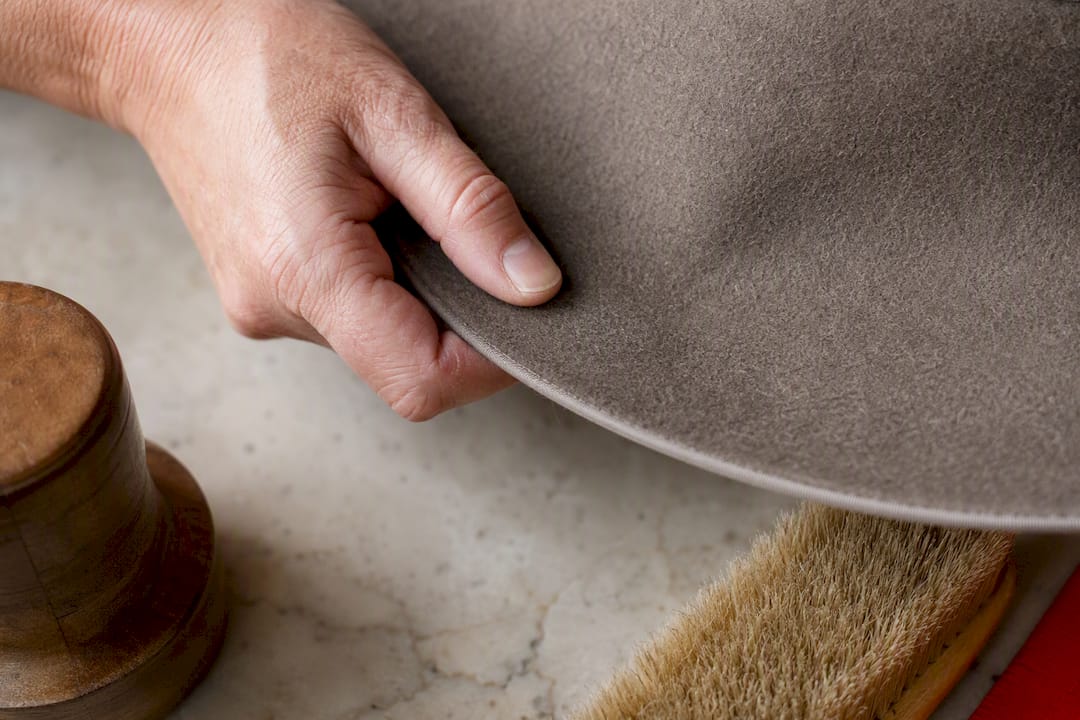
This is also where the term reblocking comes from: steaming a felt hat back over a wooden block to restore its original crown and brim shape, a process that’s kept genuinely old fedoras wearable for the better part of a century.
Why is the fedora linked to gangsters and jazz?
Hollywood did more to fix the fedora’s meaning than any tailor ever could. Film noir directors dressed their detectives and their criminals in near-identical fedoras, and audiences absorbed the visual shorthand without ever being told to. Vice’s history of the fedora traces how thoroughly film noir and Prohibition-era crime stories welded the hat to a specific archetype: morally ambiguous, urban, dangerous, and always slightly shadowed by the brim.
Music culture ran a parallel track. Jazz musicians wore fedoras as part of a sharp, deliberate look, and the association carried forward into later subcultures:
- Prohibition-era gangster imagery cemented the fedora as visual shorthand for organised crime, fair or not.
- Jazz-age performers used the hat as part of a considered, stylish stage presence rather than a costume cliché.
- Ska and rude boy culture in the 1960s and beyond adopted the pork-pie and fedora shapes as identity markers tied to music and community, not nostalgia.
- Internet-era “fedora bros” turned the hat into a punchline in the 2010s, a stigma that had almost nothing to do with the hat itself and everything to do with a specific online stereotype.
That last shift is worth sitting with. A hat that once meant suffragist, then businessman, then detective, then jazz musician, ended up meaning poorly socialised internet commenter to an entire generation, purely through meme culture rather than any change in the object itself.
When did fedoras become uncool, and why?
The fedora’s fall from daily wear wasn’t sudden. It tracked a broader loosening of dress codes that started gathering pace through the 1950s and accelerated hard in the 1960s. Men stopped needing a hat to look finished, and once that expectation dropped, an entire retail category lost its reason for being. By the mid-20th century, fedoras had slipped out of everyday menswear as casual dress norms took hold, rather than any single trend killing the hat outright.
Revivals since then have come in waves, usually triggered by something specific rather than a genuine return to daily wear:
- Cinema and television nostalgia (period dramas, noir revivals) periodically reintroduces the silhouette to new audiences.
- Celebrity adoption sparks short bursts of retail demand every few years.
- Subcultural cycles, from mod revivalists to modern heritage-menswear circles, keep smaller but dedicated wearer bases alive.
The difference between then and now is context. In 1938, a fedora was default dressing. In 2026, it’s a deliberate style choice, closer to a considered accessory than a wardrobe basic.
Religious and subcultural uses that never went away
While mainstream fashion cycled the fedora in and out of relevance, some communities never stopped wearing it, and their reasons had nothing to do with trends.
Black fedoras have long marked identity within Haredi and other Orthodox Jewish communities, worn as a matter of religious custom and communal belonging rather than seasonal style. That use has stayed remarkably stable for generations, insulated from whatever Hollywood or high street fashion happened to be doing with the same silhouette.
Zoot suit culture in the 1930s and 1940s paired wide-brimmed fedoras with exaggerated tailoring as a deliberate statement of identity among Mexican-American and Black communities. Ska and rude boy subcultures picked up narrower-brimmed versions decades later for similar reasons: the hat signalled belonging to a specific scene, not a passing look.
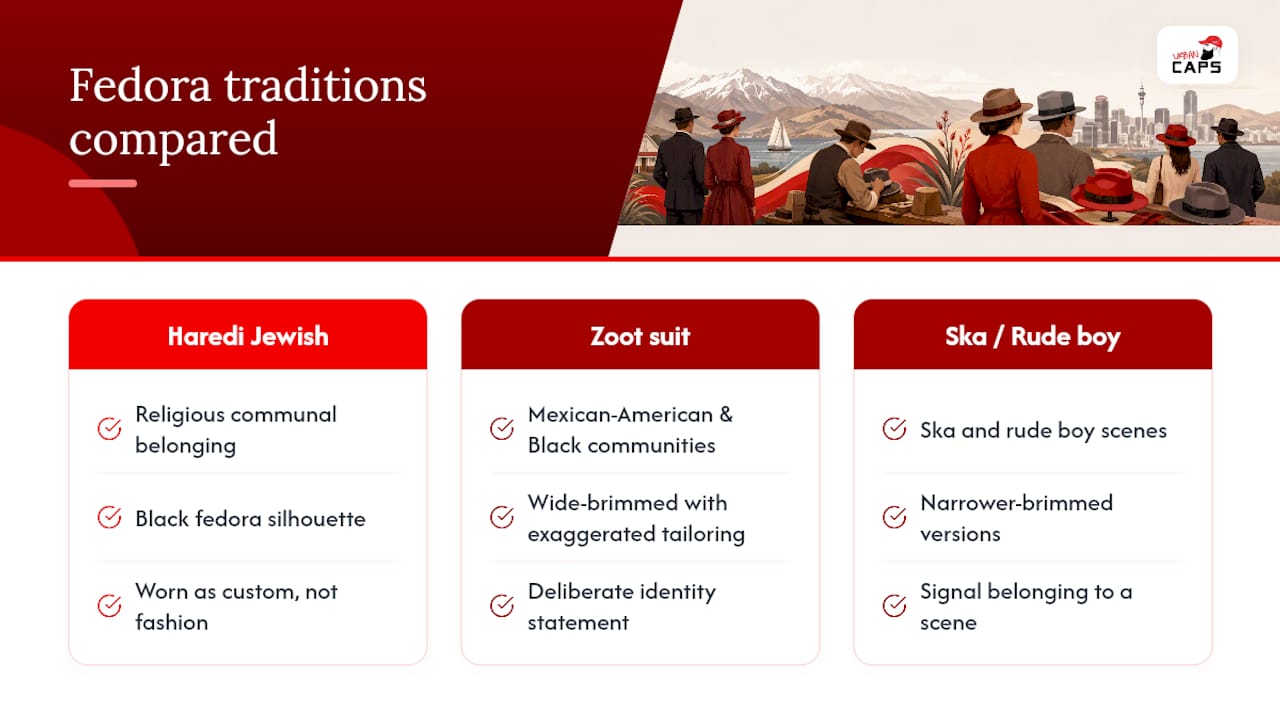
These specialised traditions explain why the fedora never fully disappeared even during its least fashionable decades. Somewhere, it always meant something specific to somebody.
How do you choose and care for a fedora?
Buying a fedora with any intention of keeping it means paying attention to the same details milliners always have. Material comes first: fur-felt (rabbit, nutria, or beaver) holds a crease and resists light rain far better than wool felt, though wool costs less and suits occasional wear. Crown shape and brim width should suit your face and your intended use, a wider brim for sun protection, a narrower one for a tidier daily look.
Care is straightforward once you know the rules:
- Store on a hat stand or in its box, never crushed flat or stacked under other items.
- Brush with a soft hat brush in the direction of the nap to lift dust without damaging the felt.
- Keep water exposure minimal; fur-felt tolerates light rain, but soaking distorts the shape.
- Reblock when the crown or brim loses its line, rather than forcing a shape back by hand.
Pro Tip: Steam reshaping and professional reblocking can restore a tired vintage fedora almost completely, but always match the reshaping to the original block style rather than guessing at a new crown.
Vintage pieces reward this kind of attention because the felt quality is often superior to modern budget hats. A well-made new fedora built for reblocking, though, gives you the same longevity without the hunt through op shops and estate sales.
Urban’s take on heritage hat craft
Urbancaps has written at length about what actually makes a fedora a fedora and how to style one for modern wear, and that grounding in the construction detail matters when you’re sourcing heritage pieces rather than costume props. The brand’s heritage collections lean on the same principles that separated quality mid-century fedoras from mass-produced ones: proper crown shaping, brim structure that holds a snap, and felt weights chosen for how they age rather than how cheap they are to produce.
That approach shows up directly in the range. The Churchill Heritage Homburg Hat, built from premium Australian wool felt, reflects the structured European silhouette that ran parallel to the fedora through the same decades. It sits alongside contemporary fedora styles for shoppers who want the history without needing to track down a genuine 1940s piece.
Why heritage craft still matters in a fedora
Fashion history repeats because good design doesn’t really go out of date, it just goes quiet for a while. When Urbancaps builds a hat with proper brim snap and a crown that holds its crease, that’s not nostalgia for its own sake, it’s borrowing construction logic that was already proven decades before anyone at this company was born. Understanding where the fedora came from, a hat born of theatre and suffrage before it ever meant “gangster,” changes how you shop for one. You start looking for structure and material instead of just a silhouette. That’s the whole point of stocking heritage-inspired headwear alongside contemporary pieces: give people the option to wear history properly, not just reference it.
— Urban
Shop fedora styles built on that history
Urbancaps sells the fedora the way it was actually built, not the flattened costume-shop version most retailers push. Where a lot of sellers offer one generic black fedora and call it done, Urbancaps stocks distinct historical silhouettes so you can pick the era and material that actually suits how you’ll wear it.

The Fedora Hat Jazz Style Fedoras Hat leans into the wide-brimmed, strong-crease look that defined the swing era, a solid pick if you want the classic film-noir silhouette rather than a narrower modern cut. For something with more visual flair, the Embroidered Fashion Fedoras Hat takes the traditional shape and adds decorative detailing, better suited to fashion-forward wear than strict period accuracy. If you want the structured European cousin of the fedora, the Churchill Heritage Homburg Hat in premium Australian wool felt gives you that stiffer crown and rolled brim for a more formal look. And for something well outside the historical mainstream, the Steampunk Hat Gear Punk Rivet Hat Gothic Glasses Magic Hat Fedoras Hat takes the fedora base and pushes it toward costume and subculture styling entirely.
Check crown shape and brim width against your face shape before you buy, and browse the full fedora range to compare materials side by side.
Sources
- Fedora
- Clothes and dress — Te Ara encyclopedia of New Zealand
- The history of the fedora — Vice
- 1940s fashion in Auckland — Auckland University heritage blog
- Encyclopedia
FAQ
When did fedoras become uncool?
The fedora’s decline tracked the loosening of men’s dress codes from the 1950s onward, with casual wear largely replacing hats as everyday menswear by the 1960s.
Is a fedora a gangster hat?
Not originally. It began as a women’s fashion and suffragist accessory in the 1880s; the gangster association came decades later through Prohibition-era crime stories and film noir imagery.
When did Jewish communities start wearing fedoras?
Black fedoras became an established feature of Haredi and other Orthodox Jewish dress as the hat spread through the early 20th century, and that religious and cultural use has remained largely stable since.
Why does no one wear fedoras anymore?
Casual dress codes replaced the daily need for hats from the 1950s onward, though the fedora still reappears through cinema nostalgia, celebrity influence and subcultural revivals rather than disappearing completely.
What defines a genuine fedora versus a costume version?
A genuine fedora has a soft felt crown with a centre crease, an indented top and a brim built to snap and hold shape, features that separate quality construction from flimsy costume versions.