

Hats with glasses: easy style rules and best pairings
Wearing hats with glasses comes down to three rules: balance proportions (hat size versus frame size), keep 5–8 mm of vertical clearance between your brim and frame top, and coordinate colour and texture for a cohesive look. Get those three right and you can wear almost any hat style with confidence.
Here’s why each rule matters:
- Proportion: A large-brimmed hat paired with chunky frames creates visual overload. A smaller hat with bold frames, on the other hand, lets both pieces breathe. Styling guides consistently link hat scale to frame weight — larger hats with slimmer frames, smaller hats with bolder frames.
- Clearance: When a brim sits too close to your frames, it pushes them down your nose and creates an awkward stacked look. A small vertical gap between the top of your frames and the underside of your hat brim is the practical sweet spot.
- Colour and texture: Matching the metal tone of your frames to a hat’s hardware, or pairing acetate frames with a wool hat, makes the combination look deliberate rather than accidental.
Pro Tip: Snap a quick photo from the front and at 45° before heading out. Proportion issues that feel fine in the mirror often show up clearly in a photo.
Key takeaways
Pairing hats with glasses works when you match proportions, keep 5–8 mm of clearance between your brim and frames, and coordinate colour and texture for a deliberate look.
| Point | Details |
|---|---|
| Proportion rule | Large hats suit slimmer frames; small hats suit bolder frames for visual balance. |
| Clearance standard | Keep 5–8 mm between your frame top and brim underside to prevent glasses being pushed down. |
| Colour and texture | Match metal tones and echo textures — acetate frames with wool hats, wire frames with straw. |
| Face shape starting point | Round faces suit angular hats; long faces suit wide brims or tilted berets. |
| Urbancaps range | Stretchy beanies, adjustable ivy caps, and structured fedoras available with free NZ shipping. |
Table of Contents
- What hats go well with glasses, style by style?
- How do you check that a hat fits over glasses comfortably?
- Which hat and frame shapes suit your face shape?
- Seasonal tips for wearing hats and glasses in New Zealand
- Styling hats with glasses: practical notes for women and non-binary wearers
- Common hat and glasses mistakes — and how to fix them
- Buying hats for glasses wearers in New Zealand
- Which lens type works best with which hat style?
- The Urbancaps take on hats for glasses wearers
- Glasses-friendly hats, ready to shop at Urbancaps
- Sources
- FAQ
What hats go well with glasses, style by style?
Every hat type has a natural frame partner. The logic is usually contrast or harmony: angular hats soften round frames, and structured hats ground lightweight metal frames. Here’s the full breakdown, hat by hat.
Beanie
Beanies are the most forgiving hat for glasses wearers because they sit above the temple arms rather than pressing against them. Round or minimalist frames pair especially well with a knit beanie — the soft, casual texture of wool or acrylic echoes the relaxed silhouette. Oversized frames also work well here; the beanie’s low profile keeps the overall look balanced.
- Do: Pull the beanie up slightly so it clears your temple arms.
- Don’t: Fold a thick cuff down over your ears — it compresses the temples and causes pressure.
The Fashion Knit Beanie from Urbancaps has a stretchy knit construction that sits comfortably above most temple arms, making it a practical pick for everyday glasses wearers.
Fedora and trilby
Fedoras suit rectangular or sleek metal frames. The structured brim and angular crown create visual contrast against softer, rounder faces and frames. A trilby’s shorter, snapped-down brim works well with aviator or browline frames — the horizontal line of the brim echoes the keyhole bridge of an aviator.
- Do: Tilt the fedora slightly to one side to add asymmetry and reduce visual weight.
- Don’t: Pair a wide-brim fedora with thick, heavy frames — both compete for attention.
How to style a fedora covers outfit pairings in more detail. The Fedora Hat at Urbancaps has a crown height that clears most frames without interference.
Bucket hat
Bucket hats pair naturally with round or oval frames. The downward-sloping brim softens angular faces and adds a casual, relaxed feel. Metal wire frames or thin acetate styles keep the look light.
- Do: Choose a medium brim — wide enough for sun protection, narrow enough to avoid pushing frames.
- Don’t: Wear a deep-crown bucket hat with thick plastic frames; the combined bulk reads heavy.
Baseball cap
Baseball caps work with almost every frame shape, which is why they’re the most popular casual pairing. Classic combinations include a baseball cap with wayfarers — the wayfarer’s bold rectangular shape contrasts cleanly with the cap’s curved brim. Dad caps, with their unstructured crown, also suit round or cat-eye frames.
- Do: Wear the cap forward so the brim provides clearance above your frames.
- Don’t: Wear a low-profile cap that pushes the brim onto your frames.
For a deeper look at cap silhouettes, this comparison of dad hats and baseball caps breaks down the structural differences worth knowing before you buy.
Flat cap and baker boy
The flat cap (ivy cap) and baker boy (newsboy cap) both suit browline or round frames. The structured peak and low-profile crown create a smart-casual look that pairs well with vintage-inspired acetate frames. Browline frames are a particularly effective match because the cap’s horizontal peak echoes the frame’s strong upper line.
- Do: Choose a herringbone or tweed texture — it pairs naturally with tortoiseshell acetate.
- Don’t: Pair a flat cap with oversized wraparound frames; the proportions clash.
The Heritage Herringbone Ivy Cap from Urbancaps is an adjustable fit, which helps glasses wearers dial in the right crown height.
Beret
Berets are highly versatile for glasses wearers because they sit on top of the head rather than pulling down over the ears. Tilt a beret to one side and it adds perceived width to a long face. Cat-eye or geometric frames pair well with a beret’s soft, rounded silhouette — the contrast between angular frames and the beret’s curve creates visual interest.
- Do: Tilt the beret to create asymmetry and balance face proportions.
- Don’t: Pull it straight down over both ears — it flattens the look and can press on temple arms.
Aviator/trapper hat
Trapper hats with ear flaps are the trickiest style for glasses wearers because the flaps sit directly over the temple area. Choose a trapper with thin, soft ear flaps and slim temple arms on your frames. Rectangular or narrow frames minimise the contact points.
- Do: Tuck ear flaps up when indoors to relieve temple pressure.
- Don’t: Wear thick acetate frames with a bulky trapper — the temple area becomes crowded.
Pro Tip: Chromatic harmony makes the whole combination look intentional. Match the metal tone of your frame hardware to any metal detail on your hat — a gold-toned buckle on a trapper hat echoes gold wire frames cleanly.
How do you check that a hat fits over glasses comfortably?
Fit is where most glasses wearers run into trouble. The 5–8 mm vertical clearance guideline is the starting point: aim for roughly 5–8 mm between the top of your frames and the underside of the hat brim to prevent the brim from pushing your glasses down your nose.
Beyond clearance, run through this checklist before committing to a hat:
- Crown height: A higher crown keeps the hat body away from your temple arms. Low-crown hats are the most common source of temple pressure.
- Temple arm thickness: Thicker acetate arms need more lateral clearance inside the hat band. Slim metal arms are easier to accommodate.
- Hat tightness: A hat that’s too tight squeezes the temple arms inward, which pushes the nose pads into your face. Size up if you feel that pressure.
- Adjustable bands: Hats with an internal drawstring or adjustable band let you fine-tune the fit without affecting the external silhouette.
- Anti-slip nose pads: Silicone nose pads on your frames reduce the tendency for glasses to slide when a hat shifts position.
- Strap or retainer: For active use (hiking, cycling), a glasses retainer cord keeps frames in place regardless of hat movement.
Testing at home: Put the hat on over your glasses and wear it for 5–10 minutes. Move your head side to side, look down, and bend forward. If your glasses shift or feel pinched, the hat is either too tight or the crown is too low. Adjust the band first; if that doesn’t resolve it, try a different crown height.
Pro Tip: For winter hats specifically, try swapping to slimmer temple arms or fitting a thin silicone temple sleeve over your existing arms. It reduces the contact surface inside a snug beanie or trapper hat without replacing your frames.
Which hat and frame shapes suit your face shape?
Face shape is a practical starting point for narrowing down hat and frame combinations. The visual objective is always balance: add angles to soft faces, add softness to angular ones, and add width or height where the face lacks it.
For a detailed step-by-step guide, Urbancaps covers how to select the perfect hat for your face shape with measuring guidance.
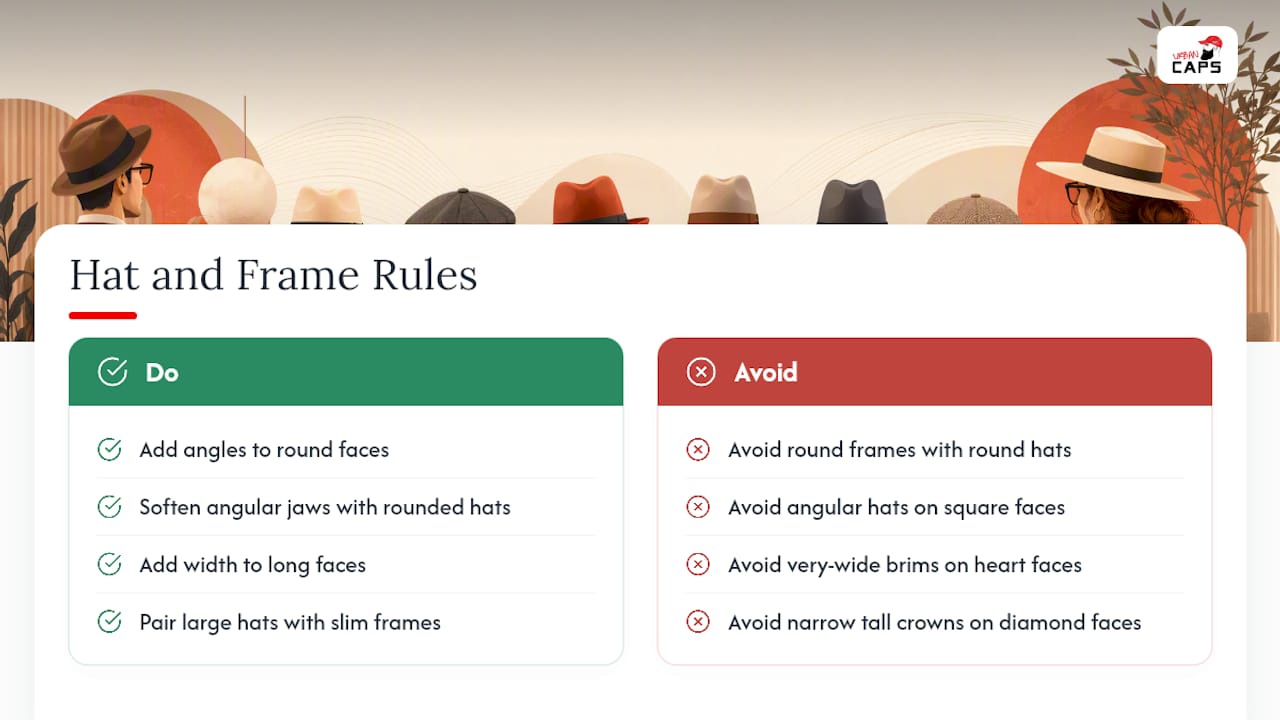
Round face: Add angles and length. Choose structured hats (fedora, trilby, flat cap) and angular frames (rectangle, browline, geometric). Avoid round frames with round hats — they amplify the circular shape.
Oval face: The most flexible face shape. Almost any hat and frame combination works. Use this as an opportunity to experiment with proportion — try a wide-brim hat with slim wire frames, or a baker boy with bold acetate.
Square face: Soften the jawline. Choose hats with rounded crowns (bucket, beret, beanie) and round or oval frames. Avoid very structured, angular hats that echo the jaw’s strong lines.
Heart face (wide forehead, narrow chin): Add width at the jaw and reduce width at the top. Medium-brim hats worn straight work well; avoid very wide brims that emphasise the forehead. Cat-eye or upswept frames add lift without widening the upper face.
Diamond face (narrow forehead and chin, wide cheekbones): Add width at the forehead and chin. Wide-brim hats and full-rim oval or round frames balance the cheekbones. Avoid narrow, tall crowns that elongate the face further.
Long face: Add width. Wider-brimmed hats or slanted styles like berets create perceived width. Pair with wide rectangular frames or round frames to break up the vertical line.
One proportion rule applies across all face shapes: larger hats pair with slimmer frames; smaller hats allow bolder frames. Keep that ratio in mind and the combination will read as considered rather than accidental.
Seasonal tips for wearing hats and glasses in New Zealand
New Zealand’s UV index is among the highest in the world, which makes the hat-plus-sunglasses combination genuinely functional, not just stylish. Hats reduce sunlight reaching the eyes while sunglasses block UV — together they offer more protection than either alone.
For sun protection in NZ conditions, a wide-brim hat (at least 7.5 cm) paired with wraparound or large-lens sunglasses is the most effective combination. Keep the 5–8 mm clearance rule in mind: a wide brim that sits too low will push your sunglasses down and reduce both comfort and coverage.
Winter considerations:
- Choose soft, stretchy beanies over rigid knit styles — they conform to your temple arms rather than pressing against them.
- Medium-brim wool hats (like a homburg or rancher) provide insulation without the low-crown interference that flat caps can cause.
- Avoid very low-crown hats for all-day wear with glasses; the crown compresses onto the temple arms within an hour.
Fogging prevention:
Fogging happens when you move from cold air into a warm space and your lenses cool rapidly. A hat brim angled slightly upward at the front allows more airflow across the lens surface, which reduces condensation. Anti-fog lens treatments (available from most NZ optometrists) are the most reliable fix for persistent fogging.
Clearance standard: The 5–8 mm vertical clearance guideline between frame top and brim underside is the practical comfort standard recommended for pairing sunglasses with hats. It prevents brim-to-frame contact and keeps glasses sitting correctly on the nose.
For seasonal hat picks across all NZ weather, best hats for every season covers the full range.
Styling hats with glasses: practical notes for women and non-binary wearers
Tilt is one of the most underused tools for glasses wearers. Tilting a beret or fedora to one side changes the perceived width of your face, which directly affects how your frames read. A beret tilted left, for example, draws the eye across the face rather than straight down — useful if you have a long face and want to add visual width.
Cat-eye and geometric frames add lift under a hat’s brim. The upswept outer corners of a cat-eye create an upward visual line that counteracts the downward angle of a brim, keeping the face looking open rather than shadowed.
Accessories around the hat-glasses junction deserve attention:
- Scarves: A loosely draped scarf adds texture around the neck without adding bulk at the temples. Avoid wrapping a scarf tightly over the ears — it compresses the temple arms.
- Hat pins: A small pin on the brim or crown draws the eye upward and away from the glasses, which is useful when you’re wearing a hat that sits close to your frames.
- Glasses chains: A chain that drapes below the hat’s brim adds a vertical line that elongates the face — useful for round or square faces. Coordinating the chain’s metal tone with your hat’s hardware keeps the look cohesive.
Five practical outfit pairings that work across genders:
- Oversized knit beanie + round acetate frames + chunky knitwear
- Tilted beret + cat-eye frames + trench coat
- Wide-brim fedora + slim metal aviators + linen shirt
- Baker boy cap + tortoiseshell browline frames + tailored blazer
- Baseball cap + wayfarers + casual denim
Common hat and glasses mistakes — and how to fix them
Most problems with hats and glasses come down to three issues: the hat is too tight, the brim is too low, or the proportions clash. Each has a straightforward fix.
- Hat too tight → temple pressure: Size up one size or loosen the internal band. If the hat has no adjustment, a hat stretcher (available at most NZ shoe repair shops) can open the band by a few millimetres.
- Brim hitting frames → glasses pushed down: Raise the crown by choosing a taller hat style, or switch to slimmer frames with a lower profile. Alternatively, tilt the brim slightly upward at the front.
- Fogging → condensation on lenses: Apply an anti-fog treatment, or adjust the brim angle to allow more airflow. A beret or beanie (which has no brim) eliminates this issue entirely.
- Clashing proportions → look feels heavy: Apply the proportion rule — large hats with slimmer frames, small hats with bolder frames. If both pieces feel heavy, remove one layer of visual weight (swap thick frames for wire, or choose a lower-profile hat).
- Temple arms slipping inside hat band: Use a thin silicone temple sleeve over the arm. It adds grip and reduces the friction that causes glasses to shift when you move.
Common practical fixes for hat-glasses interference also include choosing hats with higher crowns and trying different temple arm thicknesses before buying.
Pro Tip: Keep a compact silicone temple sleeve in your bag during winter. It takes seconds to fit and solves the most common beanie-and-glasses problem without replacing anything.
Buying hats for glasses wearers in New Zealand
Getting the right fit starts with measuring your head. Use a flexible tape measure around the widest part of your head, roughly 2 cm above your ears and eyebrows. Most adult heads fall between 54 cm and 60 cm. If you’re between sizes, size up — a slightly loose hat is easier to adjust than one that presses on your temple arms.
Materials and what they mean for glasses wearers:
- Wool felt: Structured and warm; holds its shape well. Best for fedoras, homburgs, and rancher hats. Requires reshaping after rain — use a hat form or stuff with tissue paper while damp.
- Knit wool or acrylic: Stretchy and forgiving around temple arms. Best for beanies. Hand wash in cold water and lay flat to dry.
- Cotton: Breathable and lightweight; good for baseball caps and bucket hats in NZ summer. Machine washable in most cases.
- Straw: Lightweight and structured; suited to wide-brim sun hats. Keep away from water — straw warps when wet.
- Leather: Durable and structured; suited to rancher and heritage styles. Condition regularly with a leather balm to prevent cracking.
For care basics, Urbancaps publishes essential best practices for hat selection and care covering cleaning and storage guidance.
Storage tip: Store hats on a hat rack or in a protective box, not stacked. Stacking deforms the crown over time, which changes the fit and can create pressure points against your temple arms.
Urbancaps stocks all of the styles above with fast NZ shipping and a straightforward returns process. The Classic Knit Beanie suits slimmer frames and minimalist looks; the Churchill Heritage Homburg Hat in premium Australian wool felt is a strong pick for dressier occasions with refined frames; and the Dakota Heritage Wool Rancher Hat pairs well with larger-frame sunglasses for outdoor use.
Which lens type works best with which hat style?
The type of lens in your glasses changes how a hat pairing reads and functions.
Prescription lenses in everyday frames are the most straightforward. Any hat style works as long as the fit and clearance rules above are met. The main consideration is lens thickness — high-prescription lenses in thick acetate frames add more visual weight, so balance them with a lower-profile hat (beanie, baseball cap, flat cap) rather than a wide-brim statement hat.
Sunglasses benefit most from wide-brim hats for UV protection, but the brim-to-frame clearance matters more here than with prescription glasses. Wraparound sunglass frames sit further from the face, which can reduce clearance under a brim. Choose a hat with a higher crown to compensate. Classic pairings like fedora plus aviators and baseball cap plus wayfarers work because the frame shapes are proportionate to the hat’s scale.
Clear or blue-light lenses in fashion frames are the most flexible. Because these frames are often chosen for their aesthetic rather than their optical correction, you have more freedom to match them to a hat’s colour and texture. A clear-lens frame in a warm tortoiseshell pairs naturally with a wool hat in camel or tan; a clear-lens wire frame suits a straw or linen hat in summer.
Photochromic (transition) lenses darken outdoors, which means the lens colour shifts depending on light. Pair these with neutral-toned hats (navy, black, grey, camel) that work whether the lens is clear or dark. Avoid hats with strong colour contrasts against the lens — the shift from clear to dark can make the combination look mismatched mid-wear.
The Urbancaps take on hats for glasses wearers
At Urbancaps, fit is the first question we ask about any hat. A hat that looks great on a shelf but presses your temple arms after ten minutes isn’t doing its job. That’s why the range includes adjustable-band styles, high-crown options, and stretchy knit constructions — all of which make life easier if you wear glasses every day.
The care guides on the Urbancaps site cover cleaning and reshaping for wool, cotton, and knit styles, so your hat holds its shape and its fit over time. Browse the full hat style tips guide for outfit ideas across seasons.
Glasses-friendly hats, ready to shop at Urbancaps
Urbancaps carries the styles that work hardest for glasses wearers, all with free NZ shipping and local stock ready to go.

The Fashion Knit Beanie is the everyday pick — stretchy, soft, and sits cleanly above most temple arms. The Winter Bonnet Beanie adds extra warmth for colder NZ days without the rigid structure that causes temple pressure. For a smarter look, the Heritage Herringbone Ivy Cap pairs naturally with browline or round frames and has an adjustable fit that glasses wearers will appreciate. Check the size guide on each product page, pick your style, and check out — fast NZ delivery, no fuss.
Sources
These sources informed the proportion, clearance, face-shape, and seasonal guidance throughout this guide:
- Our top tips on how to wear a hat with glasses
- How men can pair sunglasses, hats & watches
- Styling your eyewear with hats: a style guide | Zenni Optical Blog
- How to wear a hat with glasses
- How to wear sunglasses with a hat
- Hats and Eyewear: Style, Comfort and Protection Together – Bassol optic
FAQ
What is the best hat for someone who wears glasses?
A stretchy knit beanie or a high-crown fedora tends to work best for glasses wearers. Both styles sit above or clear of the temple arms, avoiding the pressure and fit issues that low-crown or rigid hats cause.
How do you wear hats with glasses as a woman?
Tilt a beret or fedora slightly to one side to balance face proportions and add asymmetry. Cat-eye or geometric frames pair well under a hat’s brim because their upswept corners create lift and contrast against the brim’s downward angle.
What winter hats look good with glasses?
Soft, stretchy beanies are the most comfortable winter option for glasses wearers because they conform around temple arms rather than pressing against them. Medium-brim wool hats like a homburg also work well, provided the crown is tall enough to clear the frames.
How do you look classy with glasses and a hat?
Chromatic harmony is the key: match the metal tone of your frame hardware to any metal detail on your hat, or pair acetate frames with a wool hat in a complementary colour. A deliberate texture and colour match is what separates a polished look from an accidental one.