

How to spot premium headwear: a practical guide
TL;DR:
- High-quality hats are indicated by materials like combed cotton and wool blends that hold their shape and look structured over time. Craftsmanship signs include tight, consistent stitching, neat finishing, and the ability to spring back after flexing, revealing durable construction. Verifying fit, structure retention, and internal details, along with scrutinizing authenticity markers, ensures long-lasting headwear that justifies its premium price.
You buy a hat that looks sharp on the shelf, wear it a handful of times, and watch it lose its shape, fade unevenly, or develop loose threads at the embroidery. Knowing how to spot premium headwear before you spend your money saves you from exactly that frustration. True quality is not always obvious at first glance, but it reveals itself through specific materials, construction details, and real-world wear performance. This guide walks you through exactly what to look for, from fabric texture and stitch density to fit, structure retention, and authenticity checks.
Table of Contents
- Key takeaways
- How to spot premium headwear through materials
- Craftsmanship signs: stitching, embroidery, and finishing
- Assessing fit, structure, and real-world wear
- Verifying authenticity in premium branded headwear
- Common mistakes when choosing premium headwear
- My honest take on quality over marketing
- Find premium headwear that actually delivers
- FAQ
Key takeaways
| Point | Details |
|---|---|
| Materials signal quality fast | Combed cotton, wool blends, and brushed twill hold shape and look structured; avoid thin, shiny polyester. |
| Stitching tells the real story | Tight, consistent stitch density with no loose threads or puckering is a reliable sign of craftsmanship. |
| Structure matters over time | A premium hat returns to its original shape after wear; cheap hats collapse panels and warp brims. |
| Tactile checks beat visual checks | Press, flex, and handle the crown and brim before buying to assess construction beyond appearances. |
| Price alone is not enough | Authenticity and quality require physical inspection of materials, stitching, sweatbands, and retailer reputation. |
How to spot premium headwear through materials
The fabric a hat is made from is your first and fastest quality indicator. Not all textiles age the same way, and the difference between a hat that looks great at week one and one that still looks great at year two comes down almost entirely to material choice.
Combed cotton and wool blend hats feel soft but maintain their shape and appear clean and structured over time. Cheap materials, by contrast, wrinkle and take on a shiny, plasticky appearance that signals low-grade fibres. Brushed cotton twill is another strong indicator. It has a matte, slightly textured finish that photographs well and holds colour depth far better than standard cotton.
Here is a quick breakdown of materials worth knowing:
| Material | Premium indicator | Warning signs |
|---|---|---|
| Combed cotton | Soft hand-feel, matte finish, consistent weave | Shiny surface, pills quickly, thin weight |
| Wool blend | Structured, holds shape, rich texture | Scratchy feel, visible loose fibres, uneven surface |
| Brushed cotton twill | Matte finish, colour depth, slight texture | Stiff or papery feel, colour fades fast |
| Performance fabric | Moisture-wicking, consistent stretch | Thin, see-through, pulls at seams easily |
| Cheap polyester | N/A | Shiny, slippery feel, loses shape in heat |
When you are identifying high-quality hats, fabric weight is something most buyers overlook. A heavier fabric generally indicates more material and better construction, but weight alone is not the full picture. A well-woven lightweight fabric can outperform a dense but poorly constructed one. Run your fingers across the surface and apply slight pressure. Premium fabrics resist deformation. Cheap fabrics indent and crease immediately.
One mistake worth flagging: do not confuse stiffness with structure. Some cheap hats use heavy interfacing to fake a structured look. That interfacing breaks down after a few washes, leaving you with a floppy, shapeless crown. True structure comes from the fabric and construction working together, not from hidden filler materials.
Craftsmanship signs: stitching, embroidery, and finishing
Fabric gets you part of the way there. Craftsmanship is what separates a good material from a finished product worth buying. And craftsmanship, fortunately, is something you can assess quickly with your eyes and hands.
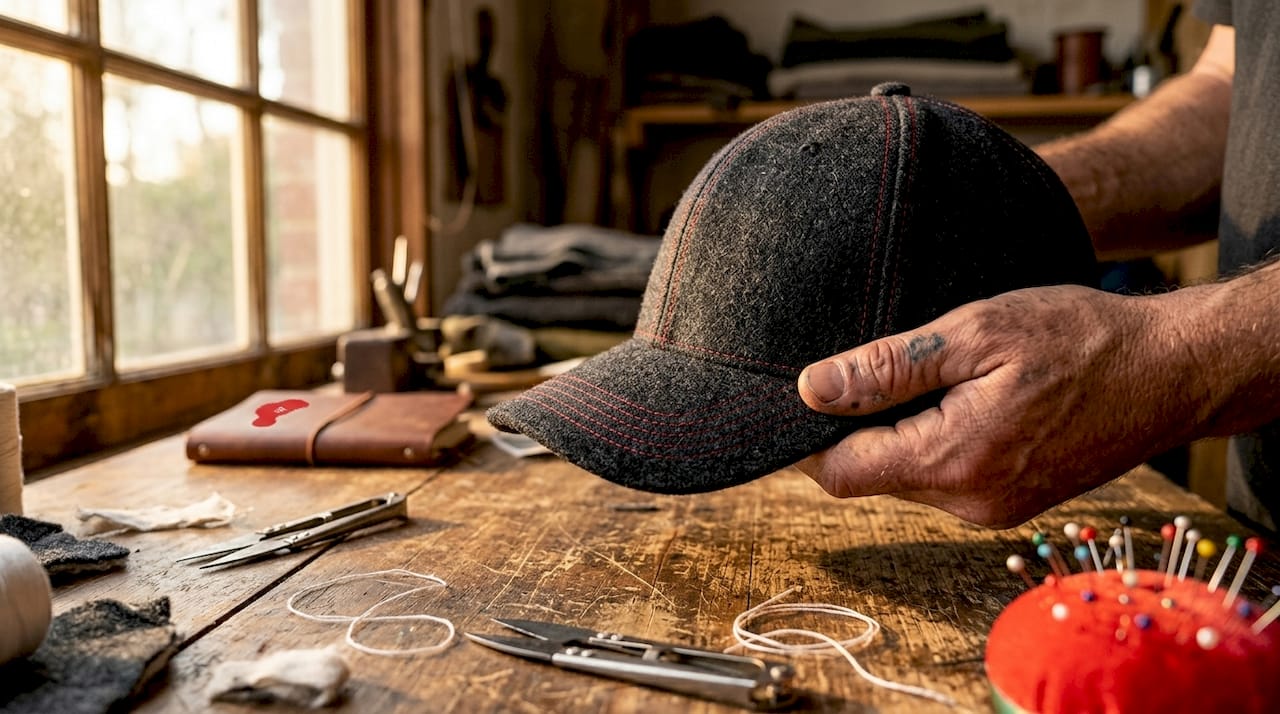
Premium stitching features tight, consistent stitch density with clean embroidery and no loose threads. Cheap hats show uneven patterns and fraying at stress points. A useful benchmark: quality hats maintain 8-12 stitches per inch with no puckering and reinforced stitching at stress points like the brim attachment and panel seams. You do not need to count stitches, but you can feel the difference. Run your thumb over the embroidery or logo. It should feel raised, smooth, and solid. Not scratchy, not loose, and definitely not flat.
Common craftsmanship red flags to watch for:
- Loose threads at logo edges or panel seams
- Uneven embroidery tension causing fabric to pucker underneath
- Misaligned logos or patches that sit at an angle
- Visible glue residue near the brim or sweatband
- Fraying at the brim edge or crown seam after minimal wear
- Inconsistent panel height or shape across the crown
- Sweatband that is loosely attached or already peeling at the edges
Edge finishing is another detail most buyers skip. Flip the brim over and look at the underside edge. Premium hats finish this neatly with a consistent fold and stitching. Cheap hats often have rough, unfinished edges or visible heat-bonded tape that starts to lift within a few weeks.
Pro Tip: Before you buy, gently flex the brim between your fingers and lightly press the crown inward with your palm. A premium hat springs back to its original shape within seconds. If it creases, dents, or holds a new shape, the internal structure is not up to standard.
The same flex test applies to the crown panels. Push gently on the side panels and release. They should snap back without hesitation. This quick physical check tells you more about long-term durability than reading any product description. For a deeper look at what separates good construction from average, the Urbancaps guide on headwear craftsmanship and quality is worth bookmarking.
Assessing fit, structure, and real-world wear
A hat that fits well on day one but distorts after three wears is not a premium hat. Structure retention over time is one of the most reliable signs of quality headwear, and it is something you can partially assess before you even leave the shop.
Follow this process when evaluating fit and structure:
- Place the hat on your head and check that it sits level without you adjusting it. A well-structured hat finds its position naturally.
- Move your head side to side and nod forward. The hat should remain stable without shifting or tilting.
- Press lightly on the crown from above. It should hold its dome shape under mild pressure and recover immediately.
- Check for pressure points around the brim edge. A quality sweatband distributes pressure evenly; a cheap one creates uncomfortable hotspots at specific points.
- Look at yourself straight on in a mirror. The brim should sit symmetrically. Any visible lean or asymmetry suggests either a structural flaw or a fit issue worth investigating further.
A premium hat sits balanced and stable without creating pressure points during normal movement. Fit quality comes from good internal structure, not just head circumference sizing. This is why two hats that are nominally the same size can feel completely different on your head.
Brim quality deserves particular attention. Premium brims maintain a consistent curve and stiffness over time. Cheaper brims warp, fray at the edges, or develop an uneven curve that you cannot correct without reblocking the hat entirely. When you are shopping online, customer photos and reviews are your best evidence of how a brim holds up after real use. Look specifically for reviews that mention wear over weeks or months, not just first impressions.
Pro Tip: If you are buying online and cannot physically handle the hat, check whether the retailer offers returns or an exchange policy. A brand confident in its product quality will back it with a fair return window. That policy itself signals something about the standard of what they are selling.
For anyone wanting to go deeper on how to choose premium headgear that balances fit, structure, and style, the principles above apply whether you are buying a structured cap, a flat cap, or a fedora.
Verifying authenticity in premium branded headwear
Branded headwear adds another layer of complexity. Knowing the signs of quality is useful, but when you are buying a specific premium brand, you also need to know whether what you are looking at is genuine.
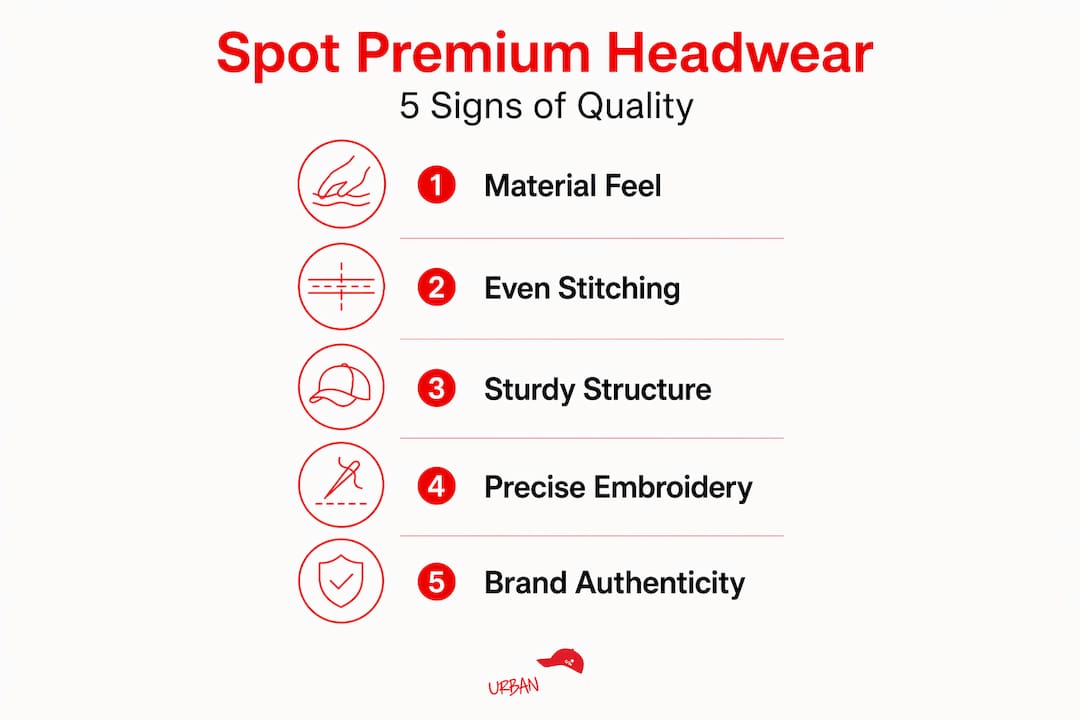
Authenticity in premium caps comes down to precise embroidery, material texture, sweatband quality, inner tags, retailer reputation, and pricing consistency. If the price seems too low for a product that is typically positioned as premium, that gap is almost always explained by a counterfeit or heavily defective unit.
Embroidery is your fastest visual check. On a genuine premium cap, logos are sharp, colours match brand specifications exactly, and the stitching around logo edges is tight with no visible backing material showing through. Fakes often have dull colours, blurry logo outlines, or embroidery that sits unevenly on the fabric surface.
Authenticity red flags to avoid:
- Logos with blurred edges or off-brand colour tones
- Embroidery backing visible through the front panel fabric
- Sweatband material that feels thin, plasticky, or already separating
- Inner tags that are poorly printed, slightly misaligned, or feature inconsistent font weights
- A chemical or glue smell that does not fade after airing the hat out
- No size indicator on the sweatband or inner tag
- Pricing significantly below the brand’s standard retail range
The sweatband is one of the most telling internal details. Premium branded headwear uses a quality sweatband material, usually cotton or a breathable performance fabric, that is cleanly stitched and labelled. On fakes, this is often the detail that manufacturers cut corners on most aggressively because most buyers never check it in store.
The smell test sounds unusual but is genuinely useful. Genuine premium branded caps carry a faint fabric scent. Counterfeits often carry a chemical adhesive smell from the materials used in production. It is not foolproof, but combined with the other checks above, it rounds out your assessment.
Common mistakes when choosing premium headwear
Even buyers who know what they are looking for fall into predictable traps. Understanding these mistakes in advance means you can sidestep them without second-guessing yourself at the point of purchase.
| Common mistake | Better approach |
|---|---|
| Relying on price alone | Check stitching, materials, and structure regardless of price point |
| Judging by first impressions only | Flex and press test the crown and brim before deciding |
| Ignoring internal details | Always check the sweatband, inner tag, and edge finishing |
| Trusting brand name without verification | Verify embroidery, colours, and retailer reputation |
| Skipping the return policy check | Confirm exchange or return options before buying, especially online |
Cheap hats often look acceptable initially but degrade quickly after multiple uses. The problem is that first impressions are designed to fool you. Mass-produced headwear is often finished to look clean and structured on a shelf or in a product photo. It is only after two or three wears, a wash, or a day in the sun that the real quality reveals itself.
One of the most overlooked internal details is the sweatband stitching. Buyers rarely flip a hat inside out in a shop, which is exactly why manufacturers cut corners there. Take thirty seconds to do it. If the sweatband is already separating, loosely attached, or made from material that feels rough and synthetic, that hat will not last.
When you are uncertain, ask questions. A reputable retailer can tell you the fabric composition, the country of manufacture, and whether the product has a return or exchange option. Uncertainty on those points, or vague answers, is information in itself.
My honest take on quality over marketing
I’ve seen a lot of hats come through at Urbancaps, and the pattern is always the same. The ones that photograph beautifully but feel hollow in your hands are the ones that disappoint buyers six weeks later. The ones that feel structured, dense, and almost slightly heavy when you first pick them up? Those are the ones that come back in customer reviews three months on, still looking sharp.
What I’ve learned is that buyers consistently overweight brand recognition and underweight tactile feedback. You can tell a lot about a hat in fifteen seconds if you know what you’re pressing on and why. The flex test I mentioned earlier is not just a trick. It is the fastest honest answer a hat can give you about its construction.
The other thing worth saying plainly: investing in quality headwear pays off over time in a way that buying three cheap replacements never does. There is a confidence that comes with wearing something that holds its shape and still looks deliberate after months of use. That is not marketing. That is just craftsmanship doing its job.
Apply the checks in this guide consistently and you will stop wasting money on headwear that looks the part but cannot go the distance.
— Urban
Find premium headwear that actually delivers
At Urbancaps, every hat in our collection is chosen with the criteria above in mind: material quality, construction integrity, and real-world wear performance. We are proudly NZ owned and operated, and we trust every product we stock to hold up to the standards this guide describes.

Whether you are after a structured cap for everyday wear or a classic premium fedora for a more dressed occasion, our product pages include detailed material information so you can make an informed decision before checkout. For cooler months, the woollen fedora range combines warmth, shape retention, and style in one piece. Free shipping on all NZ orders. Trusted by Kiwis nationwide.
FAQ
How do I quickly test hat quality before buying?
Press and flex the crown and brim with your hands. A quality hat springs back to its original shape immediately. Also inspect stitching density and the sweatband finish for any signs of loose construction.
What materials indicate premium headwear?
Combed cotton, wool blends, and brushed cotton twill are strong indicators of quality. These materials hold their shape, maintain colour depth, and feel structured rather than thin or shiny.
Can price alone tell me if a hat is premium?
No. Cheap hats often degrade quickly despite an initially acceptable appearance. Physical checks of stitching, materials, and internal details like the sweatband are more reliable than price as a quality indicator.
How do I spot a fake premium branded cap?
Check the embroidery sharpness, colour accuracy, sweatband quality, inner tag printing, and retailer reputation. A chemical smell that does not fade is also a common sign of a counterfeit product.
What is the most overlooked quality indicator in headwear?
The sweatband and internal edge finishing. Most buyers never check these in store, but they reveal a great deal about overall construction standards and how the hat will perform over time.