


Importance of local hat manufacturing for Kiwis
TL;DR:
- Local hat manufacturing maintains quality, transparency, and supports local economic growth through value retention. It also reduces environmental impact by shortening supply chains and enabling real-time waste management, fostering sustainability. Supporting local production preserves crucial artisan skills and creates a strong market for high-quality, heritage-inspired headwear.
Local hat manufacturing is defined as the end-to-end production of headwear within a domestic market, from fibre sourcing through to finished product. The importance of local hat manufacturing goes well beyond nostalgia or national pride. It delivers measurable advantages in quality control, supply chain transparency, environmental impact, and economic value retention. New Zealand exports enough fibre to fill 6,600 shipping containers annually, yet over 80% of wool apparel consumed locally is imported. That single fact reveals how much value leaves the country before a hat ever reaches a Kiwi’s head.
Why does local hat manufacturing matter for quality and transparency?
Local production gives makers direct control over every stage of the process. When a hat is knitted, cut, and sewn in the same region where the wool is shorn, there is no gap in the chain where materials can be swapped or diluted. Controlling all manufacturing stages locally prevents fibre substitution and quality degradation, ensuring authentic premium material use throughout.
Offshore supply chains rely on third-party certifications to verify material claims. Local makers do not need that layer because the evidence is visible at every step. A merino beanie made in New Zealand can be traced from a specific farm to the finished product without paying for an external audit. That traceability is something consumers increasingly demand, and it is something local production offers without extra cost.
Quality control is also faster when production is nearby. A local maker can catch a stitching fault or a dye inconsistency the same day and correct it before it scales. Offshore production runs the risk of an entire batch arriving with a defect that took weeks to surface. The feedback loop in local manufacturing is tight, and that tightness produces better hats.
Supply chain resilience is another concrete advantage. Geopolitical risks to trans-Pacific shipping routes have grown since the disruptions of the COVID-19 pandemic, and brands relying entirely on offshore production remain exposed to those risks. Local makers are not immune to disruption, but their exposure is far narrower.
- Material traceability: You can verify exactly which wool clip or fibre batch went into your hat.
- Faster quality correction: Faults are caught and fixed in days, not months.
- No certification dependency: Local oversight replaces the need for costly third-party audits.
- Supply chain resilience: Proximity insulates local makers from global shipping disruptions.
- Authentic fibre use: Local control eliminates the risk of cheaper fibres being substituted mid-production.
Pro Tip: When buying a locally made hat, ask the retailer which region the wool came from. A maker with genuine local production will answer that question without hesitation.
What are the economic benefits of supporting local hat makers?
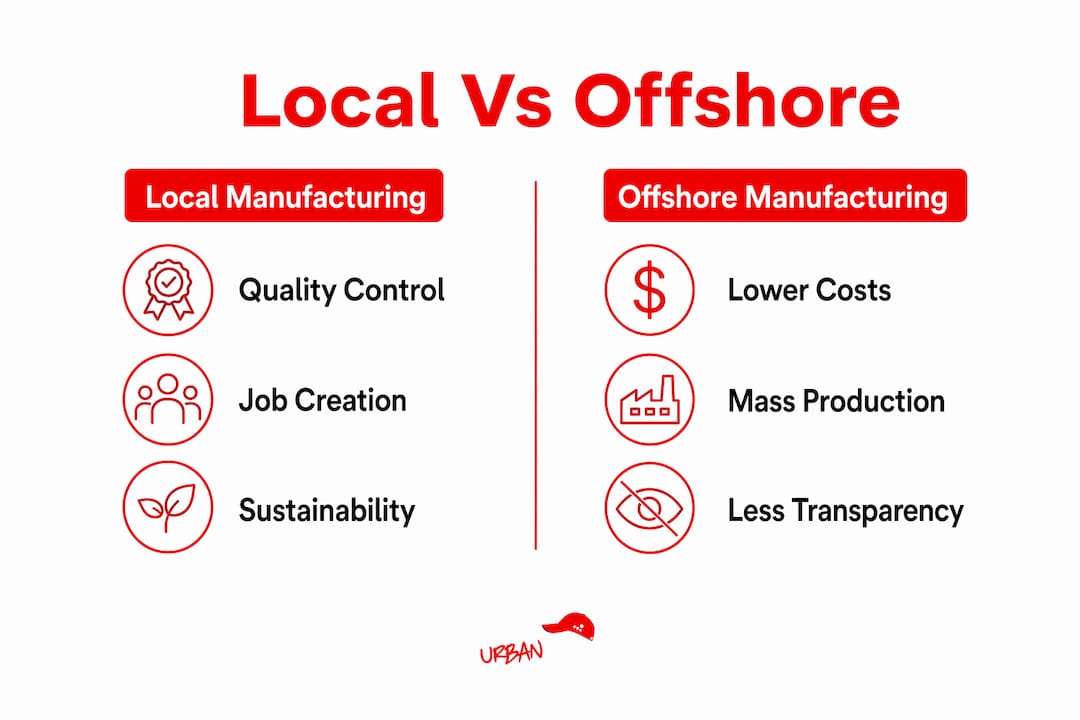
The economic case for supporting local hat makers is grounded in value capture. A kilogram of greasy wool fetches around $2 NZD at the farm gate, but that same kilogram retails as a garment for the equivalent of $37 per kilogram. The difference between those two figures is the value added through manufacturing and retail. Right now, most of that value is captured offshore.
New Zealand’s textile manufacturing workforce has shrunk by over 80% since the 1980s, falling from around 110,000 workers to roughly 9,500. That collapse did not just reduce employment numbers. It eroded the specialist skills, including patternmaking, cutting, and dyeing, that make local production viable. Once those skills disappear from a region, rebuilding them takes a generation.
The economic multiplier effect of local spending makes the case even stronger. When you buy a locally made hat, the money paid to the maker recirculates through wages, local suppliers, and community services. That same dollar spent on an imported hat leaves the country almost immediately. The difference in community impact is significant, even if the price tags look similar.
| Economic factor | Local manufacturing | Offshore manufacturing |
|---|---|---|
| Value captured domestically | High | Low |
| Skilled jobs retained | Yes | No |
| Supply chain wages paid locally | Yes | No |
| Economic multiplier effect | Strong | Weak |
| Resilience to global disruption | High | Low |
The sector already contributes $7.8 billion and 1.9% of GDP to New Zealand’s economy, but captures little added value within the country. Shifting even a portion of hat and apparel production back onshore would change that equation. The raw material is already here. The opportunity is in the making.
Artisan skills also carry cultural value that cannot be measured in GDP alone. Heritage techniques in wool felting, brim shaping, and hand finishing represent knowledge built over decades. Local hat production preserves those techniques and passes them to the next generation of makers.
How does local production reduce environmental impact?
Local hat production reduces environmental impact primarily by cutting transport distance. A hat manufactured in New Zealand and sold in New Zealand travels a fraction of the distance of one made in Asia and shipped across the Pacific. Shorter journeys mean lower emissions per unit, and that difference compounds across thousands of hats per season.
The environmental advantages go deeper than shipping. Local production enables visibility of waste streams in real time, which makes it possible to refine pattern efficiency and find circular solutions for offcuts. Offshore and fragmented supply chains make that kind of waste management practically impossible.
- Reduce transport emissions. Manufacturing locally eliminates the bulk of ocean freight emissions associated with finished goods.
- Manage textile waste in real time. Local makers can see exactly how much offcut material is generated and redirect it immediately.
- Support circular economy initiatives. Offcuts from local hat production can be recycled into home insulation or processed into biochar, uses that are not feasible when waste is generated overseas.
- Extend product lifespan. Extending garment life by even a few months significantly lowers its environmental footprint, and local makers are better placed to offer in-house repair services.
- Iterate design for less waste. Local proximity allows makers to test and refine patterns quickly, increasing material efficiency with each production run.
Pro Tip: Look for local hat brands that publish their offcut reuse or recycling policy. That detail signals a maker who takes waste seriously, not just one who uses the word “sustainable” as a marketing label.
Sustainability in hat production also means thinking about what happens at the end of a hat’s life. Local circular initiatives that target zero textile waste go beyond ethical sourcing. They treat the product’s full lifecycle as the maker’s responsibility. That mindset is far easier to maintain when production and retail happen in the same community.
What challenges come with scaling local hat production?
Scaling local hat manufacturing sustainably is genuinely difficult. The domestic market in New Zealand is small, which limits production volumes and raises per-unit costs compared to offshore factories running at scale. Strategic investment in high-quality and specialty manufacturing is the realistic path forward, not a full return to mass domestic production.
Automated knitting technology is changing that equation. New automated knitting technology reduces labour costs and improves the economic feasibility of local manufacturing, shifting the competitive position of New Zealand producers toward niche, high-end goods. A skilled operator running an automated knitting machine can produce consistent, premium results at volumes that would have required a much larger workforce a decade ago.
| Production approach | Volume capacity | Quality ceiling | Cost per unit | Best suited for |
|---|---|---|---|---|
| Fully manual local production | Low | Very high | High | Heritage, limited edition |
| Automated local production | Medium | High | Medium | Premium everyday wear |
| Offshore mass production | Very high | Variable | Low | Fast fashion, commodity |
Consumer mindset is shifting in favour of local makers. Consumer demand is moving toward authentic, high-quality, and sustainable products that can compete globally when paired with automation and skilled local labour. That shift creates a genuine commercial opportunity for local hat makers who position themselves clearly in the premium segment.
The skills gap remains the most pressing structural challenge. Maintaining the full ecosystem of skills, including patternmaking, cutting, and dyeing, is critical to viable local manufacturing. Loss of any part of that ecosystem undermines entire production capacity. Apprenticeship programmes and industry partnerships are the most direct tools for addressing that gap, and they require sustained investment from both government and the private sector.
Local makers who integrate with global markets, selling premium locally made hats internationally while maintaining domestic production, can achieve the volume needed to justify investment in automation and skills development. That model does not compromise the core benefits of local production. It funds them.
Key takeaways
Local hat manufacturing delivers quality, economic, and environmental advantages that offshore production cannot replicate, making it the most defensible choice for consumers who value authenticity, sustainability, and community impact.
| Point | Details |
|---|---|
| Quality and traceability | Local production prevents fibre substitution and enables direct oversight without third-party certification. |
| Economic value capture | Manufacturing locally retains the value added between raw wool and finished hat within the domestic economy. |
| Environmental impact | Shorter supply chains cut transport emissions and enable real-time waste management and circular reuse. |
| Skills preservation | Supporting local makers funds the specialist skills, patternmaking, dyeing, and finishing, that make future production viable. |
| Scaling with technology | Automated knitting technology makes local production economically competitive in the premium segment. |
Urban’s take on where local hat making is headed
The conversation around local manufacturing has shifted noticeably in the past few years. Consumers who once bought on price alone are now asking where their hat was made and what happened to the offcuts. That is not a trend driven by marketing. It is a genuine change in values, and it is creating real commercial space for local makers who can answer those questions honestly.
What I find most underappreciated is the skills argument. The economic and environmental cases get most of the attention, but the loss of patternmaking and dyeing expertise is the most irreversible damage from decades of offshoring. You can rebuild a factory. You cannot quickly rebuild a generation of skilled makers. Every locally made hat sold today helps fund the training that keeps those skills alive.
The opportunity I see for local hat production in New Zealand sits squarely in the premium and heritage segment. Automated knitting brings costs down enough to compete on quality, and the provenance story, New Zealand wool, made in New Zealand, sold to a world that increasingly values authenticity, is genuinely compelling. That story works for wool hat buyers here and abroad.
My practical advice is straightforward. When you are choosing between a locally made hat and an imported one at a similar price point, the local option almost always wins on quality, longevity, and the value it returns to your community. Price parity is increasingly common as automation matures. When it exists, the choice is clear.
The role of hats in fashion has always been tied to identity and craftsmanship. Local production is what keeps that connection real rather than decorative.
— Urban
Locally made headwear from Urbancaps
Urbancaps is proudly NZ owned and operated, and the range reflects a genuine commitment to quality craftsmanship and heritage-inspired design.

Whether you are after a classic Churchill Heritage Homburg made from Australian wool felt, a Dakota Heritage Wool Rancher from the Western Collection, or a winter knit beanie built for cold NZ weather, Urbancaps stocks headwear that stands behind the values this article covers. Fast NZ delivery, trusted by Kiwis nationwide, and backed by a team that genuinely cares about what goes into every hat.
FAQ
What is local hat manufacturing?
Local hat manufacturing is the production of hats within a domestic market, covering fibre sourcing, knitting or weaving, cutting, and finishing. It contrasts with offshore production, where these stages are split across multiple countries.
Why buy local hats instead of imported ones?
Local hats offer direct material traceability, better quality control, and stronger support for domestic jobs and skills. The value added through manufacturing stays within the local economy rather than being captured offshore.
How does local hat production support sustainability?
Local production cuts transport emissions, enables real-time waste management, and supports circular economy initiatives like offcut recycling into insulation or biochar. Extending a hat’s life through local repair services further reduces its environmental footprint.
Is locally made headwear more expensive?
Local hats often carry a higher price than mass-produced imports, but automated knitting technology is narrowing that gap in the premium segment. The quality, longevity, and community impact of a locally made hat typically justify the difference.
What skills are at risk if local hat manufacturing declines?
Specialist skills including patternmaking, dyeing, and hand finishing are most at risk. New Zealand’s textile workforce has shrunk by over 80% since the 1980s, and rebuilding those skills once lost takes decades of sustained investment.