

What is a trilby hat: style, history and how to wear one
TL;DR:
- A trilby hat features a narrow brim, a shallow indented crown, and a distinctive tilted silhouette. It differs from a fedora mainly in brim width, angle, and crown depth, with trilbies being more casual and youthful. Proper wearing involves positioning it slightly back with an angled brim, suitable for various casual to smart-casual occasions.
Most people have pointed at a fedora and called it a trilby. Or done the reverse. If you’ve ever wondered what is a trilby hat, exactly, and why it keeps getting confused with its broader-brimmed cousin, you’re not alone. The trilby has a sharply specific silhouette, a fascinating literary origin, and a cultural history that stretches from Victorian theatre to modern music festivals. This guide covers the trilby hat definition in full, walks through the key differences in the trilby vs fedora debate, and gives you practical advice on how to wear a trilby with confidence.
Table of Contents
- Key takeaways
- What is a trilby hat: definition and origins
- Trilby vs fedora: what’s the real difference?
- How to wear a trilby: styling tips and occasions
- The cultural history of the trilby hat
- My honest take on the trilby’s place in modern style
- Find your perfect trilby at Urbancaps
- FAQ
Key takeaways
| Point | Details |
|---|---|
| Distinctive silhouette | A trilby is defined by its narrow brim and deeply indented crown, not just its material. |
| Literary origins | The hat takes its name from the heroine of George du Maurier’s 1894 novel Trilby. |
| Trilby vs fedora | Trilbies have a shorter, angled brim and shallower crown compared to the wider, flatter fedora. |
| Brim angle matters | Wearing the front brim tilted down and the back slightly up preserves the hat’s signature profile. |
| Versatile styling | Trilby hats suit casual, smart-casual, and festival looks depending on material and colour choice. |
What is a trilby hat: definition and origins
The trilby hat definition according to Oxford Learner’s Dictionaries is straightforward: a man’s soft hat with a narrow brim and a top part that is pushed in from front to back. That pushed-in crown, known as a centre crease, paired with the narrow turned-down front brim and slightly upturned rear brim, is what gives the trilby its unmistakable profile. You can spot one from across a room purely by its silhouette.
The name itself comes from one of the more charming origin stories in fashion history. The hat is named after the heroine in George du Maurier’s 1894 novel Trilby, and it was the subsequent stage adaptation of that novel where the style first appeared as a prop and costume piece. The theatre audience took notice. The hat’s association with the stage gave it an air of artistic credibility that carried through into everyday fashion, and the name stuck permanently.
Traditionally, trilbies were crafted from rabbit hair felt, which gave the hat its distinctive soft, pliable texture. That material lent itself well to the creased crown style because it could be shaped and held without becoming stiff or brittle. Over time, modern trilbies evolved to include a much broader range of materials: tweed, straw, heavyweight cotton, and wool blends. This material evolution is worth understanding because it means that today, the trilby is defined far more by its shape than by what it’s made from.
Here are the classic design features that define a trilby hat:
- Brim width: Narrow, typically 1.5 inches or less, angled down at the front
- Crown shape: Shallow and indented with a lengthways crease running front to back
- Brim rear angle: Slightly turned up at the back, creating a distinctive tilted silhouette
- Crown height: Shorter than a fedora, giving the hat a snug, close-set appearance
- Material: Traditionally rabbit hair felt; now commonly tweed, wool, straw, or cotton blends
Understanding these features matters because the best way to identify a trilby is by its silhouette, specifically the brim angle and crown indentation, rather than the fabric or the brand label.
Pro Tip: If you’re browsing hats and can’t tell whether something is a trilby or another style, look at the brim from the side. A genuine trilby shows a clear forward tilt at the front and a slight upward kick at the rear. That angled brim profile is the giveaway.
Trilby vs fedora: what’s the real difference?
This is the question that trips up even confident hat wearers. Both hats feature a creased crown, both are made from felt or similar materials, and both carry a certain vintage authority. The common confusion exists precisely because the two hats share that crown indentation. But once you understand the structural differences, they’re easy to tell apart.
The most immediate difference is brim width and angle. Fedoras have wider brims, typically 2.5 inches or more, with a flatter or slightly downturned profile all around. Trilby brims measure 1.5 inches or less, tilt down sharply at the front, and kick upward at the rear. That angle is not a style preference. It’s structural to the design.
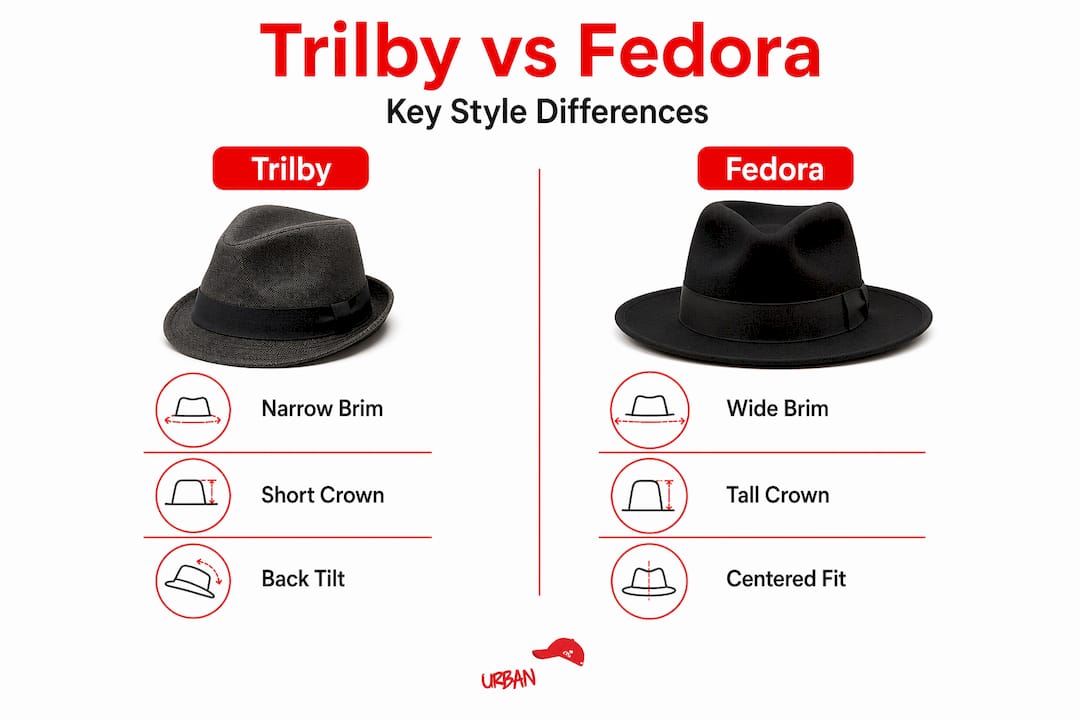
Crown depth is the second major separator. Fedora crowns sit deeper and taller on the head, giving the wearer a more commanding, formal presence. Trilby crowns are shallower and sit lower, which is part of why the trilby reads as more casual and youthful.
Here’s a direct comparison to make the differences concrete:
| Feature | Trilby | Fedora |
|---|---|---|
| Brim width | Narrow (approx. 1.5 inches or less) | Wide (approx. 2.5 inches or more) |
| Brim angle | Angled down front, turned up at rear | Flat or downturned all around |
| Crown depth | Shallow and close-set | Deep and tall |
| Crown crease | Centre crease, front to back | Centre crease, pinched at front |
| Typical material | Felt, tweed, straw, wool blends | Felt, leather, wool |
| Style register | Casual to smart-casual | Smart-casual to formal |
| Common occasions | Festivals, day events, casual wear | Weddings, formal outings, office |
The occasion and outfit pairing is where the two hats really diverge in practice. A fedora worn to a garden party reads as intentionally dressed up. The same occasion in a straw trilby reads as relaxed and considered. Neither is wrong, but confusing the two sends unintended style signals.
Pro Tip: When shopping online, always check the listed brim measurement. Any hat labelled a trilby with a brim exceeding two inches is almost certainly a fedora being mislabelled. Knowing the numbers saves you from an unwanted surprise when the box arrives.
Wearing style also affects how each hat is perceived. Trilbies are typically worn further back on the head, which reinforces their casual, youthful energy. Fedoras sit centred or slightly forward, which adds formality and structure to the overall look. The same person wearing the same outfit can read entirely differently depending on whether the hat sits back on the crown or pulled down to the brow.
How to wear a trilby: styling tips and occasions
The trilby is a genuinely versatile hat, but it does have rules. Get the brim angle and head placement wrong, and the hat loses what makes it distinctive. Get it right, and it pulls an entire outfit together with very little effort.
-
Position the hat correctly. Wear the trilby slightly back on your head, not centred and not pulled down over your brow. This positioning is part of what gives it that relaxed, off-duty quality. Brim angle is fundamental: the front brim should angle downward slightly toward your face, and the rear brim should tilt upward. This is the hat’s signature profile, and flattening the brim removes it entirely.
-
Match the material to the occasion. A straw trilby works beautifully at outdoor events, summer festivals, and beachside settings. A wool or tweed trilby suits cooler months and smarter casual outfits. A felt trilby in a neutral tone like charcoal, navy, or camel is the most adaptable option year-round. If you want to understand which hat fabrics suit which occasions, it’s worth reading up on how different materials behave in varying conditions.
-
Choose outfits that complement, not compete. Trilby hats work well with slim-fit jeans and a casual shirt, with a smart blazer and chinos, or with a summer dress for women. The hat’s narrow brim means it looks best with outfits that are themselves relatively streamlined. Oversized or heavily layered clothing can visually overwhelm the hat’s delicate silhouette.
-
Get the colour right for your wardrobe. Classic trilby colours are brown, black, grey, and natural straw tones. These neutrals integrate easily across a wardrobe. If you’re buying your first trilby, start with a neutral. Once you have a feel for the style, coloured or patterned options in tweed or cotton give you more scope for personal expression.
-
Avoid common fitting mistakes. A trilby that sits too low on the forehead reads as oversized and sloppy. One that perches too high looks precarious. The hat should sit comfortably with the front brim roughly one to two finger-widths above your eyebrows. If you’re not sure how to choose the right hat for your face shape and head size, that’s worth figuring out before you buy.
The occasions that suit a trilby best include music festivals, casual weekend outings, picnics, race days (particularly in a straw or natural felt style), and smart-casual evenings. It’s a hat that transitions well between those settings without looking out of place.
Pro Tip: A trilby in a textured material like herringbone tweed adds visual interest to a simple outfit without needing any other accessories. It’s one of the easiest ways to make a plain white shirt and trousers look genuinely considered.

The cultural history of the trilby hat
The trilby has had several distinct lives in popular culture, and understanding that history explains why it carries the associations it does today.
Its origins, as noted, were theatrical. The hat emerged from a stage production and quickly found its way onto the heads of fashionable Londoners in the 1890s. It became associated with British artistic circles, creative types, and anyone who wanted to signal a slightly unconventional sensibility without fully stepping outside the social norm.
By the early twentieth century, the trilby had drifted into horse racing culture. In Britain, the hat became known colloquially as the “brown trilby,” and it was a common sight at race meetings, particularly among well-dressed men who wanted something less formal than a top hat but more considered than going bare-headed. This association gave the trilby a dual identity: artistically credible but also socially acceptable in upper-class leisure settings.
“The hat’s silhouette became culturally significant through theatrical portrayal and popular stage fashion repetition.” The trilby’s identity is partly performative. It was born on stage, wore its meaning visibly, and has shaped hat culture ever since.
Through the mid-twentieth century, the trilby was adopted by jazz musicians, beatniks, and later by the mod subculture in Britain. Each group slightly reinterpreted its meaning. What started as a wealthy person’s leisure hat became a symbol of creative independence, then youth culture, then eventually something more generically fashionable.
Contemporary trilby hat fashion trends reflect that complicated history. The hat experienced a significant revival in the 2000s and early 2010s, partly driven by music culture and festival fashion. It became a staple of the smart-casual wardrobe for younger men and women who wanted a hat with genuine style heritage. Today, the trilby remains a respected option in hat-wearing culture, particularly for those interested in timeless hat styles with real historical weight.
The key to its continued relevance is that narrow brim. At a time when oversized accessories dominate certain fashion cycles, the trilby’s restraint reads as deliberate and refined.
My honest take on the trilby’s place in modern style
I’ve spent a lot of time around headwear, and the trilby is one of those pieces that people either deeply understand or constantly underestimate. What I’ve noticed is that the hats people dismiss as “too trendy” or “over” are almost always being worn incorrectly. The brim is flat, the hat is sitting in the wrong position, and the material doesn’t suit the outfit. Then someone writes off the entire style when what they’re actually looking at is a fit problem, not a design problem.
My honest view is that the trilby is one of the most forgiving hats you can own, provided you respect its structure. The narrow brim means it integrates into an outfit without demanding attention. That’s rare in headwear. Most hats make a strong statement. The trilby makes a considered one.
What I find genuinely interesting is the material shift. The move from rabbit hair felt to modern blends has freed the trilby from its class associations. A straw trilby at a summer market feels completely different from a dark felt trilby at an evening event, but they share the same essential silhouette. That flexibility is underutilised. People buy one trilby and treat it as a single-occasion accessory when it’s actually capable of covering a lot of ground.
My advice is to start with a neutral felt option, learn the correct brim angle and head positioning, and then branch into materials once you’re comfortable. The trilby rewards that investment of attention. It’s a hat with real style history behind it, and wearing it well is genuinely satisfying.
— Urban
Find your perfect trilby at Urbancaps
If this guide has you ready to find a quality trilby or explore the closely related fedora family, Urbancaps has you covered. The Urbancaps collection includes a thoughtfully curated range of premium headwear suited to every occasion, from relaxed weekend styles to smart-casual options with real craftsmanship behind them.

Whether you’re after a classic felt silhouette or something with a bit more seasonal warmth, the woolen fedora hats and the multicolour fedora range at Urbancaps offer genuine options at every style register. Free shipping across NZ, proudly Kiwi owned and operated. Browse the full collection and find the hat that suits your look.
For more guidance on selecting the right style, the Urbancaps guide on stylish hat selection is a useful next step.
FAQ
What is the main difference between a trilby and a fedora?
A trilby has a narrow brim of approximately 1.5 inches or less, angled down at the front and turned up at the rear, with a shallower crown. A fedora has a wider, flatter brim and a deeper crown, making it more formal overall.
How should a trilby hat be worn correctly?
A trilby should sit slightly back on the head with the front brim tilted downward and the rear brim angled upward. Wearing it flat or too far forward removes the hat’s defining silhouette and makes it look like a generic cap.
What materials are trilby hats made from?
Traditionally made from rabbit hair felt, trilby hats are now produced in a range of materials including tweed, straw, wool blends, and heavyweight cotton. The shape and brim angle define the style more than the specific material used.
Are trilby hats suitable for women?
Yes. Trilby hats work well for women and men alike. Straw and lightweight felt trilbies pair particularly well with summer dresses, wide-leg trousers, and smart-casual outfits. The narrow brim complements a range of face shapes.
Where does the name “trilby” come from?
The name comes from the heroine in George du Maurier’s 1894 novel Trilby. The hat’s distinctive style appeared in the stage adaptation of the novel and became associated with the character’s name in popular culture.