


Safety First Chin Straps for Bucket, Straw, and Leather Hats
Yes, you can add a chin strap to most non-safety hats, and the safest DIY approach is an adjustable cord anchored at reinforced points with a breakaway clasp. This works on bucket hats, straw hats, fabric sun hats and even leather styles. The one hard exception is certified hard hats and climbing helmets: use only the OEM chin strap the manufacturer supplies.
TL;DR:
- Most non-safety hats like bucket, straw, or fabric styles can have DIY chin straps added using adjustable cords, breakaway clasps, and appropriate attachment methods.
- The attachment technique depends on hat material: sewing into the seam for fabric, eyelets with patches for straw, or rivets for leather; certified hard hats must only use OEM straps.
- Proper placement of anchor points is crucial; they should be behind the ear, reinforced, and away from the brim edge to prevent tearing or failure in windy conditions.
- Testing fit and safety after installation is essential, including pull tests and ensuring the strap does not cause pressure or choking hazards, especially on children’s hats.
- Buying hats with pre-installed straps offers a quick, reliable alternative to DIY modifications, especially for active wear or children’s styles designed with proper retention features.
Table of Contents
- What materials and tools do you need to add a chin strap to a hat?
- How do you choose the right attachment method for your hat type?
- How do you attach a chin strap to a hat step by step?
- What safety checks and care does a chin strap need?
- What does Urban Caps recommend from years of building hats with straps?
- Where do most people go wrong when they add a chin strap to a hat themselves?
- Would a ready-made chin strap hat save you the hassle?
- Sources
- FAQ
What materials and tools do you need to add a chin strap to a hat?
Before you touch a needle or a hole punch, lay out your components. Most hat chin strap DIY projects use the same basic kit, just scaled to the hat’s material.
For cord length, Goober Pea Designs recommends two short anchor pieces of roughly 10cm each and one longer adjustable cord around 35 to 40cm, with cord widths between 1 and 1.3cm.
- Cord or ribbon in your chosen width, plus a lighter or heat tool if it is synthetic
- A breakaway clasp (essential for kids’ hats and recommended for adults too)
- A two-hole cord lock or toggle for adjustability
- An eyelet kit or snap kit, depending on your hat’s fabric
- A sewing needle, strong thread, and a thimble if you are working through thick straw or leather
- A seam ripper, for unpicking a sweatband edge cleanly
If your hat is a cheap, thin store-bought style, simple ribbon-and-eyelet tutorials show it can work without any sewing skill at all, provided you reinforce the holes. If gathering all this gear sounds like more effort than it is worth, buying a hat with a strap already built in is often the faster call, which we will come back to later.
How do you choose the right attachment method for your hat type?
The material dictates the method. Get this wrong and you will tear straw, split leather, or leave stitch holes in a fabric hat that never quite look right again.
- Bucket and fabric hats. Sandwich the strap anchor under the sweatband or sew it directly into the seam. This keeps the exterior untouched and is one of the most durable options because the sweatband already carries structural stitching.
- Straw hats. Punch or heat-set an eyelet, but back it with a small internal fabric patch, glued and stitched, so the weave does not tear under tension. Place anchors just above the ear line, never near the brim edge where the straw is thinnest.
- Leather, structured and cowboy hats. A stampede strap suits these best. Install it through reinforced leather or fabric loops sewn or riveted to the inner band, since leather resists eyelets but holds stitching and rivets well.
- Reversible hats. Use a buttonhole-and-snap approach so the strap can be unclipped for washing or flipped to the other side. Twig + Tale’s method uses buttonholes around 1.5 to 2cm with snaps or hook-and-loop for full removability.
- Hard hats and climbing helmets. Stop here. Do not drill, glue, or sew anything onto a certified hard hat. Chin strap requirements depend on employer policy and manufacturer design, and a homemade attachment can void the certification that keeps the shell rated for impact.
Picking the right method by hat type matters more than picking the “best” chin strap for hats in general. A straw hat treated like a bucket hat will fail at the first strong gust.
How do you attach a chin strap to a hat step by step?
This universal method works for the majority of fabric, straw and bucket hats, and it is the same sequence experienced makers use whether they are building a beach hat or a kids’ sun hat.
- Measure and mark. Try the hat on and find where the strap should sit, just behind the ear, then mark both sides symmetrically with a fabric pen or pin.
- Prepare the anchor points. For eyelets, punch the hole and set the metal ring with a hammer tool. For sweatband hats, unpick a small section of the band’s edge with a seam ripper.
- Attach the short anchor pieces. Sew each 10cm anchor into place using a ladder stitch, which closes the opening invisibly while still catching the strap material for a strong hold.
- Thread the adjustable cord. Run your 35 to 40cm cord through both anchors and slide it through a two-hole cord lock, adding a breakaway clasp on one or both ends.
- Finish the stitching. Backstitch over the anchor points two or three times to spread the load, trim loose thread, and heat-seal any cut synthetic cord ends so they cannot fray or unravel.
- Test fit and comfort. Put the hat on, tighten the cord lock, and check for throat clearance. You should be able to fit a finger between the strap and your throat comfortably.
Pro Tip: Anchor the strap slightly behind the ear rather than directly under the chin point. It spreads the pulling force more evenly and stops the strap riding up onto your throat in strong wind.
What safety checks and care does a chin strap need?
A chin strap that is not built with safety in mind can do more harm than good, particularly on children’s hats.
- Fit a breakaway clasp on every child’s hat. A continuous, unbroken loop around the neck is a genuine strangulation hazard, which is exactly why breakaway hardware exists: it holds under normal wear but releases under sudden force.
- Never retrofit a certified hard hat. OSHA notes chin straps aren’t mandatory on every hard hat but may be required by an employer or manufacturer when retention is critical, and only OEM-approved attachment points meet that standard.
- Run a pull test after installation. Tug gently on the strap while the hat is worn and check for rubbing, pinching, or pressure on the throat.
- Wash removable straps separately and check cord for fraying every season, replacing any clasp that feels loose or sticky.
What does Urban Caps recommend from years of building hats with straps?
Building chin straps into hats at scale teaches you where DIY attempts usually go wrong. On styles like the Voyager and Anchor, the anchor point sits just behind the sweatband seam, not on the brim, which keeps stitching hidden and stress off the fabric edge.
- Keep visible stitching tight and even. Loose stitches are the first thing to fail under wind load.
- If you are not confident with an eyelet kit or a needle, a ready-made hat with a factory-fitted strap avoids the guesswork entirely.
- Straw and structured hats benefit most from buying a strap already engineered into the design, since retrofitting rigid materials carries the highest risk of cracking or tearing.
Where do most people go wrong when they add a chin strap to a hat themselves?
The two mistakes I see most often are placing anchor points too close to the brim edge, where straw and light fabric have almost no strength, and skipping reinforcement on straw hats entirely because it looks fine at first glance. Both fail the same way: under a gust of wind, not at home.
A quick checklist before you call it finished: do reinforce every anchor point, do use a breakaway clasp, do test the fit while walking, don’t loop cord continuously around a child’s neck, and don’t ever touch a certified hard hat with a homemade strap.
— Urban
Would a ready-made chin strap hat save you the hassle?
If sourcing eyelet kits and testing stitches sounds like more Saturday than you want to spend, buying hats with straps already built and tested lets you skip the retrofit entirely and get a finished, wearable result straight out of the box, such as the Gulf of America red baseball hat.
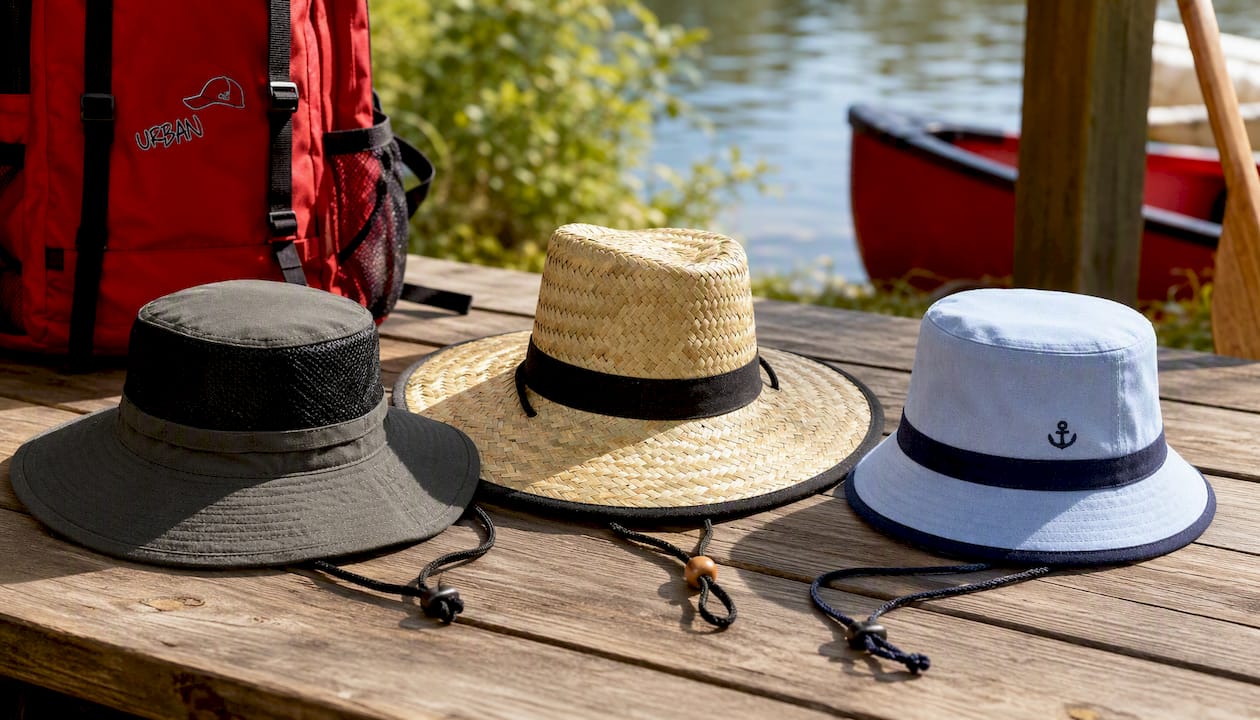
For active outdoor wear, the Voyager lightweight mesh bucket hat comes with an adjustable chin strap already sewn into a breathable mesh shell, built for hikes, fishing trips and windy days where a plain bucket hat would blow off. If you want a dressier option with the same wind security, the Houston Plantation wide-brim straw hat has a cotton chin tie toggle and UPF 50 protection, suited to beach days or garden parties where a raw eyelet retrofit would spoil the finish. For kids, the Anchor bucket hat has a wide brim and a properly designed chin tie, sized and built for small heads rather than adapted from an adult pattern. Browse the current range at Urbancaps and pick the style that matches how you actually plan to wear it.
Sources
- How to add an Adjustable Breakaway Safety Chin Strap to Any Sun Hat — Goober Pea Designs
- How to make an Adjustable Breakaway Chin Strap for a Reversible Hat – Twig + Tale
- Can You Add Chin Straps to a Hard Hat or Climbing Helmet? | Helmet Safety Guide
FAQ
Can you add a chin strap to any hard hat?
No. Certified hard hats and climbing helmets should only use the manufacturer’s OEM chin strap, since drilling or gluing a homemade strap can void the certification that keeps the shell safety-rated.
How do you put a chin strap on a hard hat?
You clip or thread the manufacturer-supplied strap into the hard hat’s existing OEM attachment points, following the instructions that came with the helmet rather than improvising new holes.
What can you use instead of a chin strap?
A snug, correctly sized hat with a firm sweatband can reduce blow-off in light wind, but for genuine retention in gusty conditions, an adjustable cord with a breakaway clasp is the more reliable fix, and it is exactly what Urbancaps builds into styles like the Voyager.
What is the main purpose of a chin strap on a hard hat?
It keeps the helmet seated on the head during impact, tilt, or sudden movement. OSHA guidance notes chin straps become necessary whenever retention is critical to the job, even though they are not required on every hard hat by default.