


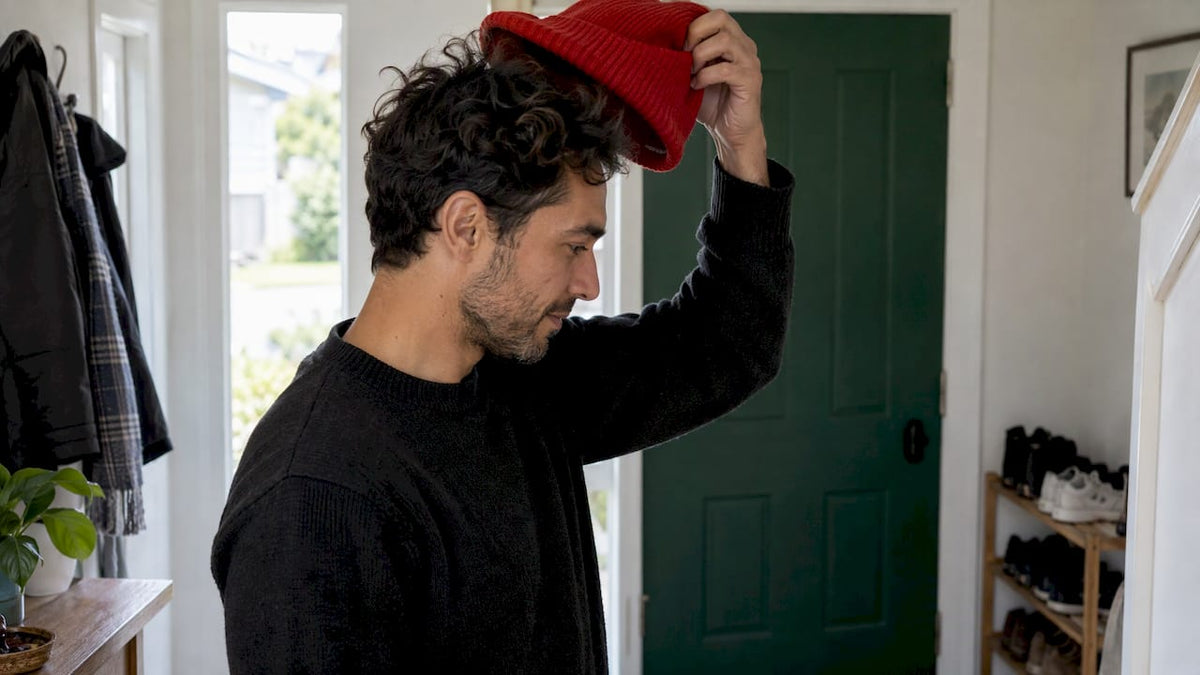
Static hair after a beanie comes from friction on dry hair in dry air, and you can prevent most of it with three things: a beanie in a natural fibre, hair that is dry and lightly conditioned before the hat goes on, and a gentle removal. If it has already happened, a pea-sized dab of leave-in cream or a little hand cream smoothed over the flyaways settles it in seconds. Below is the full routine, from choosing the beanie to fixing the flat roots it can leave behind.
TL;DR
- Static is a charge built up by rubbing hair against fabric. Dry winter air and indoor heating stop it from draining away.
- Natural fibres such as cotton and wool generally build up less charge than nylon and polyester, so the fabric of your beanie matters.
- Put the beanie on over dry hair that has a little conditioner or leave-in through the mid-lengths and ends, and take it off slowly.
- To calm flyaways, use a dab of leave-in, light cream, hand cream or a dryer sheet, not a brush.
- A looser fit, or a style with a hair opening, helps with flat roots and friction.
Table of Contents
- Why a beanie makes your hair crackle
- Start with the fabric of the beanie
- Before you put it on: a two-minute routine
- Putting the beanie on and taking it off
- Already static? Fast fixes after you take it off
- The other beanie problem: flat roots
- Do beanies damage hair, including curly hair?
- A quick checklist for a Kiwi winter
- Find your beanie
- Our view on beanies and static
- FAQ
- Sources
Why a beanie makes your hair crackle
It helps to know what is happening, because every fix below works on one of three causes: friction, dryness and fabric.

When two materials rub together, electrons move from one to the other. McGill University’s Office for Science and Society uses hair and a hat as its example: the rubbing transfers charge, and strands carrying the same charge push each other apart, which is why your hair lifts and floats away from your head.
The second cause is the air. The same McGill explanation notes that humid air helps a charge drain away, while dry winter air lets it stay put. That is why you notice it in July and barely at all in February. In a New Zealand winter you also bring in heating: a Kiwi hair-care guide from Shampoo Plus points out that indoor heating can lower indoor humidity and make static worse. You walk from damp outdoor air into a warm, dry office or car, pull off your beanie and get the full effect.
The third cause is the hair itself. A stylist quoted in Marie Claire UK explains that healthy hair has a smooth outer layer (the cuticle) made of overlapping cells that lie flat, hold moisture and create little friction. When that layer is lifted by brushing, heat or synthetic fabrics, friction and charge transfer go up sharply. The same piece draws a useful line between static, which is an electrical effect of dryness and friction, and frizz, which comes from hair absorbing too much water from humid air. A beanie can give you either, but this guide deals with static.
A beanie is a particularly efficient static machine. It sits tight against the whole head, it moves a little every time you turn, and you take it on and off several times a day. Good Housekeeping quotes a celebrity hairstylist who names winter as the worst season for exactly this reason: low-humidity air, plus hats and scarves coming on and off, means constant friction.
The good news is that static is a surface effect, not damage. Northeastern University adds that static electricity is generally harmless outside flammable or industrial settings, so a zap from your hair is an annoyance, nothing more.
Start with the fabric of the beanie
The material touching your hair is the biggest variable you control at the shop, before you even get home.
Northeastern University’s winter static guide says natural fibres such as cotton, wool, silk and linen generally generate less static than many synthetic fibres such as nylon and polyester. The Marie Claire stylist adds that wools, especially synthetic wools, can make static worse, so what a knit is actually made of is worth reading on the product page.
Practically, that gives you a simple buying rule:
- Check the fibre content first. If you get static easily, lean toward cotton or other natural-fibre knits.
- Think about how much of the beanie touches your hair. A slouchy or looser knit sits with less pressure than a tight, short one, so there is less rubbing against the lengths.
- Think about where your hair goes. If you have long hair, a style with a hair opening lets the lengths sit outside the hat instead of being dragged against the knit.
If you want to start with cotton, we stock the True Winter Plain Cotton Beanie and the Scott Winter Cotton Beanie. For a roomier shape, the Rhode Island Winter Knitted Slouchy Beanie sits looser on the head. If you prefer a warm lined style, the Realm Winter Fur-Lined Beanie is in the range. Browse everything in the beanie collection.
A silk or satin scarf under any beanie
Whatever you wear, you can put a smooth layer between your hair and the knit. Glamour recommends tying a silk or satin scarf around your hair before putting on a woolly hat, so the rough fibres do not drag across the strands. The same article suggests that cotton hats may help limit flatness by allowing more airflow. A scarf is bulky under a snug beanie, so it works best with a slouchy or roomy fit.
Before you put it on: a two-minute routine
Prevention is easier than repair. This is the order that works, drawing on the advice of stylists and skin and hair specialists.
1. Make sure your hair is dry
Glamour advises fully drying hair before you wear a hat. There are two reasons. Damp hair dries in the shape of the beanie, which leads to flat roots (more on that below). And a rough, half-dry cuticle is more likely to catch on the knit.
2. Add a little moisture to the mid-lengths and ends
Static is a dryness problem, so moisture is the fix. Glamour quotes a New York salon owner saying conditioning products help hair hold moisture and keep strands weighed down, which is the best way to fight static. Where you put it matters: for fine or straight hair, Shampoo Plus suggests conditioner on the mid-lengths and ends, not the roots, which keeps the crown from going limp.
Before heading out, a tiny amount of leave-in oil through the mid-lengths helps hair slide against the knit instead of gripping it, as an Auckland hair-care blog suggests. Keep it small. A New Zealand hair blog, Colleen, warns that too much leave-in, serum or oil weighs hair down.
3. Choose products that reduce friction
Some ingredients are better at this than others. DermNet NZ’s shampoo page explains that silicones form a thin film over the hair shaft after rinsing, which reduces friction and breakage. A dermatologist in an American Academy of Dermatology release recommends products containing dimethicone, a common silicone found in shampoos, conditioners, sprays and creams, which has been shown to decrease static electricity and improve manageability. Hair serums go on the lengths, not directly on the scalp.
On the other side, DermNet NZ notes that anionic detergents, a type of cleansing agent in some shampoos, can be harsh and cause scalp dryness, static electricity and rough hair. If your hair crackles all winter, a gentler shampoo is a reasonable thing to try.
4. Look after your hair’s moisture level week to week
Beanie static is worse on hair that is already dry. Shampoo Plus suggests avoiding excessive washing when hair is dry and using a humidifier if indoor air feels dry. Colleen recommends a hydrating conditioner, a weekly hair mask, and limiting heat styling, or using lower heat and cool air with a heat protectant. Healthier hair has a smoother cuticle, and a smoother cuticle makes less static.
5. Pick your comb and brush with care
Northeastern notes that metal combs absorb and disperse electrical charge while plastic combs make static worse. A wide-tooth comb or just your fingers is gentler still, and that is the tool to use straight after taking a hat off.
Putting the beanie on and taking it off
Most of the charge is created at two moments: pulling the hat down and pulling it off.
- Pull it on from the front, not dragged back across the hair. Place the front edge, then draw the hat over the crown.
- Wear the edge behind the hairline where practical. This keeps the band off your fringe and away from the front of your hair.
- Take it off slowly. SOS Beauty’s static hair guide advises removing a hat or jumper gently and limiting friction against the lengths. Lifting it straight up and away is better than peeling it back.
- Do not rub your head afterwards. A quick scrub with your hand to “fix” things creates more friction and more charge.
Already static? Fast fixes after you take it off
If your hair is already standing up, do not reach for a brush. Silkie’s winter hat guidance is not needed for this: the point is simply to wait, let hair settle, then use something that adds moisture or conductivity. Here are the options, roughly from quickest to most thorough.
| Fix | How to do it | Source |
|---|---|---|
| Dryer sheet | Wrap or gently rub the sheet over the flyaway strands; the smoothing is immediate | Good Housekeeping |
| Light cream or leave-in | A pea-sized amount smoothed over the surface helps hair settle | Marie Claire UK |
| Hand cream or face moisturiser | A small amount smoothed over static strands | Healthline |
| Damp fingertips | Run slightly damp hands over the strands without wetting the hair | SOS Beauty |
| Anti-static spray | Lightly misted over the hair or a brush | Northeastern University |
A few notes on getting the most from each:
- Dryer sheets are the quick fix the Good Housekeeping stylist confirms really works. Use it on the top layer and flyaways only.
- Light creams and serums work because they increase conductivity enough for the hair to settle, as the Marie Claire stylist puts it. Warm a pea-sized amount between your palms first, then smooth it over the surface, not into the roots.
- Anti-static sprays work by introducing conductive agents, moisture-attracting substances or compounds that neutralise charge, according to Northeastern. Spray a brush or your hands, not directly at the hair from close range.
- Hairspray also gets a mention from Healthline as a quick option: a light mist on a flyaway-prone section holds it down.
One warning from SOS Beauty: do not try to “discharge” your hair with a homemade acidic mixture. Plain moisture does the job.
The other beanie problem: flat roots
While you are sorting static, you probably want to stop the flattened crown too. Pressure from a snug beanie squashes the roots, and a Kiwi beanie-hair guide says damp hair can set in the hat’s shape. Its advice is to start with dry hair, choose a looser fit and wear the edge behind the hairline where practical. After you take the hat off, loosen the roots with your fingertips and use a short burst of cool air.
The Silkie guide adds a few more habits: avoid heavy product at the roots, lift and separate the crown with your fingers, shift your parting slightly, and give the roots a moment to recover before restyling.
This is where the shape of the beanie helps. A slouchy knit rests lightly on the crown. A beanie with a hair opening keeps a ponytail or bun out of the pressure zone entirely. We carry the Women’s Ponytail Beanie with hair slot design and the High Bun Cable Knit Beanie, fleece lined, with hair opening, both made so your tied-up hair comes out of the hat. For a plain everyday option, there is the Classic Solid Beanie. We also cover this in our guide to preventing hat hair.

Do beanies damage hair, including curly hair?
Mostly they cause temporary static, frizz and flattening. Hair damage is a different matter and comes from repeated physical stress. DermNet NZ says repeated physical injury is a common cause of increased hair fragility, and recommends gentle hair care and conditioner. It also says acquired changes in the hair shaft may improve once the cause is removed.
For your beanie habit, that translates into gentle handling:
- Take the hat off slowly instead of tugging it.
- Detangle with fingers or a wide-tooth comb once the hair has settled.
- Keep curls moisturised, since dry curls grab on knit fabric. A leave-in on the lengths before you go out is the simplest protection.
- Keep the inside of the beanie clean, because a hat that is dirty or stiff drags harder on the hair. Our guide on how to clean beanies without shrinking or damage covers it.
If you notice breakage, thinning or a sore scalp that does not improve when you change your routine, see your GP or a dermatologist.
A quick checklist for a Kiwi winter
- Pick a beanie in a natural fibre, in a fit that is not squeezing your head.
- Dry your hair fully before wearing it.
- Put a tiny amount of leave-in through the mid-lengths and ends.
- Use a silk or satin scarf underneath if the knit is scratchy.
- Take the beanie off slowly and let your hair settle.
- Smooth, do not brush: a dab of cream, a dryer sheet or damp fingertips.
- Add moisture indoors with a humidifier if the heating dries the air out.
Find your beanie
If static is the reason you are shopping, start with our beanie range: cotton knits, slouchy shapes, lined styles and hair-opening designs, all stocked for New Zealand winters. Shipping is free on orders within New Zealand and Australia. If you are not sure whether a beanie or a cap suits your day, our beanies vs. caps guide sets out the differences.

For warmer days, the same collection approach applies to baseball caps and bucket hats, which sit looser on the hair and so make less static.
Our view on beanies and static
We are a New Zealand owned and operated store, and winter is our busiest season for a reason: Kiwis wear beanies for work, school sport, the hills and the commute.
Our view is that nobody should have to choose between a warm head and a good hair day. Static is not a reason to give up beanies. It is a reason to buy a better one and wear it a little more carefully.
That is why we curate a large range of beanies, from plain cotton knits to slouchy shapes, lined styles and designs with a hair opening, instead of one style for everyone. Different hair, different head shapes and different winters need different hats, and the fabric and fit are the first things to look at.
Pair the right beanie with dry, lightly conditioned hair and a slow removal, and most of the crackle goes away. We would rather you found a beanie you reach for every morning than one that sits in a drawer.
Urban
FAQ
Why does my hair go static when I take off a beanie?
Rubbing hair against the hat’s fabric moves electrons and leaves your strands with the same charge, so they repel each other and lift. Dry winter air and indoor heating stop the charge from draining away, so the effect is strongest in cold months.
What beanie material is best for static hair?
Natural fibres such as cotton and wool generally build up less static than synthetics like nylon and polyester, according to Northeastern University. Cotton is a good first choice, and a looser fit means less rubbing against your hair.
How do I get rid of static hair quickly?
Smooth a pea-sized amount of light leave-in cream or a little hand cream over the flyaways, or gently run a dryer sheet over them. Avoid brushing straight away, since a brush adds friction and more charge.
Will a beanie flatten my hair?
It can. Pressure squashes the roots, and damp hair can dry in the shape of the hat. Start with dry hair, wear a looser beanie, and lift the roots with your fingertips after taking it off.
Do beanies damage curly hair?
Beanies mainly cause temporary static and frizz, not lasting damage. Keep curls moisturised with a leave-in, remove the hat gently and detangle once your hair has settled. If you notice breakage that persists, see your GP or a dermatologist.
Sources
- McGill University Office for Science and Society: How can I stop getting static shocks?
- Good Housekeeping: How to Make Your Hair Less Static
- Marie Claire UK: Static Hair: Simple Tricks to Smooth Flyaways Instantly
- Shampoo Plus: How to stop static hair
- Northeastern University: 10 Tips to Get Rid of Static Electricity This Winter
- Glamour: 9 Tips to Beat Winter Hat Hair
- Little Garage: Winter Hair Care Tips for Auckland
- Colleen: Bring static hair down to earth
- DermNet NZ: Shampoos
- American Academy of Dermatology release via PR Newswire: Going to Great Lengths for Beautiful Hair
- SOS Beauty: Static Hair: Causes and What to Do
- Healthline: How to Get Rid of Static in Hair
- Little Garage: Beanie Hair
- DermNet NZ: Defects of the hair shaft


Leave a comment
This site is protected by hCaptcha and the hCaptcha Privacy Policy and Terms of Service apply.