

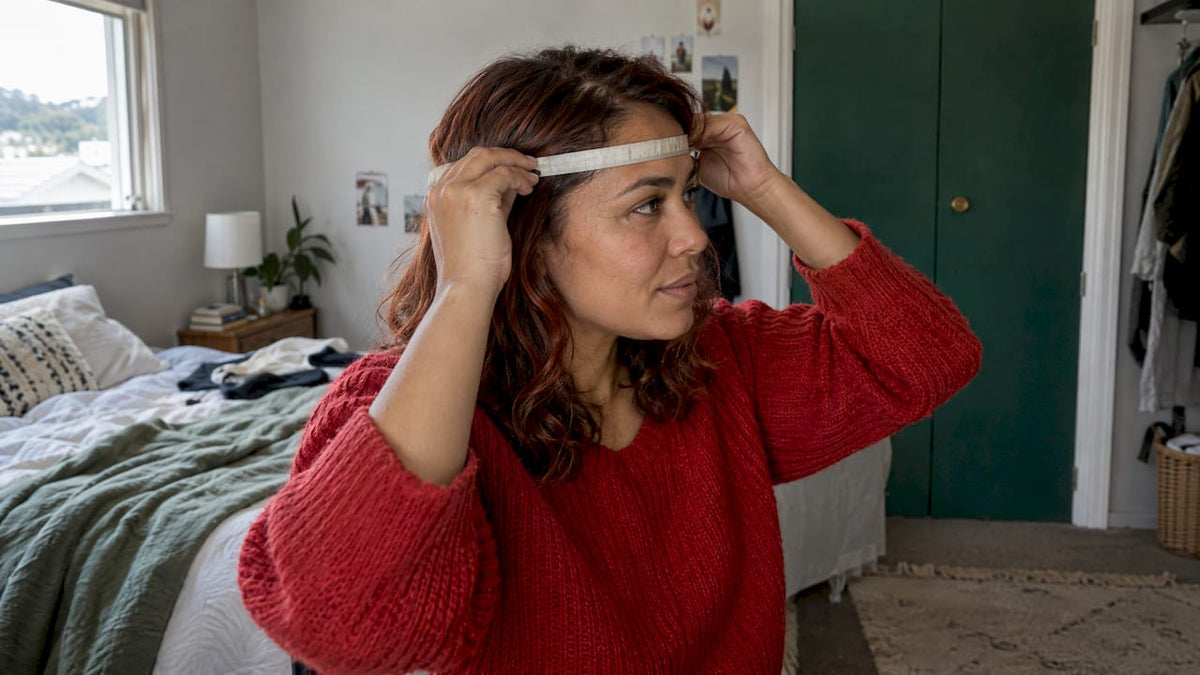
Measure your head in centimetres, then match it to the chart below. In New Zealand, hat sizes are read from head circumference in cm: 54 cm is a Small, 56 cm a Medium, 58 cm a Large, 60 cm an XL and 62 cm an XXL. That one number, taken with a soft tape, is all you need to buy a cap, beanie, fedora or bucket hat online with confidence. The rest of this page shows how to measure, how the cm, inch, US and UK labels line up, and what to do when you land between sizes.
TL;DR
- Wrap a soft tape around your head about 1 cm above your eyebrows and over the widest part at the back. Read it in cm.
- Match that number to the chart: 54 cm is S, 56 cm is M, 58 cm is L, 60 cm is XL, 62 cm is XXL.
- A US fitted size is your head diameter in inches, and a UK size runs one-eighth smaller than the US size, so always buy by the cm range rather than the letter alone.
- Between sizes, size up for a hat you will wear with a beanie or in the cold, and size down only if the style has an adjuster.
- Different styles fit differently: fitted caps need exact numbers, while snapbacks, bucket hats and brimmed hats allow some give.
Table of Contents
- The NZ hat size chart
- How to measure your head for a hat
- Understanding cm, inches, US, UK and letter sizes
- Which size do most people need?
- Fit by style: how each hat behaves
- What if you are between sizes?
- How to tell if a hat fits properly
- Our view on hat sizing
- Find your size in our range
- Quick reference: measure, match, check
- FAQ
- Sources
The NZ hat size chart
New Zealand retailers mostly size hats the way the international standard does. The headwear standard ISO 4417 uses head girth, the distance around your head, as the control dimension, and says the size designation is that figure in centimetres. So the cm number is the one that matters, and every other label is a translation of it.
Here is the chart, using the conversions published in a hat size conversion table:
| Head circumference | Inches | US fitted size | UK fitted size | Letter size |
|---|---|---|---|---|
| 54 cm | 21¼″ | 6¾ | 6⅝ | S |
| 56 cm | 22″ | 7 | 6⅞ | M |
| 58 cm | 22⅞″ | 7¼ | 7⅛ | L |
| 60 cm | 23⅝″ | 7½ | 7⅜ | XL |
| 62 cm | 24⅜″ | 7¾ | 7⅝ | XXL |
How to read it: find your measurement in the left column and read across. If you measure 57 cm, you are between M and L. The sections below cover exactly that case.
A few points keep the chart honest:
- Round to the nearest half centimetre, then compare with the product page. A tape measure is not precise to the millimetre, and neither is a hat.
- Letter sizes are the least exact system. One brand’s S/M can cover a wider range than another brand’s Medium, so the cm range printed on the product page is the number to trust.
- Kids’ hats run smaller. Children’s sizes are usually given as a head measurement too, so measure the child, never guess from age.
How to measure your head for a hat
You need a soft, flexible tape, the kind used for sewing. No tape? Use a piece of string, then lay it flat against a ruler. A metal tradie’s tape is too stiff to follow the curve of your head.
Step by step
- Find the line. Imagine where the band of a cap would sit: about 1 cm above your eyebrows and the top of your ears, which is the line a hat naturally rests on.
- Wrap the tape level. Run it around the front, over the widest part at the back of your head, and back to the start. The tape should be level all the way round. A mirror makes this much easier, or ask someone to help.
- Snug, not tight. The tape should touch your skin or hair without pressing in. If it leaves a mark, it is too tight.
- Read the number in cm where the tape meets the start. Take the measurement three times and use the middle value.
- Note your hair. Measure with your hair as you normally wear it under a hat. A thick ponytail or a bun at the back can add a centimetre or more.
Where measuring goes wrong
Most sizing mistakes come from the same few slips:
- The tape slopes. If it sits higher at the back than the front, the number comes out too large. Keep it level.
- Pulling too hard. A tight tape gives you a size that will feel loose by lunchtime.
- Measuring over a beanie. Take it off, unless you are buying a winter hat you will wear over another layer.
- Using your old hat as the guide. Hats stretch and shrink with wear and washing. A number from a tape beats a label from a hat that has been through three summers.
If you want a second reference, our wool hat sizing guide goes further on how wool behaves once it is on your head.
Understanding cm, inches, US, UK and letter sizes
Five labels for one measurement is confusing, so here is how each one works.
Centimetres
The plain circumference of your head. It is the standard for headwear designation, and it is what we recommend you buy by.
Inches
The same circumference in imperial units. One inch is 2.54 cm, so 56 cm is about 22 inches. Some older hat makers and overseas sites still list only inches.
US fitted sizes
The numbers like 6¾, 7 and 7¼ describe head diameter in inches, which is circumference divided by 3.14, as explained in the conversion table. That is why a 22-inch circumference becomes size 7. You will see these on fitted baseball caps and many fedoras.

UK fitted sizes
UK sizes run one-eighth smaller than the matching US size. A US 7 is a UK 6⅞. If a hat is labelled with a fraction and no country, check which system it uses before you order.
Letter sizes
S, M, L and XL are quick labels. They are convenient but the least precise. The cm range under each letter can differ from one brand to another, so read the product page rather than the letter.
Which size do most people need?
The middle of the chart, 56 to 58 cm, is where most adult heads land, which is why many one-size hats are cut to cover that span. If you measure below 54 cm, look at kids’ or small-fit ranges. Above 60 cm, look for XL or big-fit styles. Our Voyager range includes a big-fit bucket hat for larger heads.

Getting the size right matters for more than looks. A hat that is too tight gives you a headache and a red line across your forehead. A hat that is too loose slides over your eyes or leaves on the first gust. Kiwi weather, wind on the Wellington waterfront or a southerly on the Canterbury Plains, is not forgiving of a loose fit.
Sizing across brands is a problem in every product that has to fit a body, from hats to safety gear. This explanation of why sizing matters across brands makes the same point for another kind of product: the size label means less than the measurement behind it.
Fit by style: how each hat behaves
The same 57 cm head does not need the same label in every style. Here is how the common styles work.
| Style | How it fits | What to check |
|---|---|---|
| Fitted cap | Fixed size, no adjuster | Exact cm or fitted size |
| Baseball cap with strap | Adjustable at the back | The adjuster’s range, and crown depth |
| Beanie | Stretches | Length of the knit and how snug it is |
| Bucket hat | Soft, forgiving | Crown depth and brim width |
| Fedora | Structured, stiff band | Interior band size in cm |
| Newsboy or flat cap | Structured, little stretch | Exact cm, plus room for a liner |
| Cheesecutter cap | Structured, often with a back strap | Back adjuster range |
Fitted caps
Fitted caps have no adjuster, so the number has to be right. Our snapback vs fitted cap guide sets out the differences. If you want the cleanest line around the head, go fitted. If you want flexibility, a strap does the job.
Baseball caps and snapbacks
Adjustable caps cover a range, so a Medium measurement and a Large measurement can often wear the same cap. What changes is crown depth: a shallow crown on a large head sits high and looks small. Browse the baseball caps and read the product page for the adjuster range.
Beanies
Knit stretches, so a beanie fits a wider range of heads than a structured hat. Choose by how you like to wear it: pulled down over the ears for a cold morning on the ski field, or sitting higher for the street. See our beanies.
Bucket hats
Soft crowns give some give, which suits growing kids and changing hairstyles. Because the brim hangs from the crown, a hat that is too big will drop over your eyes. Browse the bucket hats.
Fedoras and brimmed hats
A structured hat has an inner sweatband that does not stretch, so the cm size on the label is the real limit. Brim width also changes how the hat sits. We cover brim width in our guides to outback hats and outback hats against fedoras. For a fedora with a size that matches your cm number, see our fedora hats.
Newsboy and cheesecutter caps
Both are structured, with panels that hold their shape. They suit people who like a heritage look, and a size that is a half centimetre out shows. Look at the newsboy caps and cheesecutter caps with your measurement in hand.
Kids’ caps
Children’s heads grow quickly. Measure at the time of buying, and pick a style with an adjuster so the cap lasts a season or two. The kids’ caps range is where to start.
What if you are between sizes?
This is the most common sizing problem, and it has a simple rule: pick by how you will wear the hat.
- Size up for wool, felt, leather and any hat you will wear with a beanie or in cold weather. A little room is easy to fix, and a tight hat is not.
- Size down only when the hat has an adjuster or a drawcord, so you can tighten it.
- Bucket hats and soft caps forgive a half size either way.
- Structured hats such as fedoras and flat caps need the closer match. Go up, then add padding.
A small amount of extra room can be taken up with a hat-sizing foam strip or a folded piece of tape under the sweatband, a few millimetres thick. We walk through this in our guide to being between hat sizes. It is easy to add padding to a hat that is slightly big. It is not possible to stretch a hat that is slightly small without risking the shape.
A worked example: you measure 57 cm. That sits between M (56 cm) and L (58 cm). For a wool flat cap you will wear in winter, choose L and add a thin strip of padding if needed. For a cotton cap with a strap, M or L will both work and you can tune the strap.
How to tell if a hat fits properly
Once the hat arrives, check these five things in front of a mirror:
- It sits level, with the front edge about a finger-width above your eyebrows, not pushed down onto them.
- Snug, not squeezing. You should be able to slide one finger under the band at the temple. If you cannot, it is too tight.
- No red line. After an hour of wear, there should be no deep mark across your forehead.
- It stays on in wind. Shake your head gently. A good fit moves with you, and a hat that shifts is a size too large.
- No pressure behind the ears. Pain there on a long day is a sign of a hat that is too small or too stiff.
Wear it around the house for a short time before you decide. Wool and leather soften with use, so a hat that feels just firm on day one is often right.
Our view on hat sizing
Most returns on hats come down to one thing: the buyer guessed a letter instead of measuring. We think a tape measure and a cm chart take the guesswork out, and that is the approach we recommend to every customer.
We are a New Zealand owned and operated store, and our range covers caps, beanies, fedoras, bucket hats, newsboys, cheesecutters, kids’ caps and leather hats. Every one of those fits differently, which is why we publish sizing and care guides alongside the products, from fit and style advice to how to look after your hat once it is yours.
Our advice is simple. Measure once, write the number down, and keep it on your phone. Then buy by the cm range on the product page, size up for wool and structured hats, and use an adjuster style when you want flexibility.
Urban
Find your size in our range
Once you have your number, the quickest way to apply it is to browse by style. Urban Caps is NZ owned and operated, with free shipping on all orders within NZ, and our range runs from baseball caps and beanies to fedoras, newsboys and leather hats. Have your cm measurement ready, check it against the product page, and add the hat to your cart.

If you want help choosing a style before you size it, our premium caps and hats guide covers how style and function fit together, and our hat reviews explain our top picks for Kiwi conditions.
Quick reference: measure, match, check
Keep these three steps in mind next time you shop for any hat:
- Measure your head in cm, level and snug, about 1 cm above the eyebrows.
- Match the number to the cm range on the product page, not to the letter.
- Check the fit when the hat arrives: level, snug, no red line, stays on in wind.
A summer cap worn on the beach in January and a wool hat worn on a frosty morning in July can take different sizes from the same head. That is normal. Keep your cm number, and choose the style to suit the season. For warm-weather options, see our summer hats and caps guide.
FAQ
How do I know what size a hat is?
Measure your head with a soft tape about 1 cm above your eyebrows and around the widest part at the back. Read it in cm and match it to the chart: 54 cm is S, 56 cm is M, 58 cm is L, 60 cm is XL and 62 cm is XXL. Check the product page for the cm range, because letter sizes vary between brands.
What is a 58 cm head in US and UK hat sizes?
A 58 cm head is about 22⅞ inches. That is a US size 7¼ and a UK size 7⅛, and it is usually labelled Large. UK sizes run one-eighth smaller than US sizes, so check which system a hat uses before you order.
Should I size up or down if I am between sizes?
Size up for wool, felt, leather and structured hats, and for any hat you will wear in the cold. Size down only when the hat has an adjuster. A small amount of padding under the sweatband fixes a hat that is slightly large.
Do one-size hats fit everyone?
One-size and adjustable hats cover a range, usually the middle of the chart, and the strap does the rest. They suit most adults, but very small or very large heads are better served by a specific size or a big-fit style.

Leave a comment
This site is protected by hCaptcha and the hCaptcha Privacy Policy and Terms of Service apply.