

Cowboy Hat Etiquette: 4 Moments You Should Always Remove It
Wear a cowboy hat outside; remove or respectfully tip it indoors and for formal moments. A quick brim touch acknowledges someone in passing, but funerals, anthems and the dinner table call for the hat coming off entirely. Handling matters just as much as timing: always lift a hat by the crown, never the brim, and never rest it brim-down on a bed or table.
TL;DR:
- Cowboy hats should be removed indoors at churches, funerals, and during national anthems, but can remain on at casual outdoor or western-themed events.
- When tipping or handling a cowboy hat, use the crown for lifting and opt for a brim-touch for casual greetings or full removal for formal moments like funerals or ceremonies.
- Proper storage involves placing hats crown-down on flat surfaces, avoiding brim-down on tables or beds, and keeping them away from heat sources to maintain shape and hygiene.
- Material choice depends on climate: straw is best for hot, sunny weather, while felt suits colder or dressier occasions, with fit being more important than material defaults.
- Respect regional and event-specific customs, understanding that traditional rules are flexible signals of respect rather than fixed commandments, and always adapt to the context.
Table of Contents
- What does cowboy hat etiquette say about wearing your hat indoors?
- How do you tip or remove a cowboy hat correctly?
- How should you pick up, hold and store a cowboy hat?
- Should you wear straw or felt, and does the season actually matter?
- Which cowboy hat superstitions are worth respecting?
- How Urbancaps helps you get fit and style right
- Do cowboy hat customs change from region to region?
- Does cowboy hat etiquette change between formal and casual events?
- Where does cowboy hat etiquette come from historically?
- Traditional rules still work, if you stop treating them as absolute
- Where to buy a cowboy hat built for how you’ll actually wear it
- Sources
- FAQ
What does cowboy hat etiquette say about wearing your hat indoors?
The rules for wearing a cowboy hat sound rigid until you realise they’re built around a handful of moments that actually matter. Etiquette lists consistently name four situations where the hat comes off: church services, funerals, national anthems, and the dinner table. The reasoning is old but sound. A bare head at a funeral or during an anthem signals attention and respect at the exact moment it’s expected, and removing a hat at the table keeps its brim (and whatever’s on it) away from other people’s food.
Diane Gottsman’s rundown of cowboy hat customs confirms these four as the backbone of modern hat etiquette, with places of worship topping the list for men specifically. Women have historically had more latitude to keep a hat on indoors, a distinction that still shows up in etiquette guides today.
Exceptions exist, and they matter as much as the rules. Cowboy church, for instance, often welcomes hats worn throughout the service, since removing headwear was never the point. Rodeos, western bars, and casual barbecue joints are similarly forgiving. Formal dining rooms are not. The safest approach is reading the room: if everyone else has taken their hat off, follow suit within a few seconds. If nobody has, you’ve probably landed in a space where the old rule doesn’t apply.
A short checklist helps when you’re unsure:
- Is this a place of worship, a funeral, or a moment of national reflection? Hat off.
- Are you sitting down to eat at a table, not a bar or outdoor stand? Hat off.
- Is this a rodeo, cowboy church, casual outdoor event, or western bar? Hat stays on unless local custom says otherwise.
- Has everyone else already removed theirs? Follow within seconds, not minutes.
How do you tip or remove a cowboy hat correctly?
Cowboy hat customs give you a scale of gestures, not a single move, and picking the right one is about matching the weight of the moment. A brim-touch, where you pinch the front edge and tilt it slightly, is the modern, casual version. It works for a nod to an acquaintance across the street or a quick greeting outside a shop. True West Magazine’s history of the gesture confirms the brim-tip developed as a lighter alternative to full removal, which historically signalled real formal courtesy.
Full removal is the deeper gesture. Sweep the hat off with one motion, hold it at your side or over your heart, and keep it off until the moment passes; an anthem, a funeral procession, a prayer.
A simple sequence covers most situations:
- Casual acknowledgment (passing a neighbour, greeting a stranger): brim-touch only.
- Formal respect (anthem, funeral, wedding ceremony): full removal, held at the chest or side.
- Conversation with someone you’re meeting for the first time in a formal context: full removal, then you may put it back on once seated or once the exchange ends.
Traditional etiquette assigned these gestures mainly to men, with women given more discretion to keep hats on socially. That distinction has softened considerably, and most modern hosts care more about the sentiment than who performs it.
Pro Tip: If you’re not sure whether a brim-touch or full removal fits the moment, over-remove rather than under-remove. Nobody has ever been offended by a hat coming off too readily.
How should you pick up, hold and store a cowboy hat?
Proper hat handling starts with a simple rule: touch the crown, not the brim. Gripping the brim repeatedly reshapes it over time, flattening curves that took real work to set. True West Magazine’s etiquette guide backs crown handling as the standard, both for lifting a hat off your own head and for passing one to someone else.
Showing the inside of your hat to a room, or letting the sweatband face outward while you hold it, reads as careless. Keep the crown up and the brim level when you’re carrying it rather than swinging it loosely at your side.
Storage matters just as much as handling in the moment. A few habits protect both the hat’s shape and its social standing:
- Set it crown-down on a flat, clean surface if there’s no rack nearby.
- Use a proper hat rack or wall hook at home rather than stacking it on furniture.
- Never leave it brim-down on a table, and never place it on a bed. Both risk crushing the shape.
- Keep it away from direct heat sources like car dashboards or heaters, which can warp felt and straw alike.
That bed taboo isn’t just superstition. True West Magazine’s coverage of hat etiquette ties it to a practical hygiene and shape concern that predates any folklore attached to it.
For anyone whose hat sees regular wear, brushing, drying, and sweatband care make the difference between a hat that lasts years and one that looks tired within a season. Urbancaps’ hat care checklist covers the basics, and the weatherproof maintenance guide is worth a look if you’re wearing yours through rain or heavy sun.
One more handling rule sits outside storage and care: never touch someone else’s hat without asking. Etiquette commentary from True West Magazine’s western lifestyle coverage treats a personal hat as an extension of personal space, so picking one up off a chair or trying it on uninvited crosses a line most western communities still take seriously.
Should you wear straw or felt, and does the season actually matter?
Straw and felt solve different problems, and the old “Easter to Labour Day” straw rule is a regional custom, not a law of physics. Straw breathes, sheds heat, and holds up to sweat and sun, which makes it the practical choice for anyone working or standing outdoors through summer. Felt, usually wool, blocks wind and cold far better and reads as dressier, which is why it dominates formal and cold-weather wear.
| Factor | Straw | Felt (wool) |
|---|---|---|
| Best climate | Hot, sunny conditions | Cold or mild, low sun exposure |
| Breathability | High | Low to moderate |
| Rain tolerance | Poor, can lose shape when soaked | Better, sheds light rain |
| Formality | Casual, everyday | Dressier, suits formal events |
| Typical durability | Good with care, more fragile | Very durable with proper storage |
Cowboy Hat Guide’s comparison of felt and straw backs this trade-off directly, and it’s worth treating the calendar rule as a starting suggestion rather than a hard boundary. A hot autumn day calls for straw regardless of what the calendar says, and a cold snap in early summer is still felt weather.
Fit outranks material every time. A hat that sits half a size too big will slide around no matter how well-suited the material is to the weather, so get the sizing right first and let climate and formality decide between straw and felt second.
Which cowboy hat superstitions are worth respecting?
Some hat taboos have practical roots; others are pure folklore that’s stuck around because nobody wants to be the one who breaks tradition. The hat-on-the-bed rule is the best example of the first kind. AgDaily’s rundown of hat superstitions ties it to genuine hygiene and shape concerns, not bad luck alone; a hat picks up dust and sweat all day, and a bed is exactly where you don’t want either.
Other customs are lighter in origin:
- Wearing a hat backwards is generally seen as a fashion choice rather than a breach of etiquette, though it draws odd looks in traditional western settings.
- Leaving a hat on a chair, especially at a card table, is considered bad luck in some circles, tied loosely to old gambling superstition.
- Wearing a brand-new, unbroken-in hat while hunting or competing is avoided by some for luck, though there’s no practical harm in it either way.
Treat the hygiene-based taboos as genuine advice. Treat the luck-based ones as regional colour: worth respecting around elders or at traditional events, but not something to lose sleep over if you break one by accident.
How Urbancaps helps you get fit and style right
Getting the sizing right solves more etiquette problems than any rule about tipping or removal ever will. A hat that fits correctly sits level, doesn’t need constant adjusting, and stays on through a brim-touch instead of sliding off. Measure around your head at the point about one centimetre above your ears, using a soft tape or a string you then measure against a ruler.
A few fit checks worth running before you buy:
- Confirm the hat sits level without gapping at the sides or pinching at the temples.
- Check it stays put with a moderate head tilt, not just standing still.
- Match the crown height and brim width to your face shape rather than picking on looks alone.
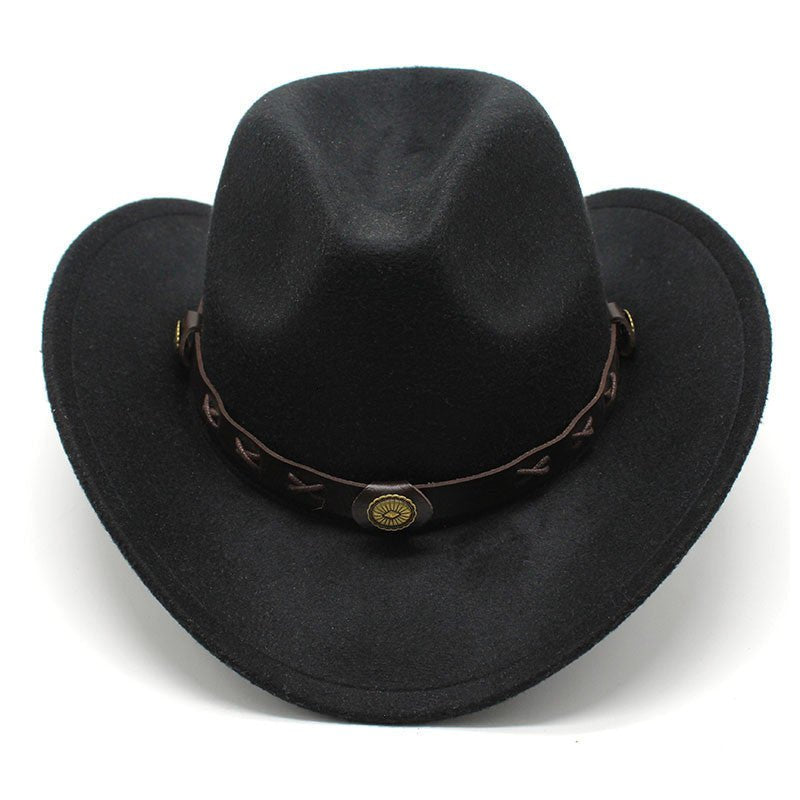
Once sizing is sorted, Urbancaps’ three cowboy hat styles cover most of the situations already discussed: the Men’s Leather Cowboy Hat suits durable, dress-casual and outdoor wear year-round, the Eastwood Australian Wool Cowboy Hat is built for cooler, casual outings, and the Premium Western Cowboy Hat in wool felt leans dressier for colder or more formal settings. Urbancaps’ sizing guide walks through the full measurement process if you want more detail before ordering.
Do cowboy hat customs change from region to region?
Etiquette for wearing hats shifts noticeably depending on where you are and what community you’re standing in. A dance hall in Texas might enforce hat removal indoors far more strictly than a casual western bar in a city that’s adopted cowboy style as fashion rather than heritage. Rodeos are their own category entirely, where hats stay on almost universally, including during competition and most social moments around the grounds.
True West Magazine’s coverage of regional custom points out that some communities, dance halls and traditional ranching towns among them, still hold firmer lines than the general etiquette lists suggest. That’s worth knowing before you assume the four standard removal moments cover every scenario you’ll encounter.
Cowboy church is the clearest regional exception to mainstream religious etiquette. Where a conventional church service expects hats off, cowboy church services in many parts of the American West and Australia’s own western heritage communities often welcome hats staying on throughout, treating the hat as part of the attire rather than something to set aside.
International contexts add another layer. Western hat culture in Australia and New Zealand carries its own heritage threads, often tied to ranching and rural agricultural history rather than the American frontier narrative, and the etiquette that travels with it tends to be looser around indoor removal, stricter around handling and respect for someone else’s hat. The safest rule anywhere: watch what the people who’ve clearly worn hats their whole lives are doing, and match it.
Does cowboy hat etiquette change between formal and casual events?
A wedding and a barbecue call for different versions of the same rules, and mixing them up is one of the more common etiquette missteps. Formal western gatherings, weddings, galas, awards dinners, tend to import mainstream formal etiquette wholesale: hats off during the ceremony, off at the dinner table, and often left off entirely once guests are seated indoors. A felt hat suits these settings far better than straw, both for the dressier look and because most formal events land in cooler months or air-conditioned venues.
Casual western gatherings run on a much lighter set of expectations. Barbecues, rodeos, county fairs and casual bar nights rarely require removal at all, and a brim-touch covers most social acknowledgment you’ll need to make. Straw hats dominate here for the obvious reason that these events tend to happen outdoors in warm weather.
The grey zone sits with semi-formal events: a ranch wedding reception held outdoors, a western-themed corporate function, or a cowboy church service that blends both registers. Read the invitation and the venue first. An outdoor reception with a barn and hay bales signals casual norms even if the ceremony itself called for hats off. An indoor function room, regardless of how western the theme, tends to default back toward formal expectations. When genuinely unsure, arrive with the hat on and take your cue from the host or the majority of guests within the first few minutes.
Where does cowboy hat etiquette come from historically?
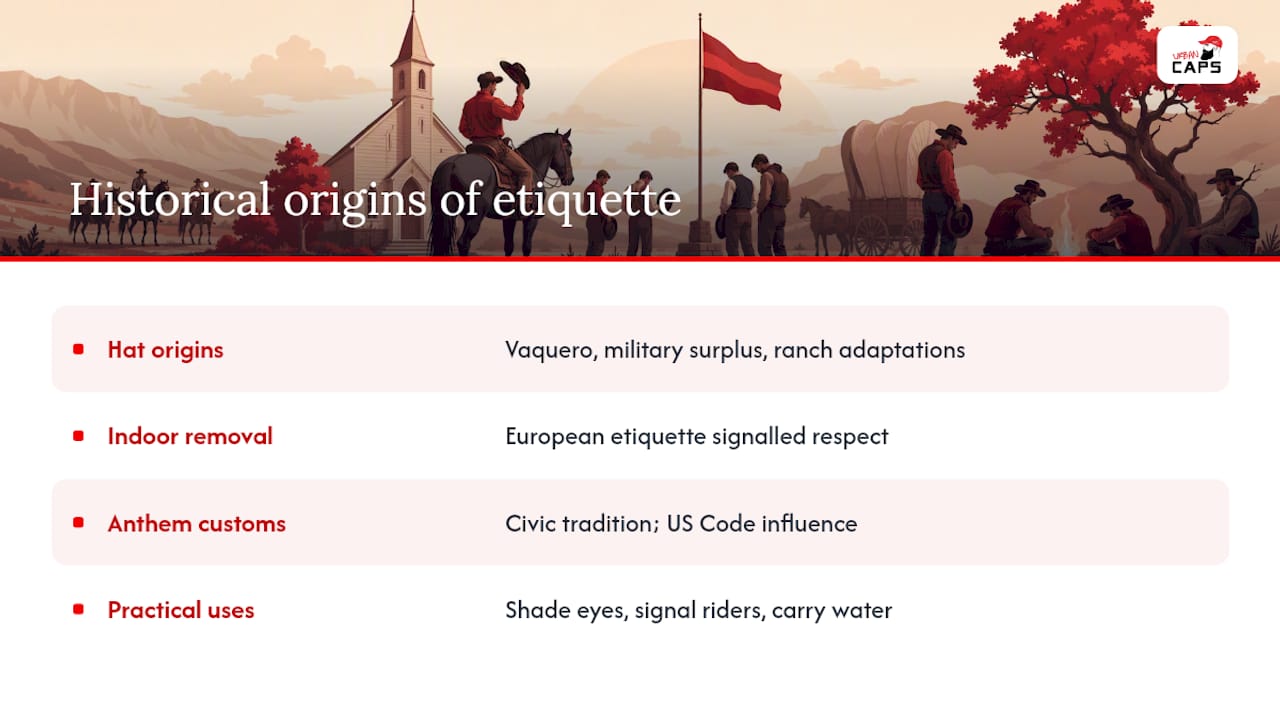
Modern hat customs trace back further than most people expect, and the practical origins explain why the rules stuck around long after their original purpose faded. The cowboy hat’s documented history shows it developing in 19th-century North America from a blend of Mexican vaquero headwear, military surplus hats, and practical adaptations working ranch hands made for sun and weather protection.
Removing a hat indoors has roots that predate the cowboy hat entirely, tracing back to European gentlemen’s etiquette where headwear removal signalled submission or respect in the presence of authority, whether that was a church, a superior, or a host’s home. Cowboys inherited that broader western etiquette and folded it into their own working culture, where a hat also served as a genuinely useful tool, shading eyes, signalling to other riders, even carrying water in a pinch, which is part of why removing it was never treated lightly.
Anthem-related removal customs sit closer to formal civic tradition than to ranching culture specifically. Cultural practice around national observances, reflected in frameworks like the US Code’s provisions on patriotic observance, reinforced the expectation that headwear comes off during anthems and moments of national reflection, a norm that layered onto existing hat customs rather than replacing them.
What’s changed since those origins is mostly flexibility. The gestures survived; the rigidity around who performs them and when has loosened considerably, especially as western hats moved from working necessity into fashion and self-expression.
Traditional rules still work, if you stop treating them as absolute
The biggest mistake people make with cowboy hat rules is treating them as a fixed code instead of what they actually are: a handful of respect signals layered onto practical common sense. The four removal moments (church, funerals, anthems, dinner tables) haven’t changed in decades, and they’re not going to. What has changed is everything around them: who wears cowboy hats, where, and why.
Rigid calendar rules around straw and felt deserve the most scepticism. Nobody’s comfort should be dictated by a date on a calendar when the actual weather in front of them says otherwise. The same goes for gender-specific removal expectations, which have softened for good reason; the sentiment behind the gesture matters more than who’s performing it.
Where the conventional advice falls short is nuance. Most etiquette lists hand you a rulebook without explaining that reading the room beats memorising a checklist every time. Prioritise the handling basics, crown not brim, no bed, no touching someone else’s hat, since those protect both the object and the relationship. Get comfortable adjusting the calendar-driven rules to what’s actually happening around you.
— Urban
Where to buy a cowboy hat built for how you’ll actually wear it
Urbancaps stocks cowboy hats that match the situations covered above rather than a single generic style, and every hat ships fast from local New Zealand stock so you’re not waiting weeks to sort your fit before an event.
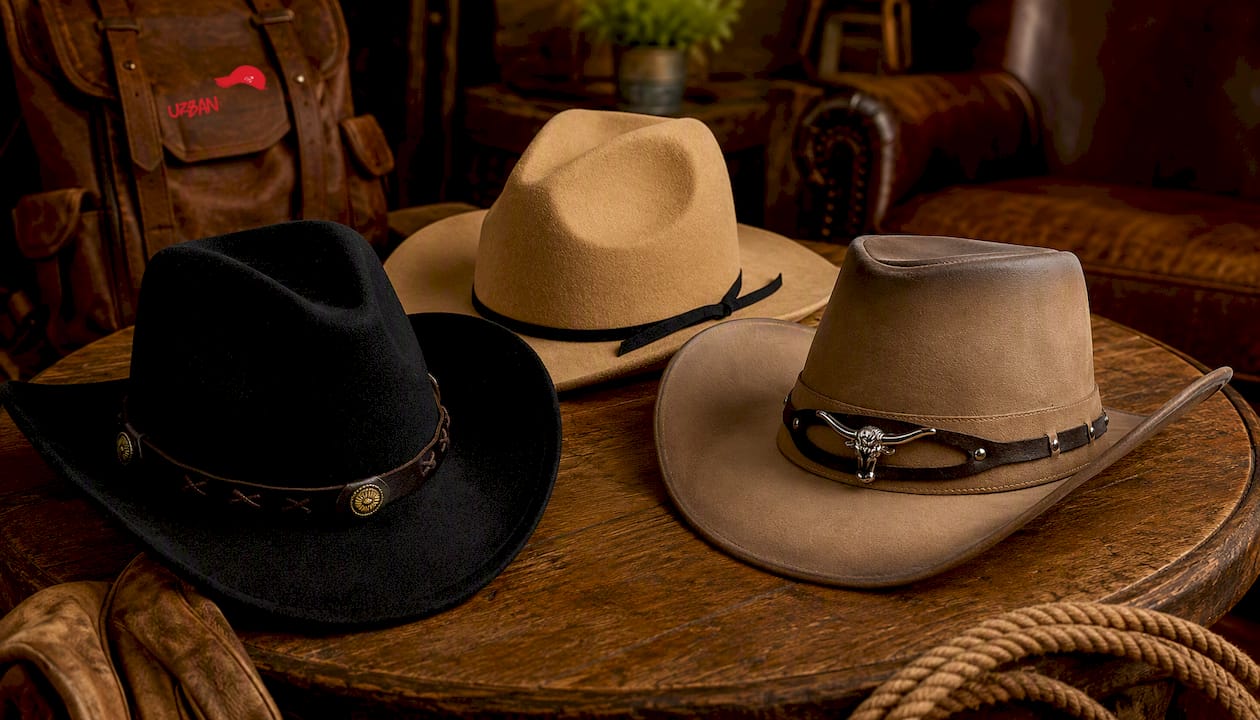
If you’re after everyday durability with a dress-casual edge, the Men’s Leather Cowboy Hat handles outdoor wear and casual social settings without fuss. For cooler-weather outings where you still want a relaxed, casual feel, the Eastwood Australian Wool Cowboy Hat delivers warmth without tipping into overly formal territory. When the occasion calls for something dressier, the Premium Western Cowboy Hat in wool felt is built for exactly that.
Not sure what size you need? Run through Urbancaps’ cowboy hat sizing guide before you order, and browse the style guide if you want a faster way to match a hat to the occasions you’ve got coming up. For headwear beyond cowboy styles, Qahwat Al’ard’s hat and cap collection is worth a look too. Head to the product pages above and check current stock for your size today.
Sources
- True West Magazine — hats-off history of cowboy hat etiquette
- Cowboy hat etiquette: traditions, rules, and modern style — Diane Gottsman
FAQ
What are the general rules for wearing a cowboy hat?
Wear it outdoors and in casual western settings without a second thought, but remove it indoors at churches, funerals, formal dinners, and during national anthems. A brim-touch works for casual acknowledgment; full removal signals deeper respect.
What does it mean when a girl puts on a cowboy’s hat?
In casual social settings, this is usually a playful or flirtatious gesture rather than a breach of hat etiquette, though traditional custom treats personal hats as private, so it’s generally best done with the owner’s clear invitation.
What are some unspoken rules about wearing cowboy hats?
Never touch or try on someone else’s hat without asking, always lift a hat by the crown rather than the brim, and never set one brim-down on a bed or table. These handling customs matter as much as knowing when to take a hat off.
What’s the rule if you wear a cowboy hat to a formal event?
Formal western gatherings, weddings and dinners generally expect the hat off once you’re seated indoors, with felt styles suiting the dressier tone better than straw. Casual outdoor events, including rodeos and cowboy church, typically don’t require removal at all.