

Find your perfect wool hat size: a complete sizing guide
TL;DR:
- Accurate head measurement ensures a perfect fit for structured or stretch wool hats.
- NZ sizing uses centimeters, with fixed sizes for structured hats and negative ease for knit styles.
- Measuring at the end of the day with a snug tape ensures optimal comfort and sizing accuracy.
You finally find a wool hat that looks incredible, exactly the right color, brim, and texture. Then it arrives and sits too tight across your forehead, or worse, wobbles around your head like a loose lid. It’s a frustrating experience that happens to a lot of Kiwis shopping for premium headwear online. Getting the right size is not just about comfort. It directly affects how the hat sits, how long it lasts, and how sharp you look wearing it. This guide walks you through every step, from understanding NZ sizing standards to measuring your head accurately, so you can order with total confidence.
Table of Contents
- Understanding wool hat sizing standards in New Zealand
- Essential tools and preparation for accurate measurement
- Step-by-step: How to measure your head for a wool hat
- How to interpret your measurement: picking your ideal wool hat size
- What most guides miss about luxury wool hat sizing
- Find your next perfect-fit wool hat
- Frequently asked questions
Key Takeaways
| Point | Details |
|---|---|
| Use centimeter measurements | NZ and global brands use centimeters, so always measure and shop in cm for the best fit. |
| Measure accurately | Wrap a soft tape around your head 1cm above your eyebrows and ears for the truest fit. |
| Account for negative ease | Knitted and stretch wool hats are made smaller than your head measurement to ensure a comfortable, secure fit. |
| Size up for hair volume | Choose a larger size if your hair is thick or you often wear it up to avoid tightness. |
| Consult brand charts | Check each brand’s chart as sizes can vary slightly across premium New Zealand hatmakers. |
Understanding wool hat sizing standards in New Zealand
New Zealand sizing for wool hats follows a centimeter-based system that aligns closely with Australian and European standards. This is good news if you shop across multiple brands or browse international collections, because the numbers translate cleanly. Most NZ retailers label their hats using a combination of letter sizes (S, M, L, XL) and centimeter measurements, and the centimeter figure is always the more reliable one to use.
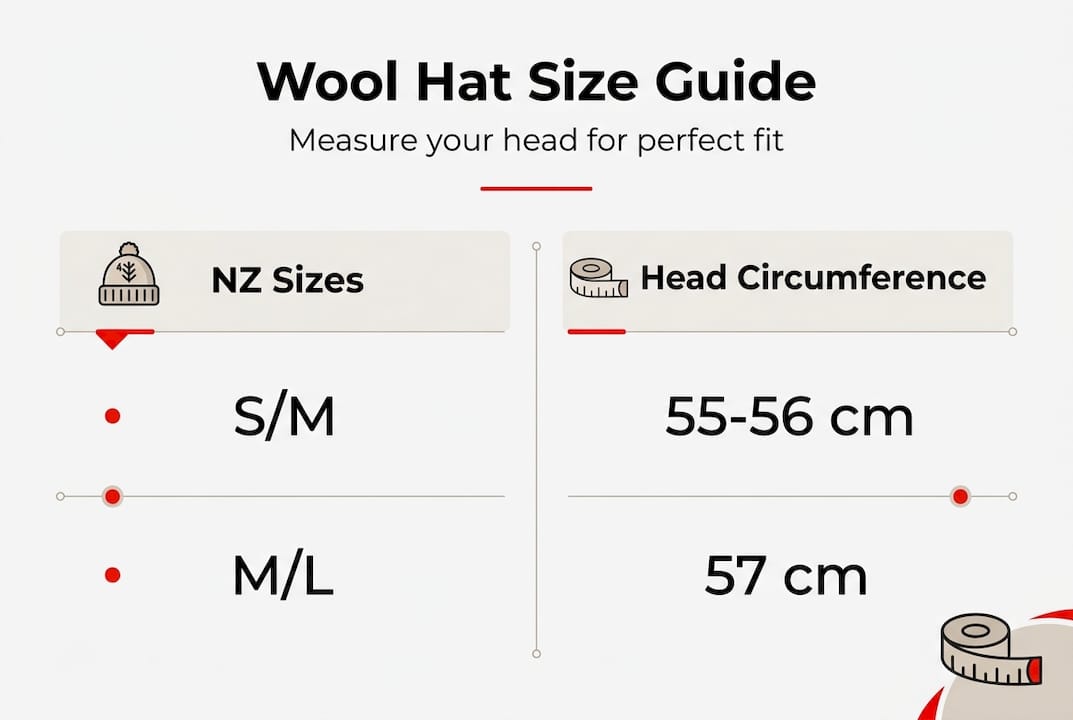
Understanding the hat sizing standards used globally helps you cross-reference any brand chart with confidence. Here is a quick reference for common NZ wool hat sizes:
| NZ Size Label | Head Circumference |
|---|---|
| S/M | 55 to 56 cm |
| M/L | 57 cm |
| L/XL | 59 cm |
| XL/XXL | 61 cm |
| Beanie (one-size) | 54 to 60 cm stretch |
As shown in the oversized knit wool beanie sizing guide, NZ sizes run S/M at 55 to 56 cm, M/L at 57 cm, L/XL at 59 cm, and XL/XXL at 61 cm, with beanies typically stretching across 54 to 60 cm in a one-size format.
Not all wool hats size the same way, though. Structured styles like barrel height fedoras use fixed sizing with no stretch, so your measurement needs to be exact. Knit beanies and stretch-band hats have more flexibility, but that does not mean you should guess.
Here are the key differences to keep in mind:
- Structured hats (fedoras, trilbies, flat caps): Fixed sizing. Match your head circumference directly to the size chart.
- Knit and stretch hats (beanies, slouch hats): Built with negative ease. They stretch to fit a range of head sizes.
- Adjustable hats (some dad hats, caps): Use a strap or snap to accommodate a wider range.
For fashion-forward Kiwis who want both style and comfort, structured wool hats in the correct size offer the cleanest silhouette. When the brim sits level and the crown does not bulge, the whole look comes together. That only happens when you start with the right number.
Essential tools and preparation for accurate measurement
With NZ sizing knowledge in hand, it is time to get the precise measurements you will need. The good news is that you do not need anything fancy. Most people already have what it takes at home.
What you need:
- A soft fabric tape measure (the kind used for sewing)
- A piece of string and a ruler (if you do not have a tape measure)
- A mirror, or a friend to help
- Good lighting so you can read the measurement clearly
Timing matters more than most people realize. Your head can swell slightly during the day due to fluid retention, heat, and physical activity. Measuring at the end of the day gives you the largest realistic size, which means your hat will fit comfortably at any time. Measuring first thing in the morning might give you a reading that is a few millimeters too small.
The goal is a fit that feels snug but not tight. A useful rule: you should be able to slide one finger under the tape measure without forcing it. If the tape digs in, loosen it slightly. If it slides around freely, tighten it a little.
Setup checklist before you measure:
- Tie back or flatten thick hair so it does not add bulk
- Stand in front of a mirror or ask someone to help position the tape
- Hold the tape parallel to the floor all the way around your head
- Keep the tape 1 cm above your eyebrows and ears
- Breathe normally and do not tense your jaw
According to how to measure your head, you should wrap the tape around the widest part of your head, 1 cm above your eyebrows and ears, and repeat the process 2 to 3 times, then average the results for accuracy.
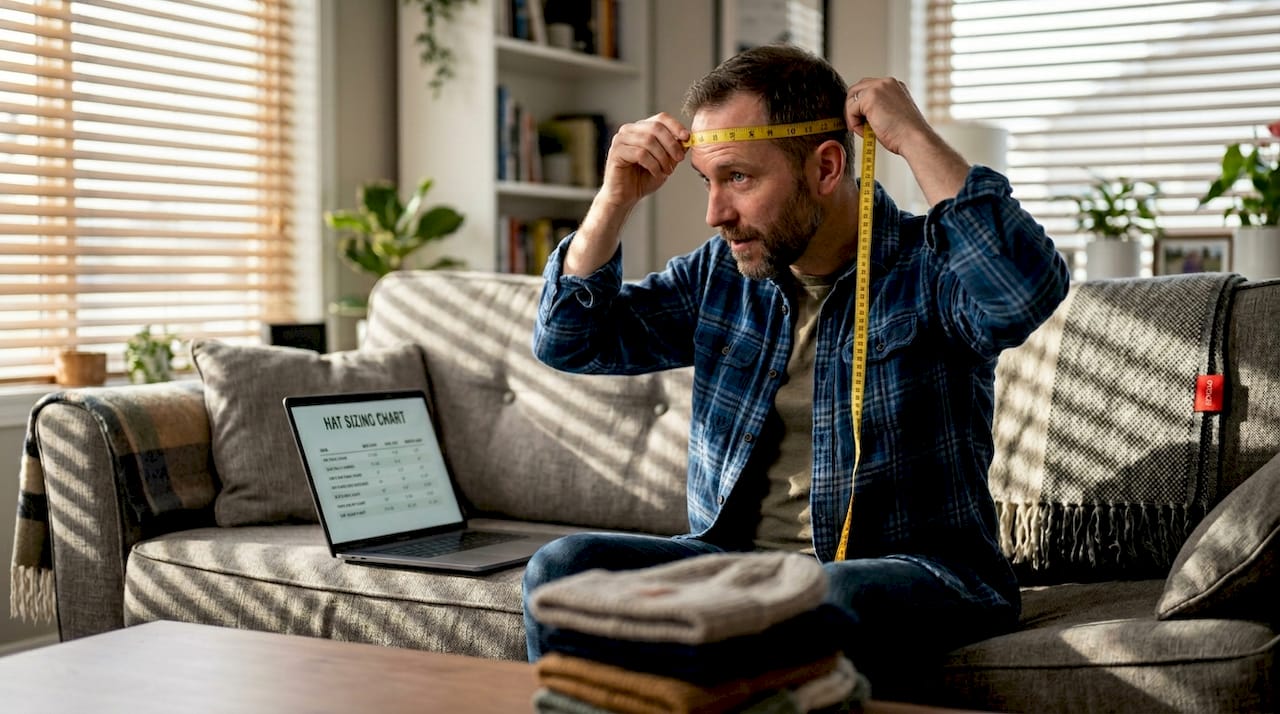
Pro Tip: If your head is not perfectly round (which is completely normal), take three separate readings and average them. A single reading from an unusual angle can throw off your size by a full centimeter, which could mean the difference between a hat that fits perfectly and one that pinches.
Once you have your tools ready and your setup sorted, you are in a great position to get a reliable number. Browse top picks for stylish wool hats once you have your measurement locked in.
Step-by-step: How to measure your head for a wool hat
Once you are fully prepared with the right tools, follow these steps for a spot-on measurement.
Prepare your hair first. If you have long or thick hair, put it down flat or tie it back the way you would normally wear it under a hat. This gives you a realistic measurement for your actual wearing style.
- Find the widest point. This is typically about 1 cm above your eyebrows at the front and 1 cm above your ears on the sides. This is the point where your hat will rest.
- Position the tape. Wrap the soft tape measure around your head at this point, keeping it level and parallel to the floor. Do not angle it up or down at the back.
- Check the tension. The tape should feel snug against your skin without pressing in. As noted in hat sizing tips, measuring around the widest part, 1 cm above your eyebrows and ears, snug but not tight, gives the most reliable result.
- Read the measurement. Note the number in centimeters. If you are using string, mark the point where it overlaps and measure the string against a ruler.
- Repeat. Do this two more times and write down each result.
- Average the readings. Add the three numbers together and divide by three. This is your head circumference.
Pro Tip: If you have very curly or voluminous hair that you typically wear out, measure with your hair down. This way, your hat will fit over your natural style without flattening it uncomfortably.
End-of-day measurement is most accurate due to slight fluid retention throughout the day. If you measure in the morning, add 2 to 3 mm to your result as a buffer.
For those exploring timeless hat styles in NZ, having an accurate head measurement means you can shop any structured or stretch style with full confidence.
How to interpret your measurement: picking your ideal wool hat size
Ready to take your freshly measured results and pick your perfect hat? Here is how to use what you have found.
Your head circumference in centimeters maps directly to a hat size. For structured hats, you want the hat’s stated size to match your measurement as closely as possible. For knit or stretch hats, the sizing works differently because of something called negative ease.
Negative ease means the finished hat is intentionally made smaller than your head. When you put it on, the fabric stretches to fit snugly. According to Craft Yarn Council standards, a finished knit hat is typically 10 to 15% smaller than the wearer’s head circumference. So if your head is 58 cm, a well-fitting knit beanie might have a finished circumference of around 49 to 52 cm.
| Head circumference | Structured hat size | Knit hat finished size |
|---|---|---|
| 54 to 55 cm | S/M | 46 to 49 cm |
| 56 to 57 cm | M/L | 48 to 51 cm |
| 58 to 60 cm | L/XL | 50 to 54 cm |
| 61 cm and above | XL/XXL | 52 to 55 cm |
For a premium style guide for NZ buyers, here are the most useful sizing tips:
- If you fall between two sizes, size up for structured hats and size down for stretch hats
- Thick hair adds 1 to 2 cm to your effective head size, so factor that in
- Always check each brand’s specific size guide, as NZ branded hats align with global size charts but individual brands may vary slightly
- A knit hat size chart can help you cross-reference styles from different makers
For anyone looking to elevate your style in 2026, knowing your exact size means you spend less time returning hats and more time wearing them.
What most guides miss about luxury wool hat sizing
Having explored the numbers, let us talk about what really separates a stylish hat from just an ordinary one.
Most sizing guides treat wool as a single material. It is not. A tightly woven merino wool fedora behaves completely differently from a loosely knit lambswool beanie. The fiber weight, knit structure, and internal band all affect how the hat fits over time. A hat that feels perfect in the store might loosen after a few wears if the band is not reinforced.
Kiwi buyers should always request a detailed brand chart rather than relying on generic S/M/L labels. A single centimeter difference can shift a hat from sitting cleanly on your crown to sliding down over your ears. That is the kind of detail that only shows up when you dig into the actual measurements.
The role of negative ease is also underappreciated. Even a few millimeters of extra stretch means all-day comfort versus a hat you take off after an hour. Fashion rule worth keeping: when in doubt, size up. A slightly larger structured hat can be adjusted with a hat size reducer strip. A hat that is too small cannot be fixed.
As one experienced hatmaker puts it, “Comfort equals confidence, especially under the NZ sun.” Explore more on premium headwear in NZ to see how quality construction and accurate sizing work together.
Find your next perfect-fit wool hat
Now that you know exactly how to size your next hat and what to look for, you can shop with total confidence.

Shopping at a dedicated NZ headwear retailer means you get access to accurate size charts, real product details, and a range built for Kiwi heads and Kiwi conditions. No guesswork, no frustrating returns. At Urban Caps, every product listing is backed by sizing information you can actually use. Take your measurement, match it to the chart, and find the style that works for you. Whether you are after a structured wool fedora or a cozy knit beanie, explore NZ wool hats to browse the full range. Ready to go structured? Check out premium fedoras in your size and find your fit today.
Frequently asked questions
How do I measure my head for a wool hat?
Use a soft tape measure around the widest part of your head, about 1 cm above your eyebrows and ears, keeping it snug but not tight, and repeat the process 2 to 3 times for accuracy.
What is ‘negative ease’ and why is it important for wool hats?
Negative ease means the hat is made slightly smaller than your head to ensure a snug, comfortable fit. For knit hats, the finished hat is 10 to 15% smaller than your head circumference.
Should I size up if I have thick hair or wear my hair in a ponytail?
Yes, size up for thick hair or a regular ponytail to ensure comfort and a secure fit in your wool hat.
Do all brands in New Zealand use the same wool hat sizing?
Most NZ brands align with global size charts, but always check each brand’s specific size guide for slight variations.
Is it better for a wool hat to fit tightly or loosely?
A snug fit is best, especially for stretch wool hats. You should be able to slide one finger under the hat band comfortably without it slipping.