


Save Your Hat on Flights: Crown Down Packing for NZ Travellers
The crown-down, stuffed-crown method is the best way to pack most structured hats for flights: lay the hat crown-side down, fill the crown firmly with socks or a rolled t-shirt, and wall the brim in with soft clothing. Wear fragile or oversized hats through the airport instead of packing them. Always check the hat is completely dry first, since a damp crown packed into a dark suitcase is an open invitation for mould.
TL;DR:
- Structurally fragile hats, such as stiff straw or wired brims, are best worn or stored in a hat box rather than packed loose in a suitcase.
- Packable hats made of synthetic fibers or wool felt recover quickly after compression, but stiff straw and raffia require special care to prevent cracking.
- Using a crown-down packing method with stuffed crowns and rolled clothing around the brim offers the most protection during transit.
- Always ensure hats are completely dry before packing to prevent mold growth, which can occur within 48 hours of dampness.
- Wearing the hat through security and on the plane is the safest way to avoid damage, while carrying it on is preferable for delicate or sentimental styles.
Table of Contents
- Quick pre-flight hat packing checklist
- How do you pack a structured hat crown-down?
- Which hat materials pack well, and which don’t?
- Should you wear, carry-on, or check your hat?
- What accessories help protect a hat in transit?
- How do you reshape a hat after a flight?
- Urban Caps’ perspective on packing hats for travel
- Shop travel-ready hats from Urban Caps
- Sources
- FAQ
Quick pre-flight hat packing checklist
Run through this before you zip the suitcase shut. It takes about a minute and it’s the difference between a hat that looks the same on arrival and one you’re trying to fix in a hotel bathroom.
- Confirm the hat is bone-dry. Any dampness left in a closed bag can turn to mould within roughly 48 hours.
- Remove pins, feathers, or clip-on embellishments before packing.
- Decide upfront whether the hat gets worn, carried on, or checked.
- Gather soft stuffing items: rolled socks, a clean t-shirt, or a scarf. Skip anything with zips or buttons.
- Grab a dust bag or soft cloth cover, plus a folded jumper to use as a top buffer.
- If the hat is genuinely fragile or sentimental, have a hat clip or hat box ready as backup.
How do you pack a structured hat crown-down?
This is the packing method most travel guides and hat brands agree on, and it works because of simple physics: the brim becomes a flat, load-bearing base, and a stuffed crown resists the kind of buckling that ruins a fedora’s shape.
- Check the hat is dry and stripped of extras. Remove any pins or decorative trims before you start.
- Choose your stuffing. Rolled socks, a soft t-shirt, or underwear work well. Avoid anything with hard edges, zips, or metal fastenings.
- Stuff the crown until firm, not stretched. You want enough fill that the crown holds its shape under pressure, but not so much that it’s straining the fabric or stitching.
- Place the hat crown-down in the suitcase, usually on top of a layer of folded clothes rather than directly against the case’s hard shell.
- Build a wall of rolled clothing around the brim. This is the step most people skip. Rolled jeans, jumpers, or jackets packed snugly against the brim’s edge stop it from flexing or catching a knock.
- Add a soft buffer on top — a folded jumper or two — before you close the lid, so nothing heavy sits directly on the hat.
This layout mirrors the technique Geneva Vanderzeil popularised for packing a fancy hat without crushing it, and it’s echoed almost identically by travel packing specialists who point out the brim’s role as a stable base.
Pro Tip: A suitcase that’s packed full but not crammed protects a hat better than one that’s half empty, because the surrounding clothing distributes pressure evenly instead of letting the hat shift and take direct hits.
Avoid overstuffing the crown, packing zips or hard trims near the brim, and leaving dead space in the case that lets everything shift mid-flight.
Which hat materials pack well, and which don’t?
Not every hat responds to travel the same way, and knowing your material saves you from a nasty surprise at baggage claim.
- Packable and forgiving: engineered synthetics and some wool felts are built to flex and spring back. Look for the word “packable” on the product tag.
- Fragile, handle with care: stiff painted straw, wired brims, and natural raffia can crack or fracture rather than crease. Wear these or use a hat box.
- Crushable vs structured: a soft crushable hat will tolerate minor creasing that steams out later; a structured felt or fedora needs the extra protection of the crown-down method every time.
- Buying for travel? Prioritise packable construction and a flexible brim over a stiff, high-fashion shape.
The mechanics matter here. Painted or stiff straw fails by fracturing when bent rather than creasing, while wool felt tends to relax back into shape with a bit of steam. Engineered synthetics are the most forgiving of the lot and recover fastest after being compressed in a suitcase.
Should you wear, carry-on, or check your hat?
Wearing the hat through the airport is genuinely the safest option, and it’s allowed. Airport security and airlines generally permit hats through screening and on board; wide-brim or tall styles are more a matter of seat-space courtesy than an actual rule.
If you’re not wearing it, carry-on beats checked luggage for anything fragile or sentimental.
- Wear the hat if it’s practical. It’s the lowest-risk option, full stop.
- If carrying on, place it crown-down in an overhead bin corner, away from bags that’ll be stacked on top.
- Checked luggage raises the risk of stacking pressure, but it’s acceptable for genuinely crushable hats packed using the crown-down method.
- A hatbox usually counts as a carry-on item, but check your airline’s size limits before you get to the gate.
- For wide-brim or tall hats, factor in courtesy toward the passenger next to you, not just the rulebook.
What accessories help protect a hat in transit?
A few purpose-built items solve specific packing headaches that clothing alone can’t fix.
- Hat boxes work well when you’re checking a structured hat; pick one that fits within your airline’s overhead bin dimensions if you plan to carry it on.
- Hat clips let you attach a hat externally to a bag for short transits or quick access, without packing it at all.
- Dust bags or padded covers stop abrasion against zippers and buckles inside a packed suitcase.
- Travel-friendly styles — beanies, bucket hats, packable fedoras, and low-profile baseball caps — sidestep most of this hassle because they’re built to be squashed and to bounce back.
Specialist hat packs and dust bags exist for a reason: they trade a bit of extra bulk in your luggage for real protection during transit, which is worth it if you’re travelling with something expensive or irreplaceable.
How do you reshape a hat after a flight?
Unpack your hat first, before anything else in your suitcase. Let it rest on a flat surface or a hat stand for at least an hour. Many packable materials start springing back into shape within 30 to 60 minutes of being unpacked, so that early rest period does more work than people expect.
- Use brief steam from a kettle or a garment steamer, held a short distance from the fabric, then reshape gently by hand.
- Never soak trims, ribbons, or leather bands. Targeted care beats a full wet clean every time.
- Wool and felt respond well to light steam; our wool hat reshaping guide covers the exact technique, and if it’s a fedora brim specifically, this steaming guide walks through safe distance and timing.
- If the hat got damp in transit, dry it completely before storing it. Packing it away still damp is how mould gets started.
Pro Tip: Don’t reach for a hair dryer to speed up drying. The concentrated heat can warp felt and crack straw. Air-drying flat, away from direct sun, is slower but far safer.
Urban Caps’ perspective on packing hats for travel
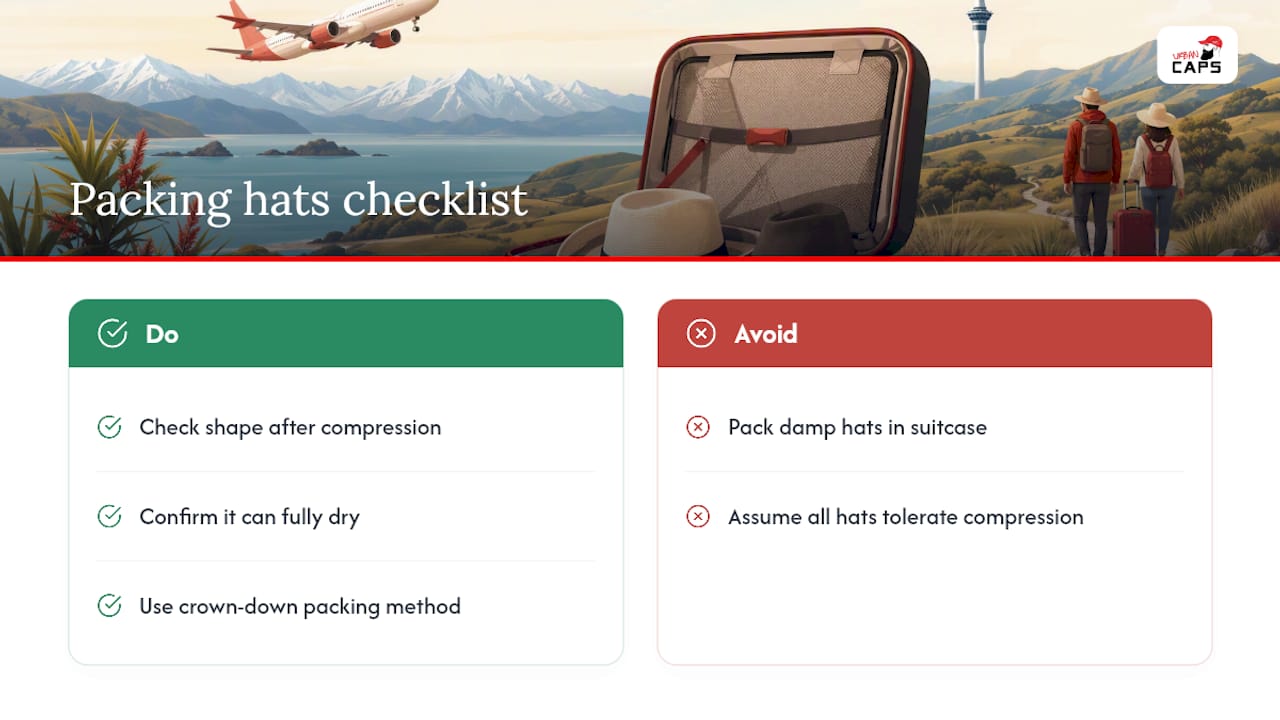
We built our travel guidance around the same checks we apply to every hat we stock: does it hold its shape after compression, and can it dry out fully without warping. Our travel hats guide runs through packability checks specific to hat type, and our pre-travel mould prevention checklist exists because damp hats in suitcases are a far more common problem than most travellers expect.
The crown-down method isn’t a trick. It’s just physics applied properly, and it works whether you’re carrying a fifty-dollar cap or a hat you’ve had for a decade.
— Urban
Shop travel-ready hats from Urban Caps
Urban Caps stocks headwear built to survive a suitcase, not just look good on a shelf, so if you’d rather buy a hat that shrugs off packing instead of babysitting a fragile one, this is the more practical route.

Our beanies compress flat and bounce back with a shake, which makes them close to foolproof for cold-weather trips. Baseball caps and bucket hats handle rolling and stuffing without complaint, and our fedoras range includes styles built with flexible brims specifically so they survive a crown-down pack. If you want a specific example rather than a whole collection, our travel fedora and fisherman-style bucket hat are both built with packability in mind. We also carry newsboy caps, cheesecutter caps, kids’ caps, and leather caps and hats for the rest of the family or a different style altogether. You can browse a range of travel-ready hats and have one sorted before your next flight.
Sources
- The best way to pack a fancy hat in a suitcase so it does not get crushed
- The best way to pack a hat in a suitcase using crown-down
- Can you wear a hat on a plane? TSA rules and etiquette (2026)
- How to pack hats for travel without crushing them - Headcase
FAQ
Is it better to wear a hat or pack it on a flight?
Wearing your hat is the safest option and it’s permitted through airport security and on board most flights. If wearing it isn’t practical, the crown-down stuffed method is the next best choice.
Can you pack a straw hat in a suitcase?
Stiff painted straw and wired brims are prone to cracking rather than creasing, so wearing the hat or using a hat box is safer than packing it loose. Softer, more flexible straw can sometimes handle the crown-down method with extra padding.
How do you get creases out of a hat after travel?
Rest the hat on a flat surface or hat stand for at least an hour, then apply brief steam from a kettle or garment steamer before reshaping by hand. Many packable materials spring back within 30 to 60 minutes of being unpacked.
How do you stop a hat getting mouldy in luggage?
Make sure the hat is completely dry before you pack it, since dampness sealed in a closed bag can develop mould within around 48 hours. If it gets damp during travel, dry it fully before storing it at home.