


Australian heritage hats: origins, styles, and meaning
Australian heritage hats began with the cabbage-tree hat and evolved through straw and felt work into the slouch hat — each type carries a clear social, economic, and military meaning. Three eras shaped this history:
- Late 18th to mid-19th century: The cabbage-tree hat, woven from Livistona australis leaves, became the first distinctively Australian headwear and a vital cottage industry.
- Mid to late 19th century: Machine-made straw and wool felt hats replaced hand-plaited styles as industrialisation changed what settlers could afford and access.
- Late 19th century onward: The slouch hat entered military service around 1885, became standard issue by 1903, and grew into a national symbol tied to the ANZAC tradition.
Museums including the Powerhouse Museum, Castlemaine Art Museum, and Armidale Regional History Museum hold original examples. For NZ buyers, Urbancaps stocks heritage-style Australian hats with fast local delivery.
Key takeaways
Australian heritage hats evolved from the cottage-made cabbage-tree hat through industrial felt production to the military slouch hat — each stage carrying distinct social, economic, and cultural meaning that persists in the styles available today.
| Point | Details |
|---|---|
| Cabbage-tree hat origins | Made from Livistona australis leaves, it was the first distinctively Australian hat and a key cottage industry from the late 18th century. |
| Slouch hat standardisation | Adopted by Australian colonial forces around 1885 and made standard Army headdress in 1903; puggaree, brim, and plume details carry regimental meaning. |
| Cork hat reality | Corks were a practical fly deterrent in some rural contexts but were never standard everyday wear; the style became a souvenir stereotype, not a historical norm. |
| Museum collections | The Powerhouse Museum, Castlemaine Art Museum, Armidale Regional History Museum, and National Trust (Australia) hold key examples for research and study. |
| Urbancaps for NZ buyers | The Flinders “Billabong,” Flinders Stockman, and Spur Distressed Cotton hats offer authentic heritage construction with fast NZ delivery from Urbancaps. |
Table of Contents
- How Australian heritage hats evolved from the 18th to 20th centuries
- The slouch hat: design, military adoption, and what it stands for
- Historic hatmakers and why their stories shape Australian hat identity
- Cork hats: practical tool or souvenir myth?
- Materials and methods: how heritage hats were actually made
- What heritage hats signified: class, labour, and national identity
- New Zealand connections: how Kiwis adopted and adapted Australian hat styles
- Why some styles faded and where museums preserved what remained
- Where to see authentic examples and buy heritage-style hats in New Zealand
- Heritage hats beyond ANZAC: notable figures and events in Australian hat history
- Regional variations in Australian heritage hat styles
- Why this history still matters for hat buyers today
- Urbancaps: heritage-style Australian hats, delivered to New Zealand
- Sources
- FAQ
How Australian heritage hats evolved from the 18th to 20th centuries
1. The cabbage-tree hat era (late 18th to mid-19th century)
The cabbage-tree hat was the first hat made entirely from Australian materials. Weavers stripped and scalded the young leaves of Livistona australis, split them into fine strips, plaited those strips into sinnet, then shaped and blocked the finished crown. The work was slow and skilled, and it supplied income for settler families — particularly women and children — during periods of economic hardship. By the 1820s and 1830s, the style was common across rural New South Wales and beyond.
2. Cottage industry and social identity (early to mid-19th century)
Hat-making from cabbage-tree palm was never just a craft. It was a small economy. Local historical records from communities like Maitland document how families produced hats for sale at markets and to travelling merchants. The hat also carried social weight: wearing one marked you as a “currency lad” — Australian-born, not a transported convict or a newly arrived Briton. That distinction mattered enormously in colonial society.
3. Straw and imported felt (mid to late 19th century)
As shipping routes improved and manufacturing scaled up, imported straw hats and machine-blocked felt hats undercut the hand-plaited cabbage-tree style on price. Rabbit-felt and wool-felt hats offered better waterproofing and durability in wet conditions. The cottage industry contracted, though cabbage-tree hats remained in use in rural areas well into the second half of the 19th century.
4. Military adoption of the slouch hat (c.1885 to 1903)
The Victorian Mounted Rifles began wearing a broad-brimmed felt hat with one side turned up around 1885. Other colonial forces followed, and by 1903 the slouch hat was standard Australian Army headdress. Its international antecedents included European and imperial military styles, but the Australian version — with its puggaree, turned brim, and later emu plume — became something distinct.
5. WWI, ANZAC symbolism, and the 20th century
Gallipoli fixed the slouch hat in public memory. Soldiers wore it at the landing in April 1915, and photographs from the campaign circulated widely. After the war, the hat’s ceremonial role grew even as everyday civilian use of broad-brimmed hats declined through the mid-20th century. Fashion shifted toward lighter, shorter-brimmed styles, and the felt outback hat became associated with rural identity rather than general wear.
6. Heritage revival and museum collecting (late 20th century onward)
From the 1970s onward, collectors, historians, and heritage events rekindled interest in colonial headwear. Museums began actively acquiring and cataloguing examples. Makers producing wool-felt outback hats found a market among people who valued provenance and craft over fast fashion — a trend that has continued into the 2020s.
The slouch hat: design, military adoption, and what it stands for
The slouch hat became standard Australian Army headdress by 1903 and remains one of the most recognisable national symbols in Australian and New Zealand military culture.
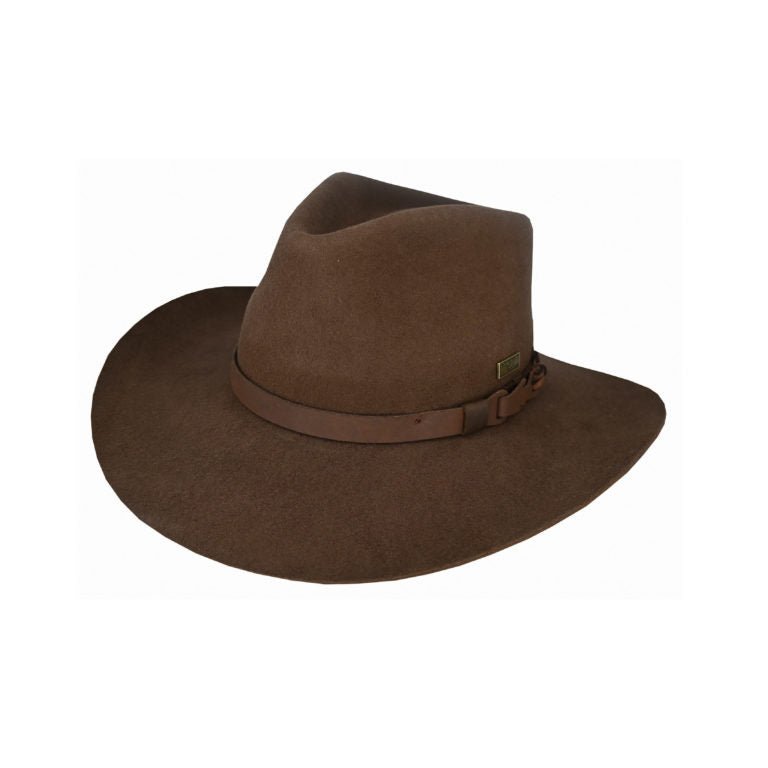
Its origins trace to the Victorian Mounted Rifles around 1885, with design influences drawn from Burmese policing hats and earlier European broad-brimmed military styles. Colonial forces across Australia adopted similar forms through the 1890s, and federation brought standardisation.
Key design features:
- Felt construction: Rabbit or wool felt, chosen for durability, water resistance, and the ability to hold a blocked shape.
- Puggaree: A pleated fabric band wrapped around the crown. The word derives from the Hindi pagri (turban cloth). Puggaree colours and pleating patterns once identified specific units and arms of service.
- Turned brim: The left brim is turned up and pinned, traditionally to allow a rifle to be shouldered without catching the brim. Some colonial units turned the right side instead, and conventions varied by colony before standardisation.
- Emu plume: Light Horse units adopted emu feathers as a distinguishing adornment. The tradition became closely associated with the Australian Light Horse of WWI.
- Chinstrap: A leather or fabric strap worn under the chin or hooked to the hat when not in use.
The hat’s ceremonial rules remain precise. The brim position, puggaree pleating, and plume placement are not decorative choices — they carry regimental meaning. For collectors and reenactors, these details matter: a wrongly pleated puggaree or an incorrect brim pin places a hat in the wrong unit or the wrong era.
Historic hatmakers and why their stories shape Australian hat identity
Maker histories are central to understanding Australian heritage hats because they institutionalised the manufacturing standards and aesthetic conventions that define the style today.
Akubra is the most prominent surviving name in Australian felt hat production. Founded in the late 19th century and operating continuously since, Akubra standardised rabbit-felt construction and wide-brim outback shapes that became the template for what most people picture when they think of an Australian bush hat. The company’s longevity means its archive spans the transition from cottage production to industrial manufacture.
Beyond Akubra, smaller regional hatmakers operated throughout the 19th and early 20th centuries, many of them supplying local markets and military contracts. Their stories are preserved in:
- Museum acquisition records: The Powerhouse Museum in Sydney holds colonial-era hats with documented provenance, including maker stamps and purchase records.
- Exhibition catalogues: The Castlemaine Art Museum and Armidale Regional History Museum have featured headwear in exhibitions on colonial life and material culture.
- Local historical bulletins: Sources like the Maitland Historical Society document regional production and the names of individual hat-makers.
Maker provenance matters for authenticity. A hat with a documented maker, a legible stamp, and a known production date is a primary historical source, not just a decorative object. When buying a heritage-style hat today, knowing whether it follows traditional felt-blocking methods or uses synthetic shortcuts tells you something real about what you are getting.
Cork hats: practical tool or souvenir myth?
The cork hat is probably the most internationally recognised Australian hat image — and also the most misunderstood. Corks suspended from a hat brim on strings do deter bush flies, which are persistent and attracted to the face. The practical logic is sound.
What the historical record does not support is the idea that cork hats were standard everyday wear for Australian settlers. Journalistic research published in the Sydney Morning Herald traced the trope and found that documentary evidence of widespread use is thin. The style appears more often in comic illustration and later tourist merchandise than in photographs or written accounts of ordinary settler life.
What the evidence actually shows:
- Corks were used in some rural and outback contexts where flies were severe enough to warrant the improvisation.
- The image entered popular culture through humour and caricature, not through broad adoption.
- By the mid-20th century, the cork hat had become a souvenir item sold to tourists as a shorthand for “Australian-ness.”
- Today it functions as a cultural stereotype — instantly recognisable, rarely worn.
The gap between image and practice is a useful reminder for anyone researching Australian hat history: popular culture and historical reality often diverge, and the cork hat is the clearest example of that divergence.
Materials and methods: how heritage hats were actually made
Heritage Australian hats used local fibres, straw, and rabbit or wool felt — each chosen for specific functional and climatic reasons.
Cabbage-tree hat construction followed a labour-intensive sequence documented in Maitland Historical Society records:
- Young Livistona australis leaves were scalded in boiling water to soften the fibres.
- The softened leaves were split into narrow strips.
- Strips were plaited into sinnet (a flat braid) by hand.
- Sinnet was coiled and sewn to form the crown and brim.
- The shaped hat was blocked over a wooden form, lined, and trimmed.
The finished hat was lightweight, breathable, and well-suited to the Australian summer. A skilled maker could produce a fine hat, but the process took many hours — which is why the cottage industry model made sense. Families could work in stages around other tasks.
Felt hat construction worked differently. Rabbit fur or wool was matted, shrunk, and blocked under heat and pressure into a dense, water-resistant shell. The puggaree was then cut, pleated, and wrapped around the crown. Felt hats were more durable in wet conditions and held their shape better over time, which is why they displaced cabbage-tree hats as the dominant style once industrial production made them affordable.
Industrialisation changed both the scale and the character of production. Machine blocking produced consistent shapes faster than hand-forming, but it also removed the individual variation that makes surviving hand-made examples interesting to collectors.
Pro Tip: When examining a heritage hat in a museum or online listing, look for hand-stitched sinnet seams (in cabbage-tree examples) or uneven blocking marks on the interior crown (in early felt hats) — these are signs of pre-industrial construction that add provenance value.
What heritage hats signified: class, labour, and national identity
Hats in 19th-century Australia were not just sun protection. They were visible markers of who you were and where you stood.
The cabbage-tree hat carried specific social meaning from its earliest years. Wearing one identified you as Australian-born — a “currency lad” — rather than a convict or a recent immigrant. Historians link the hat to republican sentiment and working-class pride in the goldfields era, where it appeared alongside other markers of colonial identity at political gatherings and labour disputes.
Key social associations by hat type:
- Cabbage-tree hat: Currency lads, rural workers, republican politics, Eureka-era goldfields identity.
- Straw and felt bush hats: Stockmen, drovers, and squatters — the broad brim as a practical tool that also signalled occupation.
- Slouch hat: Military service, the digger ethos, mateship, and sacrifice — meanings layered on top of the earlier bush identity.
- Cork hat: Comic rural character, later tourist shorthand for “Australian.”
Period newspapers and literature reinforced these associations. The cabbage-tree hat appeared in colonial fiction as a symbol of native-born defiance. The slouch hat appeared in war correspondence as a symbol of courage. These weren’t accidental associations — they were actively constructed and repeated until they became fixed in the culture.
The military adoption of the slouch hat was particularly significant because it took a civilian bush identity and gave it a commemorative dimension. After Gallipoli, the hat stopped being just a practical outback garment and became a memorial object.
New Zealand connections: how Kiwis adopted and adapted Australian hat styles
The cross-Tasman relationship in military headwear is closer than many people realise. New Zealand mounted and infantry units wore hat styles closely related to the Australian slouch hat, and the shared ANZAC experience at Gallipoli and on the Western Front cemented those visual connections.
Key NZ parallels:
- The New Zealand Mounted Rifles wore broad-brimmed felt hats with turned brims and puggarees, following conventions similar to those of Australian mounted units.
- ANZAC commemorative practices in New Zealand have kept the slouch hat visible in public memory, with the hat appearing at Dawn Services and in museum displays across the country.
- Civilian taste flows between Australia and New Zealand meant that outback and bush hat styles crossed the Tasman as fashion items, particularly from the mid-20th century onward.
For NZ collectors and researchers, the Te Papa Tongarewa collection in Wellington holds New Zealand military uniform items including headwear from WWI and WWII. The Auckland War Memorial Museum similarly holds Australasian military dress items with documented provenance. These collections are the best starting point for anyone tracing the NZ side of this history.
The heritage hat styles available in New Zealand today reflect this shared history — wool felt outback shapes and wide-brim cotton hats that echo both Australian and New Zealand bush traditions.
Why some styles faded and where museums preserved what remained
Industrial production, changing fashion, and cheaper synthetic materials drove most heritage hat styles out of everyday use through the 20th century. The cabbage-tree hat was essentially gone as a commercial product by the early 20th century. Broad-brimmed felt hats retreated to rural use. Only the slouch hat retained a formal public presence through its military role.
Museums stepped in to preserve what the market had abandoned. Key collections include:
- Powerhouse Museum (Sydney): Colonial-era hats with maker documentation and acquisition records.
- Castlemaine Art Museum (Victoria): Headwear featured in exhibitions on colonial material culture.
- Armidale Regional History Museum (NSW): Regional hat examples with rural provenance.
- National Trust (Australia): The National Trust hat collection documents regional varieties and social contexts, preserving examples that illustrate how hat styles varied by location and occupation.
The revival of interest in heritage hats from the 1970s onward was driven by collectors, historical reenactment groups, and makers who saw a market for authentically constructed pieces. That revival has continued, with wool-felt outback hats now sold as premium lifestyle items in Australia and New Zealand. The benefits of heritage headwear — durability, sun protection, and cultural resonance — have found a new audience among buyers who want something with a story behind it.
Where to see authentic examples and buy heritage-style hats in New Zealand
To see originals:
- Te Papa Tongarewa, Wellington — NZ military and civilian dress collections.
- Auckland War Memorial Museum — Australasian military uniform holdings.
- Powerhouse Museum, Sydney — colonial headwear with maker provenance.
- National Trust (Australia) hat collection — regional varieties and exhibition records.
- Armidale Regional History Museum — rural NSW hat examples.
To buy heritage-style hats in New Zealand, Urbancaps stocks three strong options that reflect the construction traditions covered in this guide:
- The Flinders “Billabong” Australian Wool Felt Hat — wool felt construction with a wide brim and classic outback profile.
- The Flinders Stockman Wool Felt Outback — a durable stockman shape that echoes the working hats of 19th-century drovers and station hands.
- The Spur Distressed Weathered Cotton Aussie Hat — a cotton alternative with a heritage aesthetic and signature pin detail, suited to NZ conditions.
Pro Tip: When buying a heritage-style hat online, check the product description for the specific felt weight (measured in grams per square metre for wool felt) and whether the brim is hand-finished or machine-bound. Hand-finished brims and heavier felt weights are the clearest markers of quality construction that follows traditional methods.
Heritage hats beyond ANZAC: notable figures and events in Australian hat history
The ANZAC story dominates public memory of the slouch hat, but the history of Australian heritage hats runs through many other significant moments.
The Eureka Stockade (1854): Miners at Ballarat wore cabbage-tree hats alongside their digger’s licences as markers of colonial identity. The hat appeared in contemporary illustrations of the stockade and the political meetings that preceded it, linking it directly to the first major organised challenge to British colonial authority in Australia.
Ned Kelly and the bush hat: Kelly and his gang wore broad-brimmed felt hats in the photographs and descriptions that circulated during and after the Kelly outbreak of 1878 to 1880. The bushranger image — wide brim, rough felt, defiant posture — drew on the same visual vocabulary as the stockman and the currency lad, reinforcing the hat’s association with colonial resistance.
Federation (1901): As Australia moved toward nationhood, the broad-brimmed hat appeared in federation imagery and political cartoons as a shorthand for the Australian character. The timing of the slouch hat’s military standardisation in 1903 was not coincidental — it followed federation and reflected a new national military identity.
Henry Lawson and the bush literary tradition: Lawson’s stories and poems from the 1890s and early 1900s placed the broad-brimmed hat on stockmen, shearers, and swagmen as a recurring visual detail. Literature fixed the hat’s meaning in the popular imagination at the same time that industrialisation was beginning to displace the cottage-made originals.
Regional variations in Australian heritage hat styles
Australia’s geography produced real differences in hat styles across regions, driven by climate, available materials, and local occupations.
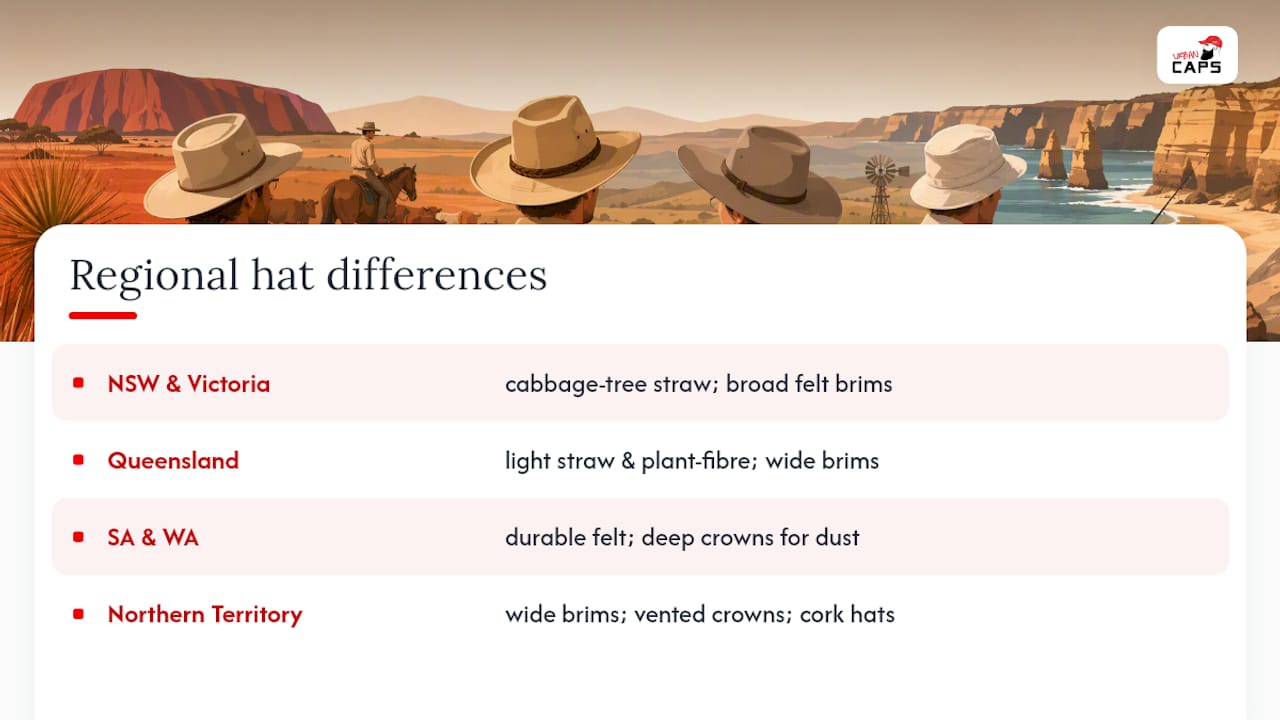
New South Wales and Victoria: The cabbage-tree hat was most strongly associated with the coastal and inland regions of NSW, where Livistona australis grew. The Maitland and Hunter Valley areas were particularly active production centres. Victorian goldfields workers favoured broader-brimmed felt hats that offered more sun protection during long outdoor shifts.
Queensland: The tropical north demanded lighter materials and wider brims. Straw hats and loosely woven plant-fibre hats were common in Queensland’s cane-growing regions, where the heat made heavy felt impractical for everyday work.
South Australia and Western Australia: Pastoral workers in these drier regions favoured durable felt hats with deep crowns — shapes that could be pulled down against wind and dust. The stockman’s hat in these areas tended toward a higher crown than the NSW equivalents.
The Northern Territory: Extreme heat and persistent flies made wide-brim hats with ventilated crowns the practical choice. This is also the region most associated with the cork hat improvisation, though even here the style was more occasional than standard.
The National Trust hat collection documents some of these regional differences, and museum holdings in each state tend to reflect local production traditions. For buyers today, understanding regional variation helps explain why “Australian outback hat” covers a range of shapes rather than a single silhouette — the top Australian hats for men available now reflect that regional diversity in their crown heights, brim widths, and felt weights.
Why this history still matters for hat buyers today
The history of Australian heritage hats is not just a museum story. It shapes what you are actually buying when you choose a wool-felt outback hat over a synthetic alternative.
The cabbage-tree hat established that Australian headwear could be made from local materials, suited to local conditions, and carry local meaning. The slouch hat proved that a functional working hat could become a ceremonial object without losing its practical roots. Both lessons apply to contemporary heritage hat production: the best makers still choose materials and construction methods that reflect those original priorities.
What gets lost in the souvenir version of this history — the cork hat, the cartoon digger — is the genuine craft and economic significance behind the real styles. Settler women who plaited sinnet for hours to produce a single hat were not making a fashion statement. They were sustaining households. That labour is part of what a well-made heritage hat carries forward.
For NZ buyers, the cross-Tasman dimension adds another layer. The shared ANZAC history means that the slouch hat’s symbolism belongs to New Zealand as much as to Australia. Choosing a wool-felt hat with authentic construction is a way of connecting to that shared history in a tangible form.
Urbancaps: heritage-style Australian hats, delivered to New Zealand
Urbancaps stocks a focused range of Australian heritage-style hats built for Kiwi conditions — wool felt, wide brims, and construction that reflects the outback traditions covered in this guide.
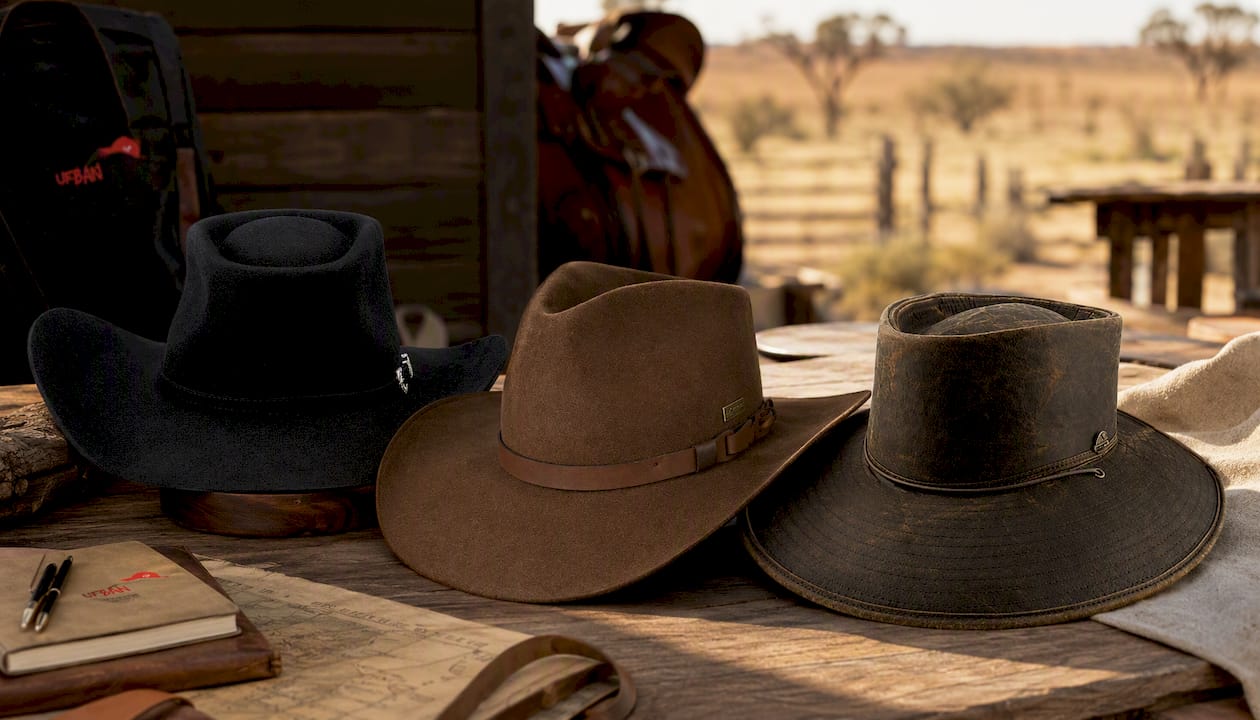
The Flinders “Billabong” wool felt hat and the Flinders Stockman both use wool felt construction with wide brims — the same material and silhouette that defined Australian working hats from the mid-19th century onward. For a lighter, everyday option, the Spur Distressed Cotton Aussie Hat brings heritage styling in a weathered cotton finish with a signature pin. All three ship fast within New Zealand. Browse the full range at Urbancaps and find the style that fits your head and your history.
Sources
- Cabbage-tree hat — Wikipedia
- Bulletin Vol 30, No 3 - Maitland Historical Society (August 2023)
- The slouch hat | Australian Army
- When did Australians start wearing hats with dangling corks? — SMH
- Hats collection — National Trust (Australia)
FAQ
What is the origin of the Australian hat?
The first distinctively Australian hat was the cabbage-tree hat, woven from the leaves of Livistona australis and produced as a cottage industry from the late 18th century onward. It was followed by straw and felt styles as industrialisation changed what settlers could access and afford.
Why do Australian hats have corks on them?
Corks suspended from hat brims were a practical deterrent for bush flies in rural and outback areas. Historical evidence suggests the style was never widely adopted as standard everyday wear — it became a souvenir and cultural stereotype more than a genuine historical norm, as journalistic research in the Sydney Morning Herald has documented.
What is the traditional Australian hat?
The slouch hat is the most formally recognised traditional Australian hat, adopted by colonial military forces around 1885 and standardised as Australian Army headdress in 1903. In civilian terms, the broad-brimmed wool-felt outback hat — shaped by the same traditions — is the style most associated with Australian heritage.
Why do Australians put one side of their hat up?
The left brim of the slouch hat is turned up and pinned to allow a rifle to be shouldered without the brim catching on the barrel. This practical military convention became a defining visual feature of the hat and, by extension, of the Australian digger image. Some colonial units turned the right side instead, with conventions varying by colony before standardisation in 1903.