
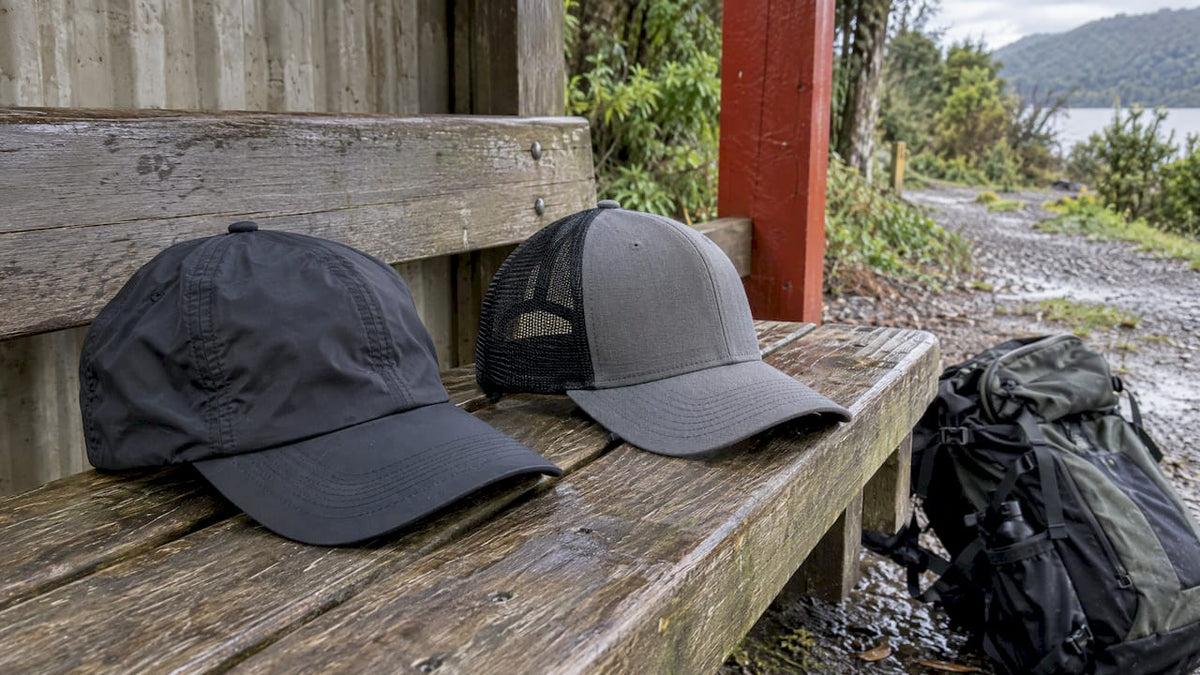
Pick polyester if you want a cap that stays cool, dries fast and holds its shape through sweat, sun and repeated washing. Pick nylon if you want a lighter, tougher cap that packs into a bag, handles rough use and shrugs off scuffs. Neither fabric is waterproof on its own, and neither is a bad choice. The right one depends on how you wear the cap, and the sections below show how to match fabric to use.
This guide is for Kiwis choosing between the two synthetics on a product page: the daily commuter cap, the tramping hat, the cap for the sideline or the beach. It covers how each fibre behaves, where the difference shows up in real wear, what to check on the label and how to look after each one. If you already know what you need, our baseball caps and bucket hats are the place to start.
TL;DR
- Polyester: best for hot, sweaty days and sport. It absorbs very little water, dries fast, keeps its shape and holds colour better in strong sun.
- Nylon: best for travel, hiking and rough use. It is stronger at a lower weight, tears less easily and crushes into a pocket and springs back.
- Weather: neither fibre is waterproof by itself. A coating or a membrane in the cap’s construction decides how it copes with rain.
- Care: wash both cool, air dry and keep them away from hot irons and dryers. Nylon softens under high heat.
- Sun: a fabric does not make a hat sun-safe. The brim does, so match the style to the job.
Table of Contents
- Nylon and polyester at a glance
- Why polyester suits hot, sweaty days
- Why nylon suits travel, hiking and rough use
- Rain, drizzle and waterproofing
- Sun, UV and what a fabric cannot do
- Which fabric for which wearer
- What to check before you buy
- Does price differ between nylon and polyester?
- Caring for nylon and polyester caps
- Our view on nylon, polyester and the cap you will actually wear
- Find your cap at Urban Caps
- FAQ
- Sources
Nylon and polyester at a glance
Both fabrics are synthetic, made from petroleum-based polymers and spun into fine threads. Both are lighter than cotton or wool, both resist wrinkling and both are common in baseball caps, bucket hats, boonies and cheesecutter caps. In a shop they can look almost identical. The difference is in how they behave when you sweat, get rained on, stuff the cap in a bag or leave it on a dashboard.
| What you notice | Polyester | Nylon |
|---|---|---|
| Water absorption | Very low | Higher |
| Drying time | Very fast | Slower |
| Strength and tear resistance | Good | Stronger at the same weight |
| Weight and packability | Light, holds structure | Lighter, soft and crushable |
| Sun fade | Holds colour longer | Can fade faster in strong sun |
| Shape after washing or folding | Returns to shape | Stable, but heat can distort it |
| Typical feel | Structured, slightly stiffer | Smooth and slippery |
This table follows the comparison in JoinTop’s guide to nylon and polyester caps, which finds polyester dries quickly and resists UV better, while nylon is stronger and more abrasion resistant but holds more moisture. Fabric is only part of the story. Weave, weight, lining and finish change how any one cap performs, so treat the table as a starting point.
Why polyester suits hot, sweaty days
Polyester is hydrophobic, which means it repels water rather than soaking it up. Sweat moves along the surface of the fibre and evaporates instead of sitting in the fabric. That is why polyester is the usual choice for moisture-wicking summer caps, especially when it is woven as an open mesh that lets air pass through the crown.
Breathability has two parts. Air has to get through the fabric, and moisture has to be pulled away from your skin. A cap with only airflow can feel drafty but clammy. A cap that wicks but blocks air can trap heat. Polyester mesh does both jobs, which is why trucker-style caps use it in the back panels. Ripstop nylon is reasonably breathable for a woven fabric, but it does not match polyester mesh for keeping a hot head cool.
There is a practical side to quick drying too. New Zealand outdoor maker Below The Kōwhai notes that staying wet can leave you cold, which is why it points to quick-drying polyester for outdoor clothing. A cap that is soaked with sweat after a morning run, then dries in the sun by lunchtime, is doing its job. A cap that stays damp under a pack strap all day is not.
Shape and colour
Polyester has what fabric people call memory: it returns to its shape after folding, crushing or washing. That is useful for a structured baseball cap with a firm front panel, because the crown keeps its profile. It also holds dye well under UV light, so a navy or black polyester cap tends to stay navy or black through a long Kiwi summer. If you wear one cap almost every day, this staying power matters.
Lab-style shrink tests from a cap maker, Leeline Promotion’s 20-wash tests, put polyester shrinkage at about 0.6% and a 70D Taslan nylon at about 0.8%. Both are small. In everyday terms, neither fabric shrinks the way cotton or wool can, so the risk in the wash is heat and brim damage, not the cap getting smaller.
Why nylon suits travel, hiking and rough use
Nylon is the stronger fibre for its weight. In one cap-material guide, Hongyuecap’s hat material comparison, nylon scores 5 out of 5 for abrasion resistance against 4.5 for polyester, and ripstop nylon weighs around 30% less than polyester of equivalent strength. Ripstop is a weave with thicker threads running through it in a grid, so a small snag or tear does not spread.
That is why nylon dominates packable hats. You can scrunch a nylon boonie into a jacket pocket or the top of a pack, pull it out at the carpark and it springs back. It also copes with pack rub, branches and the general knocks of a trail better than a lighter polyester mesh.
Nylon has two weak spots worth knowing:
- It holds more water. It dries slower than polyester, so a nylon cap that gets sweaty or wet will feel damp for longer.
- It can fade faster in strong sun. Polyester generally keeps its colour better, so a bright nylon cap left in New Zealand summer light may soften in tone sooner.
These are reasons to choose the fabric for the right job, not reasons to avoid it. A nylon boonie in a day pack is an excellent pick. If you want a cap that is stronger, lighter and ready for outdoor days, our Sampson nylon boonie hat with breakaway chin cord is built around that fabric.
Rain, drizzle and waterproofing
This is where most buyers get misled. Neither nylon nor polyester is waterproof as a raw fibre. What decides how a cap handles rain is the finish and the build:
- A DWR coating (durable water repellent) makes water bead on the surface. It copes with light drizzle and wears off with time and washing.
- A waterproof membrane with taped seams blocks rain completely. It is rare in everyday caps and shows up mostly in technical rain hats.
The same JoinTop guide makes this point: a coating on either fabric resists only light rain, and genuine waterproofing needs a membrane plus sealed seams. In practice, a tightly woven ripstop nylon with a water-repellent finish is the common pick for a rain hat. Polyester gets wet less and dries faster, so for a sudden shower on the way to the bus stop it often ends up the more comfortable cap, because it is dry again by the time you are inside.
A simple way to think about it in a Wellington or Auckland showery week: if you want a cap that sheds a passing shower, look for a nylon with a repellent finish. If you want a cap that recovers quickly after getting damp, polyester is the better bet. If you want to keep rain off a wool hat, we have a separate guide on making a wool hat water resistant.
Sun, UV and what a fabric cannot do
Polyester resists UV degradation better than nylon, which is why it holds colour longer. That is a fabric-ageing point, though, not a sun-safety point. How well a hat protects your skin depends mostly on its shape.
SunSmart New Zealand says a sun-protective hat should cover the face, head, neck and ears. For adults, it says a broad-brimmed hat needs a brim of at least 7.5 cm, and a deep-crown bucket hat needs a brim of at least 6 cm. Legionnaire-style hats with flaps over the ears and neck are also recommended. For children aged 0 to 8, the minimum brim is 5 cm for both hat types.
So if sun protection is the job, choose the style first and the fabric second. A polyester or nylon bucket hat or boonie with a proper brim does the work. Our bucket hats range and the Sampson nylon boonie both suit that job. For a closer look at fabric and UPF on a cap, see our guide on cotton or polyester caps and what to check.
Which fabric for which wearer
Here is how the choice plays out for the kinds of buyers we serve.
Commuters and streetwear wearers
You want a cap that keeps its shape, keeps its colour and gets worn almost every day. Polyester is the safer pick: the crown holds, the logo and embroidery sit flat and colour stays put. Browse the baseball caps for structured styles.
Sport and gym
Sweat is the problem here, so polyester wins. Fast drying and wicking keep the cap light on the head, and the fabric does not hang on to moisture. Mesh panels add airflow.
Tramping, fishing and travel
Nylon wins on strength, weight and packability. A hat that squashes into a pocket and takes scrapes without tearing is what you want. Clip-on chin cords matter on windy days, which is why the Sampson boonie comes with a breakaway chin cord.

Beach and boat days
Polyester dries fast and resists fading, so it copes with repeated sun and sweat. A nylon bucket hat is a fine second choice for its lightness, but expect it to stay damp longer after a swim or splash.
Kids
Kids lose caps, sit on them and wash them often. Polyester’s shape retention and quick drying fit that routine. See our kids caps for sizes made for smaller heads.
Style-led buyers
If you care more about the look, polyester is the common fabric in knit and woven fashion hats, and it holds a crease or shape cleanly. Our polyester knit trilby hat is an example. Smooth nylon suits a sleeker, more technical look.

What to check before you buy
The fibre name on the label is only the start. Look at these things:
- The full fabric content. A cap labelled polyester might be a blend. Check the main shell, the mesh and the lining, because they are often different.
- Weight. Cap shells are commonly in the 150 to 180 gsm range (grams per square metre), with typical polyester at 160 to 180 and nylon at 150 to 170, according to JoinTop’s baseball cap materials guide. Heavier feels sturdier, lighter feels cooler.
- Weave. Ripstop and tight weaves resist tearing. Open mesh breathes.
- Finish. A water-repellent coating helps in drizzle. A plain finish dries faster and feels more natural on the skin.
- Sweatband and lining. This is where sweat meets fabric. A soft, absorbent band under a quick-drying shell is a comfortable combination.
- Brim and structure. A firm brim and stitched panels keep the shape. For sun cover, brim width matters more than fibre.
- Closure and fit. Adjustable straps and chin cords stop a good fabric being wasted on a cap that blows off.
If you are choosing between nylon and canvas rather than nylon and polyester, our guide to canvas versus nylon hats covers that comparison for NZ conditions.
Does price differ between nylon and polyester?
In manufacturing, yes. Hongyuecap’s guide puts nylon at roughly US$2.40 to $3.00 per unit free on board at 500 pieces, about 50% more than polyester at US$1.50 to $1.85. Those are wholesale factory figures from that guide, not retail prices, and they will not map directly onto what you pay for a finished cap. The takeaway is that nylon costs more to make, so a nylon hat usually earns its price through strength and packability, not through looking different.
Caring for nylon and polyester caps
Both fabrics are easy to look after, and the main enemy of both is heat. Nylon softens at roughly 150°C and melts in a range of about 215 to 260°C, and polyester melts a little higher, at roughly 250 to 290°C, according to this fabric heat guide. A hot iron, a hot dryer or a sun-baked car dashboard can distort either one, so treat heat as the thing to avoid.
A simple routine:
- Spot clean first. Use a soft cloth, lukewarm water and a little mild detergent on sweat marks, especially around the band.
- Wash cool and by hand. Do not put a structured cap through a hot machine cycle. Our guide to washing a baseball cap without ruining the brim walks through it step by step.
- Use a cap frame if you have one. The dishwasher method in our 10 step dishwasher guide keeps the crown shape.
- Air dry away from direct heat. Stuff the crown with a clean towel to hold the shape, and leave it somewhere shaded and ventilated.
- Never iron the fabric directly. If you must smooth a crease, use steam from a distance or a cool setting with a cloth between.
- Protect embroidery. Turn the cap carefully and avoid scrubbing stitched logos. See how to wash and store embroidered caps.
Polyester dries fastest, so it forgives a rushed wash. Nylon needs a little more time to dry fully, so do not pack a damp nylon cap away.
Our view on nylon, polyester and the cap you will actually wear
We do not think there is one best fabric. There is a best fabric for the way you wear a cap.
We are NZ owned and operated, and we stock a large, curated range of caps, bucket hats, beanies, fedoras, newsboy caps and more, in polyester, nylon, cotton, wool and leather. That range exists because Kiwis wear hats in very different places: on a site, on a trail, at the beach, on the sideline and on a Friday night out.
Our rule of thumb is simple. If you sweat, wash your cap often or want colour that lasts, start with polyester. If you carry your hat in a bag, move through scrub or want something light and tough, start with nylon. Then check the brim, the closure and the fit, because a well-made cap in the wrong shape will sit in a drawer.
We would rather you pick the cap that fits your week than the one that looks good in a photo. Our care guides and fit advice are there for the same reason: a good cap should last.
Urban
Find your cap at Urban Caps
If you have decided which fabric suits you, the quickest next step is to browse by style. Our baseball caps, bucket hats, cheesecutter caps and newsboy caps cover everyday, outdoor and fashion wear, and there are kids caps too. We offer free shipping within New Zealand and Australia, and we are NZ owned and operated.

Start at urbancaps.co.nz and filter down to the style that suits how you wear it.
FAQ
Is nylon or polyester better for a cap?
Polyester is better for hot, sweaty or sporty wear because it absorbs little water, dries quickly and holds colour. Nylon is better for travel and rough outdoor use because it is stronger and lighter and packs down small. For an everyday cap, either works well, so choose by how you use it.
Are nylon or polyester caps waterproof?
No, not on their own. Water resistance comes from a coating or membrane added to the fabric. A repellent coating handles light drizzle and wears off over time, and a membrane with taped seams is what blocks heavy rain. Polyester also dries faster after a shower, which helps in changeable weather.
Which is more breathable for summer?
Polyester, especially as an open mesh. It wicks sweat away from the skin and lets air through the crown. Ripstop nylon breathes reasonably well for a woven fabric but is less cool in hot, humid weather.
Can I wash a nylon or polyester cap?
Yes. Spot clean or hand wash in lukewarm water with mild detergent, then air dry away from heat with the crown supported. Avoid hot dryers and irons, because nylon starts to soften at around 150°C and polyester can also distort under high heat.
Will a nylon or polyester cap protect me from the sun?
The brim matters more than the fabric. SunSmart NZ recommends a hat that covers the face, head, neck and ears, with a brim of at least 7.5 cm for a broad-brimmed adult hat, or 6 cm for a deep-crown bucket hat. Pair a good brim with sunscreen and shade.
Sources
- JoinTop: nylon vs polyester for waterproof sports caps
- Breathable summer baseball cap fabric guide
- Below The Kōwhai: fabric guide for hiking and the outdoors
- Leeline Promotion: 20-wash shrink tests for cap materials
- Hongyuecap: cotton vs polyester vs nylon hat material guide
- SunSmart NZ: slap on a hat
- JoinTop: baseball cap materials guide
- Moda Material: nylon heat resistance


Leave a comment
This site is protected by hCaptcha and the hCaptcha Privacy Policy and Terms of Service apply.