


3 Packability Checks for Travel Hats NZ Buyers Should Use
For most trips, choose one packable sun hat with a crushable fibre, a wired or stitched brim, and a UPF 50+ label, then add a compact knit beanie or felt hat for cold legs of the journey. Check listings for those three packability signals before you buy anything. Pack the sun hat crown down with clothing stuffed inside, and clip wide brims to your bag rather than folding them flat.
TL;DR:
- Genuine packability depends on fibre memory and brim construction, with wired or stitched brims being the clearest indicator of travel-ready hats.
- Lightweight synthetic and tri-braided paper straw hats with UPF 50+ and at least 7.6 cm brims are best suited for most travel climates and conditions.
- Proper packing involves crown-down placement, stuffing the crown, and surrounding the hat with soft clothing to prevent creases during transit.
- Wearing a soft, packable hat on the plane can save space and maintain shape, while structured hats should be carried with a rigid carrier or clip.
- Regular brushing, spot cleaning, and reshaping with warm fibres help extend a hat’s lifespan during travel, avoiding deep cleaning methods that damage fibres.
Table of Contents
- Travel hats guide: matching the right style to your trip
- How do you know a hat is actually packable?
- How do you pack a hat without ruining it?
- How do you care for a hat so it lasts the whole trip?
- Which hat suits which trip?
- Why Urbancaps knows travel hats
- Getting the fit right for a full day of wear
- Do you need a strap to keep a hat on while travelling?
- Where should a hat live inside your luggage?
- Does hat weight actually matter for packing?
- The real problem with most travel hat advice
- Travel-ready hats worth packing this trip
- Sources
- FAQ
Travel hats guide: matching the right style to your trip
A travel hats guide only earns its name if it tells you which shape does which job. Every hat style trades off brim coverage, breathability, and how well it survives being crushed at the bottom of a duffel bag. Get the style right first, because no amount of clever packing fixes a hat that was wrong for the climate in the first place.
Sun hats (wide-brim straw, paper braid, or technical fabric) are the default for beach days, market wandering, and anywhere the sun sits high. Look for a brim of at least 7.6 cm, which Sunsmart recommends as the minimum for genuine face and ear coverage, plus a stated UPF rating on the swing tag. Fit-wise, a slightly looser crown with an internal drawcord beats a snug one, since heat and humidity make heads swell a little over a long day out.
Bucket and boonie hats sit close to the head, shrug off rain better than straw, and pack almost flat because there’s no rigid brim to protect. They’re the pick for hiking, fishing, or festival weekends where you want sun cover without fuss. The buying cue here is fabric weight: a lightweight nylon or cotton blend with mesh eyelets breathes; a heavier canvas one gets sweaty fast and takes longer to dry.
Baseball caps and visors protect the face but leave ears and neck exposed, so they suit shorter outdoor bursts, city walking tours, or driving, rather than a full beach day. A curved, structured brim holds its shape well in a daypack, and an adjustable strap at the back matters more here than almost any other style, since caps run smaller than most people expect.
Beanies and felt hats cover the cold-weather and city-style end of the spectrum. A knit beanie is the simplest packable option for flights, ski trips, or shoulder-season travel where warmth matters more than sun protection, while a crushable felt fedora or trilby adds a layer of style for evenings out. On a product page, check whether a felt hat is explicitly labelled “crushable” or “travel” felt. Standard felt holds its shape well at home but can develop a permanent dent if you fold it the wrong way in transit.
Quick reference for what to look for on the page before you buy:
- Sun hats: brim width stated, UPF number listed, wired or stitched brim edge mentioned
- Bucket/boonie: fabric weight, mesh venting, adjustable chin cord
- Caps/visors: curved brim structure, back strap adjustability, moisture-wicking sweatband
- Beanies/felt: “packable” or “crushable” callout, fold lines pre-set into the felt, wool percentage
How do you know a hat is actually packable?
“Packable” gets printed on a lot of tags that don’t deserve it. The real test is fibre memory, or how well a material springs back to its original shape after being compressed, rather than whether it merely bends without cracking. A hat that bends easily can still crease permanently once you sit on it for six hours on a bus.
Pack Lightly’s breakdown of packable sun hats makes the distinction well: tri-braided paper straw, raffia, and technical synthetic fibres all have genuine spring-back, while a lot of natural wheat straw does not. Engineered paper straw with a UPF coating tends to recover its shape quickly after rolling, whereas untreated natural straw shows a real risk of permanent creasing, according to Hikesity’s testing of packable UPF straw hats. That’s the gap between a hat that survives a fortnight of travel and one that looks tired by day three.
Here’s how the main materials stack up against each other:
- Raffia and paper straw: excellent packability and breathability, but only moderate water resistance, so a sudden downpour will need a quick shake-dry rather than a soak
- Technical synthetics (woven polyester, treated nylon blends): the strongest all-rounder, with decent water resistance and reliable crush recovery, though breathability is a notch below natural fibres
- Wool felt: the best structure and the most style range, poor packability unless specifically labelled “crushable” felt, and slow to dry if it gets wet
A wired or stitched brim edge is the single clearest signal a hat was designed to be packed, not just worn. It lets the brim flex under pressure and then pull back into shape once the pressure’s off, instead of creasing along a random line.
Statistic callout: Sunsmart treats a brim of about 7.6 cm (3 inches) as the useful minimum for real face and ear coverage. Anything narrower is more fashion accessory than sun protection.
If a product listing doesn’t mention brim width, UPF rating, or brim construction, treat that as a gap, not an oversight. Reputable packable hats state all three because they’re the actual mechanics of the claim, not marketing flourish.
How do you pack a hat without ruining it?
The “stuff and surround” method is the closest thing travel packers have to a universal rule for structured hats, and it works whether you’re carrying a straw sun hat or a felt fedora. Luggage Inspector’s packing guide lays out the logic clearly: protect the crown from the inside, then cushion it from the outside.
- Place the hat crown-down in your suitcase, on top of a folded layer of soft clothing, never loose against the case wall.
- Stuff the crown firmly with socks, underwear, or a rolled t-shirt, filling it enough that the sides can’t collapse inward.
- Fold or roll a soft brim loosely around the crown in one gentle cylinder shape, rather than creasing it flat.
- Surround the whole hat with more clothing packed snugly on every side, so nothing shifts during transit.
- Nest a second hat inside the first if you’re travelling with two, provided both crowns are stuffed separately first.
- Position the bundle centrally in the suitcase, away from the hinges and wheels where impact concentrates.
- Close the case slowly, checking nothing has been pushed sideways before you zip it shut.
Rolling only works for genuinely crushable fibres. Roll a packable straw or synthetic brim into a loose cylinder rather than creasing it into a sharp fold; a sharp fold is exactly the kind of stress line that fibre memory can’t always undo. Wool felt behaves differently again, so a light roll along its natural fold lines beats any attempt to flatten it.
Wide or rigid brims that won’t roll at all need a different plan. Wearing the hat through the airport is the simplest option and costs nothing. A hat clip attached to your bag strap keeps a structured brim off your head and out of your suitcase entirely, and a dedicated rigid hat carrier is worth the extra piece of luggage if you’re travelling with a single expensive hat and nothing else to protect it.
Experienced packers generally agree that immobilising the hat matters more than any specific accessory. Cushioning it centrally with soft clothing on every side does more work than a fancy case, because movement, not pressure alone, is what creases a brim.
Pro Tip: If a hat comes out of your suitcase slightly crushed, don’t panic and don’t force it back into shape cold. Unpack it immediately, hang it in a steamy bathroom for a few minutes, then reshape the brim gently by hand while the fibres are warm and pliable.
How do you care for a hat so it lasts the whole trip?
Daily habits do more for a hat’s lifespan than any single deep clean. Brush straw and felt lightly each evening to lift dust before it works into the fibres, and let a sweaty hat air out fully before you pack it again the next morning. Never zip a damp hat into a suitcase pocket; the moisture has nowhere to go and mildew sets in faster than most travellers expect.
Oil stains, usually from sunscreen or hair product along the sweatband, respond best to an absorbent like cornstarch or talc pressed gently into the mark and left overnight before brushing off. For everything else, spot clean with a barely damp cloth and a touch of mild soap, working in small circles rather than scrubbing.
Reshaping is where most damage happens. GQ’s hat-care advice is blunt on this point: skip the washing machine and the dishwasher entirely for structured hats, both of which are surprisingly common suggestions online and both of which ruin brim shape permanently. Lightly dampen the felt or straw by hand instead, reshape the crown and brim with your fingers, and let it air dry on a rounded support, like a bowl or a hat form, so it dries into the correct curve rather than flat.
Practical care guidance for delicate straw echoes the same caution: avoid heavy moisture exposure altogether, and save deep cleaning for when it’s genuinely needed rather than after every wear, since over-cleaning straw wears down the fibres faster than dust does.
- Brush straw and felt each evening; never store a hat damp
- Treat oil marks with cornstarch or talc, left overnight
- Spot clean with a barely damp cloth, not a soaked one
- Reshape by hand while slightly damp, then air dry on a rounded form
- Skip the washing machine and dishwasher completely
Which hat suits which trip?
Matching the hat to the itinerary is the fastest way to stop overthinking your packing list. Each scenario below leans on a different trade-off between weight, breathability, and weather resistance.
- Beach holidays: a paper straw or raffia sun hat with a 7.6 cm+ brim; breathability matters more than water resistance here, since you’re mostly dry and hot
- Hiking and trekking: a boonie or technical synthetic hat with a chin cord; wind resistance and quick-dry fabric beat brim width if the terrain gets exposed
- City sightseeing: a structured cap or a crushable felt fedora; lower sun exposure means style and comfort during long walking hours take priority
- Cold-weather travel: a wool or acrylic knit beanie, packed flat with almost no bulk cost; warmth per gram is the only metric that matters
- Flights: a soft beanie or a packed-away sun hat, never worn through security screening for practical reasons, and stuffed into carry-on rather than checked luggage
For a mixed itinerary spanning several of these, a single technical synthetic sun hat with a stitched brim and UPF 50+ is the strongest baseline. It survives more climates than straw, packs flatter than felt, and handles the odd rain shower that would otherwise ruin a natural fibre. Add one knit beanie for cold legs, and you’ve covered nearly every scenario above with two hats instead of four.
Why Urbancaps knows travel hats
Urbancaps built its catalogue around premium headwear that has to survive real conditions, not just a studio photo shoot, and the site backs that with fast NZ delivery so travellers aren’t waiting weeks before a trip. Urban has written a series of hands-on guides on the Urbancaps blog covering how to select, style, and maintain hats across materials from wool felt to woven straw.
The advice in this guide reflects the same principle behind Urbancaps’ product range: a hat’s packability is a construction detail, not a slogan on a swing tag. Customers shopping the Australian heritage collection and the everyday travel range have flagged brim structure and crown depth as the details that matter most once a hat leaves the shop and heads into a suitcase.
That focus on the construction behind the label, rather than the label itself, is what separates a hat that survives six flights from one that doesn’t make it past the first.
Getting the fit right for a full day of wear
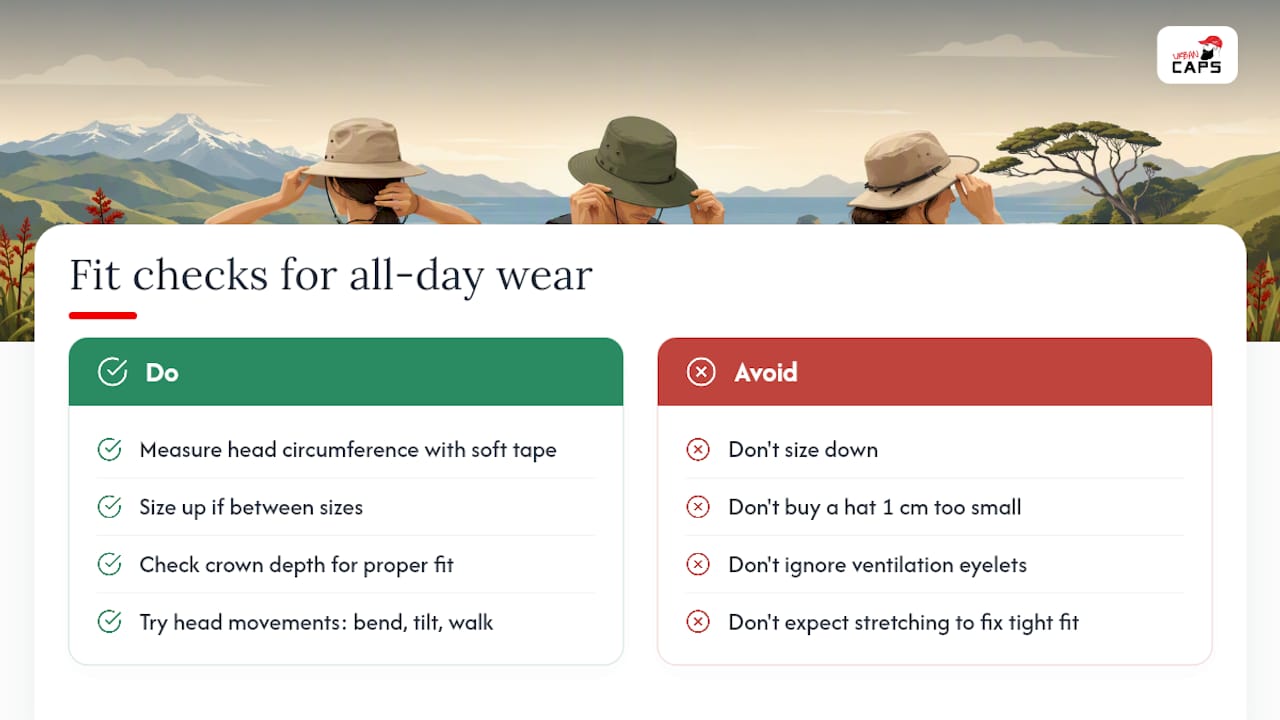
A hat that fits well at the counter can still feel wrong four hours into a walking tour. Head circumference is the number that actually matters, measured with a soft tape around the widest part of your head, just above your ears and eyebrows. Most hat sizing charts run in centimetres, and a hat sitting even a centimetre too small will leave a red line and a headache by mid-afternoon.
Crown depth matters almost as much as circumference, particularly for felt hats and fedoras, since a shallow crown perches awkwardly while a deep one sits too low over the eyes. If you’re between sizes, size up rather than down. A slightly loose hat can be tightened with a folded strip of tissue or foam tucked inside the sweatband, but a tight hat has no fix short of stretching it, which risks damaging the shape.
Ventilation eyelets, common on boonie hats and technical sun hats, do more for comfort over a long day than the fabric weight itself. They let heat escape from the crown, which matters more in humid climates than most buyers expect when comparing hats online. For beanies, a snug but stretchy knit sits better under a hood or hat clip than a rigid weave, since it moves with your head rather than against it.
Try any hat on with the kind of movement you’ll actually be doing, tilting your head back, bending down, walking briskly, rather than just checking it in a mirror. A hat that stays put through that test will stay put on the trail or the ferry deck.
Do you need a strap to keep a hat on while travelling?
Wind is the enemy of every wide-brim hat, and a chin strap or cord is the simplest fix. Boonie hats and technical sun hats typically come with an adjustable cord that sits under the chin or behind the head, and it’s worth tightening it before you set off rather than fumbling with it once a gust hits.
Elastic drawcords inside the crown, rather than external chin straps, are common on packable sun hats and let you cinch the fit without any visible strap at all, useful if you’d rather the hat looked clean for photos. For felt fedoras and trilbies, a strap generally isn’t part of the design, so wind resistance depends more on a snug crown fit than any add-on.
For genuinely active travel, hiking, cycling, boat trips, a hat clip that tethers the hat to your bag or collar is a smart backup even when the hat has its own strap. It means a sudden gust costs you nothing worse than the hat swinging on its clip rather than disappearing over a cliff edge or into a harbour. A clip like this also doubles as a way to carry a hat hands-free once you’ve taken it off, which matters more than people expect once you’re juggling a camera, a water bottle, and a map at the same time.
Baseball caps rely on their rear adjuster strap for fit rather than wind retention, so if you’re wearing one somewhere genuinely windy, a clip is still the better safeguard than trusting the brim alone.
Where should a hat live inside your luggage?
Storage during transit is really about giving the hat a fixed position it can’t move out of, since movement, not pressure, is what causes most creasing. A rigid hat carrier is the gold standard for one valuable or hard-to-replace hat, holding its shape completely independent of everything else in the case.
For most travellers carrying a packable sun hat or a beanie, the stuffed-crown method inside the suitcase, positioned centrally and surrounded by soft clothing, does the job without extra luggage. The middle of a suitcase, away from wheels, hinges, and the edges most likely to take an impact, is consistently the safest spot.
Carry-on storage works differently. A beanie can go straight into a jacket pocket or a packing cube with zero risk. A packable sun hat is safer in the main compartment of a daypack, crown stuffed and brim rolled, than clipped externally where it can catch on doorways or overhead lockers.
Between destinations, mid-trip, a hat that’s not being worn that day is often safest simply worn loosely around the neck by its strap, or clipped to a daypack, rather than repacked and unpacked repeatedly. Every pack cycle is another chance for the brim to crease in a new spot, so minimising how often a hat goes in and out of a case is a genuinely underrated protection strategy.
Does hat weight actually matter for packing?
Weight rarely breaks a packing list on its own, but it adds up faster than travellers expect once you’re juggling airline carry-on limits. A packable straw or synthetic sun hat typically weighs next to nothing, while a full wool felt fedora carries noticeably more heft, especially with a wide brim and a thick band.
The bigger issue isn’t the hat’s weight in isolation, it’s the space it claims relative to that weight. A stuffed, rolled sun hat compresses down to almost nothing per gram. A rigid felt hat that can’t be crushed takes up a fixed volume of suitcase space no matter how light it is on the scale, which is the real argument for choosing crushable fibres on a trip where every litre of carry-on space is contested.
If you’re travelling with carry-on only, prioritise one packable, lightweight hat over a heavier structured one, and consider wearing the heavier hat through security instead of packing it. That single decision, wear it or pack it, often does more for your luggage weight than agonising over grams on a product spec sheet.
The real problem with most travel hat advice
Most travel hat advice treats “packable” as a promise rather than a construction detail, and that’s backwards. A hat’s ability to survive a suitcase comes down to fibre memory and brim edge construction, full stop, and no amount of clever folding technique rescues a hat made from the wrong material.
The conventional wisdom oversells natural straw because it looks the part in holiday photos, while underselling engineered synthetics that actually recover their shape after being crushed for a week. If there’s one thing worth prioritising above brim width, style, or even UPF number, it’s checking whether the brim edge is wired or stitched, because that single detail predicts more about a hat’s travel survival than anything printed on the swing tag.
Buy fewer hats, buy the right two, and read the construction details before the marketing copy, as suggested in this travel capsule wardrobe for women guide. A crushable felt fedora built for travel and a packable sun hat with a genuine spring-back fibre will outlast a wardrobe full of hats bought on looks alone.
— Urban
Travel-ready hats worth packing this trip
Once you know what makes a hat genuinely packable, the shopping part gets simple. For cold flights, ferry decks, or shoulder-season city breaks, the Fashion Knit Beanie folds flat into a jacket pocket and adds warmth without any bulk cost. If you want something thicker for genuinely cold climates, the Winter Bonnet Beanie trades a little packability for real insulation, while the Classic Knit Beanie keeps things simple for travellers who want one hat that matches everything in the suitcase.

For style-focused city trips, the Fedoras Hat and the Churchill Heritage Homburg Hat, crafted from Australian wool felt, both hold their shape through evenings out while still surviving a properly stuffed suitcase. Heading somewhere genuinely cold and exposed, the Dakota Heritage Wool Rancher Hat and the Thunderbolt Ski Hat, with its built-in ear protection, cover the western-style and snow-sport ends of the wardrobe respectively. For a milder cold-weather look, the Heritage Herringbone Ivy Cap packs flatter than a felt hat while still reading as a proper winter piece.
None of that solves the wide-brim problem on its own, which is where the Cap Clip earns its spot in your kit, tethering a hat to your bag strap so it survives the walk between the taxi and the check-in counter without a scratch. Not sure which size to grab? Check the sizing guide on any product page before you order, and with fast NZ delivery, there’s time to swap it before you fly.
Sources
FAQ
What is the best travel hat for most trips?
A packable sun hat made from crushable paper straw or technical synthetic fibre, with a UPF 50+ rating and a brim of at least 7.6 cm, suits most travellers, backed up by a compact knit beanie for cold legs of the trip.
What is the best way to pack hats in a suitcase?
Place the hat crown down, stuff the crown firmly with socks or rolled clothing, roll any soft brim loosely rather than folding it flat, then surround the whole hat with soft clothing in the centre of your case.
Should you wear a hat on a plane?
Wearing a soft beanie or packable hat on board is fine and saves suitcase space, though most travellers remove wide-brim or structured hats before security screening for practicality rather than any rule against it.
What are some good foldable hats for travel?
Look for hats labelled with a stated UPF rating, a wired or stitched brim edge, and a crushable fibre like tri-braided paper straw or technical synthetic weave, since those three details are the real markers of genuine foldability rather than the word “packable” alone.