

What is a beret: history, styles, and how to wear one
TL;DR:
- A beret is a soft, round, flat-crowned hat made from wool or felt that has a long history of practical and cultural significance. It originated as workwear for shepherds in the Pyrenees and became a symbol of artistic, military, and revolutionary identity across centuries. Proper wearing involves fitting it snugly with an angled drape to create versatile and stylish looks.
A beret is defined as a soft, round, flat-crowned hat traditionally made from wool or felt, worn close to the head without a brim. It stands apart from almost every other hat style because it has served shepherds, soldiers, artists, and fashion icons across several centuries without changing its basic shape. If you want to understand what a beret is, you need to look at where it came from, what it means, and how to wear one well. This guide covers all three, with enough depth to satisfy anyone genuinely curious about one of fashion’s most enduring accessories.
What is the historical origin of the beret?
The beret originated as practical headwear for shepherds in the Pyrenees mountains between France and Spain, with roots tracing back to Bronze Age Europe. That is not a romantic exaggeration. Archaeological finds across Europe confirm that flat, round wool caps were worn thousands of years before the beret became a fashion item. The Pyrenean version simply survived and evolved because it worked.
How traditional berets were made
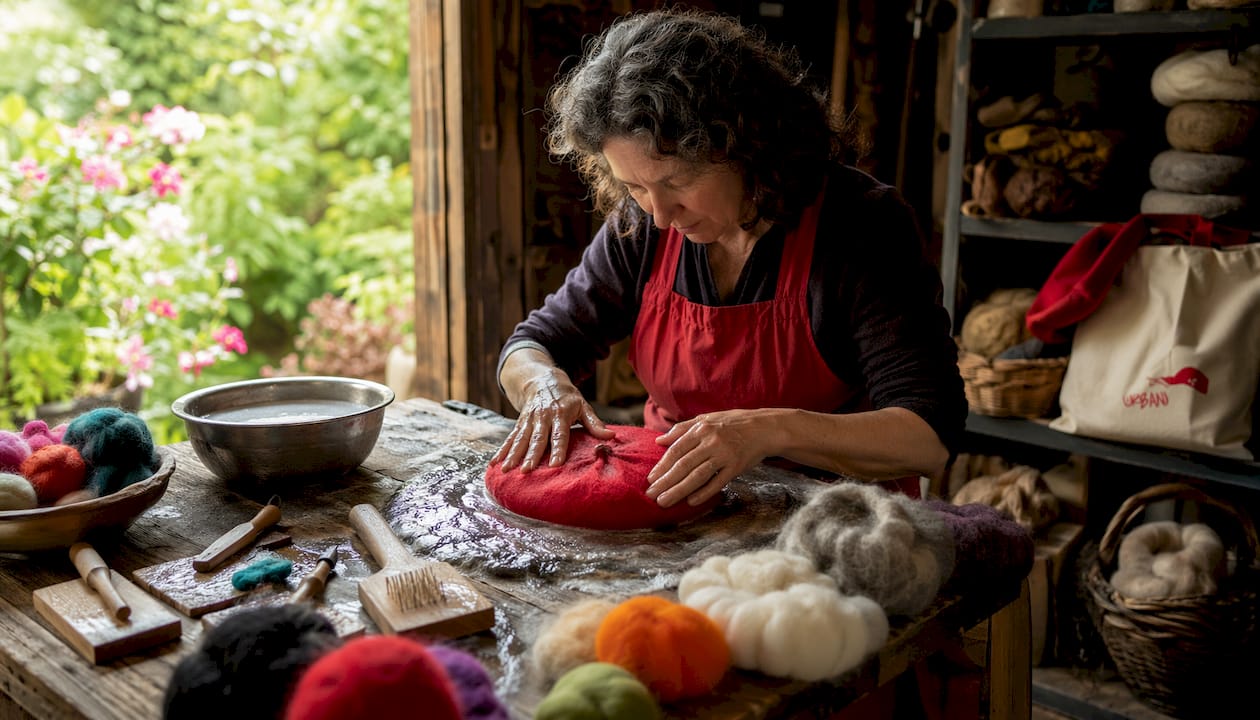
The manufacturing process explains why the beret lasted so long. Traditional beret manufacture relies on felting knitted wool, a process that compacts fibres until the fabric becomes dense, warm, and water-resistant. Shepherds working in wet mountain climates needed exactly that. A felted wool beret kept rain off the head without becoming waterlogged, and it packed flat into a coat pocket when not needed.
One detail most people miss is the small knot at the centre of the crown. Known as the cabillou, this knot is not decorative. It is a remnant of the felting process, the point where the hand-knitted fabric was gathered and compressed. A beret with a cabillou signals genuine traditional construction. That single detail separates a quality wool felt beret from a mass-produced imitation.
The transition from rural tool to cultural object happened gradually across the 19th century. Bohemian artists and intellectuals in Paris adopted the beret because it was cheap, practical, and visually distinct from the top hats and bowler hats worn by the bourgeoisie. Wearing a beret was a quiet statement about rejecting convention.
Key milestones in beret history:
- Bronze Age Europe: Flat wool caps documented across multiple archaeological sites.
- 17th century Pyrenees: Shepherds use felted wool berets as standard working headwear.
- 19th century Paris: Bohemian artists adopt the beret as a symbol of creative identity.
- Early 20th century: Mountain troops in European armies adopt the beret for its practicality in rugged terrain.
- Mid 20th century: Elite military units, revolutionary movements, and global fashion all claim the beret simultaneously.
Pro Tip: If you are buying a traditional wool beret, look for the cabillou knot on the crown. Its presence confirms the hat was made using genuine felting techniques rather than cut-and-sewn fabric.
The military adoption of the beret in the early 20th century was driven by the same logic that appealed to shepherds. The hat sat flat under a helmet, dried quickly, and could be shaped to fit any head. Mountain troops in France, Britain, and elsewhere standardised it as field headwear. From there, it spread to elite units across the world, and the beret’s association with discipline and skill began to form.
What are the different types of berets?
Berets vary more than most people expect. The basic silhouette stays consistent, but material, size, colour, and construction create genuinely different products suited to different purposes.
Materials and construction
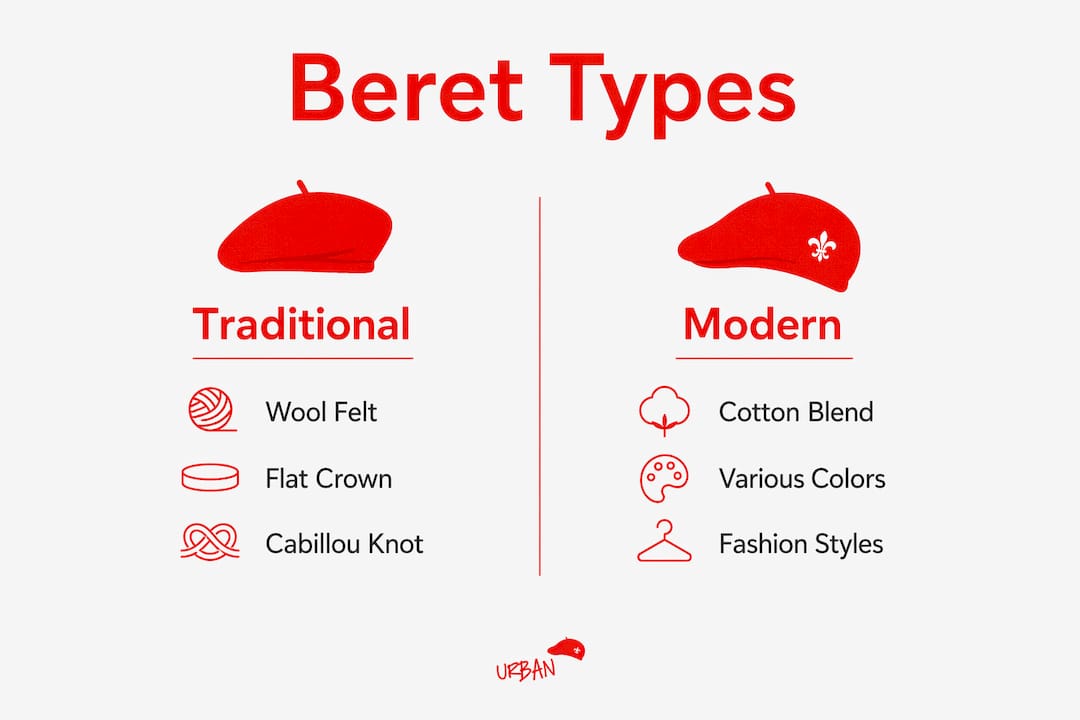
Wool felt remains the benchmark material for traditional berets. It holds its shape, resists moisture, and ages well. Modern berets may include synthetic fibres or cotton blends, and sometimes leather trims, which expands styling choices and lowers the price point. Cotton berets are lighter and better suited to warmer climates. Synthetic blends are easier to clean and hold colour more consistently. Leather-trimmed versions sit closer to fashion accessories than functional headwear.
The crown depth also varies. A shallow crown sits close to the skull and reads as more formal or military. A deeper, fuller crown gives the hat more volume and works better for the draped, angled styles associated with French fashion and artistic circles.
Colour and its meaning
Different beret colours historically identified different military corps and carry symbolic meaning. This is not a minor detail. In military contexts, the colour of a beret tells you exactly which unit a soldier belongs to. Green berets identify special forces in several armies. Red berets are associated with airborne and parachute units. Black berets carry the strongest association with elite status.
In civilian fashion, colour works differently. A classic black or navy beret reads as versatile and easy to style. Burgundy, camel, and forest green have become popular in contemporary fashion. Bright or unusual colours signal a more deliberate fashion statement.
Common beret types at a glance:
| Type | Material | Best suited for |
|---|---|---|
| Traditional wool felt | Felted wool | Cold weather, heritage styling |
| Military beret | Wool or synthetic | Uniform wear, structured looks |
| Fashion beret | Cotton or synthetic blend | Casual and seasonal styling |
| Leather-trimmed beret | Wool with leather band | Contemporary fashion statements |
| Oversized artist beret | Wool or acrylic | Draped, angled bohemian looks |
Wearing styles that change the look
The same beret can look completely different depending on how you position it. Worn flat and centred, it reads as military or utilitarian. Pulled to one side and angled down over the ear, it reads as French or bohemian. Pushed back on the head with the crown forward, it reads as casual and relaxed. The hat does not change. The angle does all the work.
What does a beret symbolize culturally and politically?
The beret carries more symbolic weight than almost any other hat. That weight comes from the specific groups who adopted it and the contexts in which they wore it.
The French identity question
The beret is globally recognised as a symbol of French identity, yet the beret is rarely worn in everyday life in France today. That gap between perception and reality is worth understanding. The beret became associated with France through a combination of rural tradition, artistic culture, and early 20th-century tourism. Visitors to France saw shepherds and artists wearing berets, and the image stuck. French people themselves largely moved on. The beret now thrives as a cultural symbol and fashion statement globally, while its domestic everyday use has faded.
Military symbolism and elite identity
Military black berets became symbols of elite status and specialised skills following practical use by mountain troops in the early 20th century. That association deepened over decades. Elite units like the Gurkhas and British Commandos adopted the black beret as a badge of honour and discipline. Earning the right to wear a specific coloured beret became a rite of passage in military culture. The hat stopped being just a hat. It became a credential.
“The beret symbolised unity, resistance, and identity beyond mere fashion. In the hands of revolutionary movements and military units alike, it communicated belonging, discipline, and a willingness to stand apart from the mainstream.”
Revolutionary and political appropriation
The beret’s most politically charged chapter belongs to the mid-20th century. The beret became a powerful symbol in revolutionary and social movements, most famously associated with figures like Che Guevara and groups like the Black Panther Party. Guevara wore a black military beret in nearly every iconic photograph, and that image became one of the most reproduced in the 20th century. The Black Panther Party adopted the black beret as part of a deliberate uniform designed to project unity and discipline.
Four distinct symbolic registers the beret occupies:
- Rural heritage: Practical headwear for working people in cold, wet climates.
- Artistic identity: A marker of bohemian culture and rejection of bourgeois convention.
- Military distinction: A credential indicating elite training and unit affiliation.
- Political resistance: A symbol of solidarity, defiance, and collective identity.
The beret’s ability to carry all four meanings simultaneously, without contradiction, explains why it has lasted. Few accessories can move between contexts that different without losing coherence. The role of hats in fashion more broadly follows a similar pattern, where function and symbolism reinforce each other over time.
How do you style and wear a beret?
Styling a beret well comes down to three things: fit, angle, and outfit pairing. Get those right and the hat works. Get them wrong and it looks like a costume.
Getting the fit right
A beret should sit snugly on the head without gripping. If it leaves a red mark on your forehead, it is too small. If it slides around when you move, it is too large. Most traditional wool berets have some stretch and will ease slightly with wear. Synthetic and cotton versions tend to hold their size more rigidly, so sizing matters more from the start.
Pro Tip: Dampen a wool beret slightly and wear it for 20 minutes to shape it to your head. The wool will mould to your skull as it dries, giving you a custom fit without any alteration.
Outfit pairing by season and occasion
The beret’s design has remained largely unchanged for centuries because its simplicity makes it adaptable. That same quality makes it easy to pair with a wide range of outfits.
Practical styling tips:
- Autumn and winter: Pair a classic wool beret with a trench coat, turtleneck, or chunky knit. Navy, black, and camel work with almost any colour palette.
- Spring: A cotton or lightweight wool beret in burgundy or forest green pairs well with linen shirts and tailored trousers.
- Casual looks: A relaxed cotton beret pulled slightly to one side works with jeans, a plain tee, and leather boots.
- Formal or smart-casual: A flat, centred wool beret in black or charcoal adds structure to a blazer outfit without competing with it.
- Men’s styling: Berets work particularly well with structured outerwear. A dark wool beret with a peacoat or overcoat reads as considered rather than costume-like.
- Women’s styling: Angled berets with midi skirts, wide-leg trousers, or layered knitwear are all strong combinations.
Caring for your beret
Wool felt berets need gentle handling. Hand wash in cold water with a wool-safe detergent, reshape while damp, and dry flat away from direct heat. Never put a wool beret in a tumble dryer. Cotton and synthetic berets are generally machine washable on a gentle cycle. Store berets flat or on a hat stand to preserve the crown shape. A well-maintained wool beret will last years. For readers who want to see how berets sit alongside other stylish headwear options, the comparison is useful for building a versatile hat wardrobe.
Key takeaways
The beret is one of the few accessories that has served as practical workwear, military insignia, artistic symbol, and fashion statement across several centuries without changing its fundamental shape.
| Point | Details |
|---|---|
| Core definition | A beret is a soft, round, flat-crowned hat made from wool, felt, or modern blends. |
| Historical roots | Pyrenean shepherds developed the felted wool beret for wet mountain conditions as early as the 17th century. |
| The cabillou knot | This small crown knot signals genuine traditional felting construction and indicates quality. |
| Symbolic range | The beret carries four distinct meanings: rural heritage, artistic identity, military distinction, and political resistance. |
| Styling principle | Fit and angle determine the look. The same beret reads differently depending on how it is positioned on the head. |
Why the beret still matters, in my view
I have spent years thinking about what makes certain accessories last while others disappear after a single season. The beret is the clearest example I know of a hat that earns its longevity rather than inheriting it.
What strikes me most is that the beret has never needed reinvention. Every decade, designers try to update it with new materials or proportions, and the result is almost always less interesting than the original. The flat crown, the soft wool, the slight drape to one side. That combination works because it is genuinely functional and visually distinctive at the same time. You cannot say that about many accessories.
The cultural symbolism is real, but I think it gets overplayed. People worry about whether wearing a beret makes them look like they are cosplaying a French stereotype or a revolutionary. That anxiety misses the point. The beret has been worn by too many different groups in too many different contexts to belong to any single identity. It is genuinely neutral in that sense. What you pair it with and how you angle it says far more than the hat itself.
The one thing I would push back on is the idea that berets are difficult to wear. They are not. They are actually one of the more forgiving hat shapes because the soft crown adjusts to your head and the lack of a brim means there is no awkward shadow or proportion problem to manage. If you have been hesitant, start with a classic black wool beret and wear it slightly to the side. That single adjustment does most of the work.
— Urban
Quality berets and headwear from Urbancaps
Urbancaps stocks a range of headwear built for Kiwis who want style and durability in the same package. Whether you are after a classic knit for cooler months or something with a bit more character, the range covers everyday wear through to fashion-forward picks.

If a beret has you thinking about warm, well-made headwear more broadly, the fashion knit beanie is a strong option for New Zealand winters. For something with more structure and personality, the classic knit beanie delivers a clean, minimalist look that pairs with almost anything. Urbancaps ships free within NZ, so finding your next favourite hat is straightforward. Browse the full range at urbancaps.co.nz.
FAQ
What is a beret made from?
Traditional berets are made from felted wool, which is dense, warm, and water-resistant. Modern versions use cotton blends, synthetic fibres, or wool with leather trims.
Where did the beret originate?
The beret originated among shepherds in the Pyrenees mountains between France and Spain, with historical roots tracing back to Bronze Age Europe.
What does the small knot on top of a beret mean?
The knot, called the cabillou, is a remnant of the traditional felting process. It indicates the beret was made using genuine hand-knitted and felted wool construction.
What does a beret symbolize?
A beret symbolises different things depending on context. It represents rural heritage, bohemian artistic identity, military elite status, and political resistance, depending on colour, context, and who is wearing it.
How do you wear a beret correctly?
Place the beret on your head and tilt it to one side, angling the crown slightly down toward one ear. The hat should sit snugly without gripping, and the drape to the side creates the most versatile and flattering look.