

Why high-quality fabrics matter: a shopper's guide
High-quality fabrics deliver longer wear, better comfort, superior appearance, and a lower lifetime environmental cost than cheap alternatives. That single claim shapes every smart buying decision, from a merino jersey to a cotton twill cap. The difference shows up in how a garment feels on day one, how it looks after fifty washes, and whether it ends up in a landfill or a second-hand shop.
Here is why it matters right now:
- Durability: quality fibres and tight construction resist pilling, abrasion, and shape loss far longer than low-grade equivalents.
- Comfort: natural and high-grade blended fibres breathe, regulate temperature, and feel better against skin.
- Appearance: colour holds, drape stays true, and seams keep their shape through repeated wear.
- Cost-per-wear: a more expensive garment worn 200 times costs less per wear than a cheap one worn 20 times.
- Sustainability: buying fewer, better-quality items that are actually worn reduces environmental harm across the full lifecycle.
Key takeaways
High-quality fabrics deliver better durability, comfort, and appearance while reducing cost-per-wear and environmental impact across a garment’s full lifecycle.
| Point | Details |
|---|---|
| Quality starts at the fibre | Longer-staple cotton and fine merino wool resist pilling and shape loss far longer than short-staple or low-grade alternatives. |
| Cost-per-wear favours quality | A $90 cap worn 150 times costs $0.60 per wear; a $30 cap worn 15 times costs $2.00 per wear. |
| NZ textile waste is significant | Only about 6.5% of consumed apparel in Aotearoa is recovered; roughly 76% goes to landfill, making durability a practical sustainability lever. |
| Care extends lifespan | Cold washing, airing between wears, and prompt repairs keep quality garments in active use and reduce replacement frequency. |
| Urbancaps | Stocks premium caps and hats in cotton twill, wool, and recycled polyester with reinforced construction for longer wear. |
Table of Contents
- What actually makes a fabric high quality?
- How high-quality fabrics change what you get from clothing
- How do you spot high-quality fabric when shopping?
- What does the evidence show about fabrics and sustainability in New Zealand?
- How do you care for high-quality fabrics so they last?
- Cost-per-wear: does quality actually save you money?
- Quick checklist for NZ shoppers at the point of purchase
- A New Zealander’s view on buying less and buying better
- Premium headwear that puts fabric quality into practice
- Sources
- FAQ
What actually makes a fabric high quality?
Fabric quality starts at the fibre level, long before a garment reaches a shop floor.
Fibre type and staple length are the foundation. Longer-staple cotton (such as Egyptian or Pima) produces smoother, stronger yarns with less surface fuzz. Merino wool, with its fine micron count, is soft enough for direct skin contact and resists pilling better than coarser wool grades. Short-staple fibres pill faster and wear through sooner.
Yarn construction builds on that foundation. A tighter twist produces a denser, more durable yarn. Thread count matters in wovens, but only up to a point: very high thread counts achieved by splitting yarns thin can actually weaken a fabric. In knits, gauge (stitches per inch) is the equivalent signal.
Fabric construction determines drape and resilience. A tightly woven twill or canvas resists abrasion better than a loose plain weave at the same weight. Knitted structures need good elasticity and recovery to avoid bagging at elbows and knees.
Finishes and treatments add performance but sometimes at a cost. Mercerisation strengthens cotton and improves dye uptake. Colourfast reactive dyes hold colour through washing far better than cheaper pigment prints. Anti-pilling treatments help in the short term but can wear off, leaving the underlying fibre exposed.
Blends are worth understanding carefully. A 98% cotton, 2% elastane blend keeps cotton’s breathability while adding stretch, which is genuinely useful in fitted garments and activewear. The trade-off is recyclability: mixed-fibre items are harder to process at end of life.
- Longer staple length = smoother yarn, less pilling
- Tighter yarn twist = stronger, more durable fabric
- Colourfast dyes = better wash-after-wash appearance
- Single-fibre construction = easier repair, recycling, and composting
Blends are a reasonable trade-off for performance, but check whether the blend is genuinely needed before accepting the recyclability cost.
How high-quality fabrics change what you get from clothing
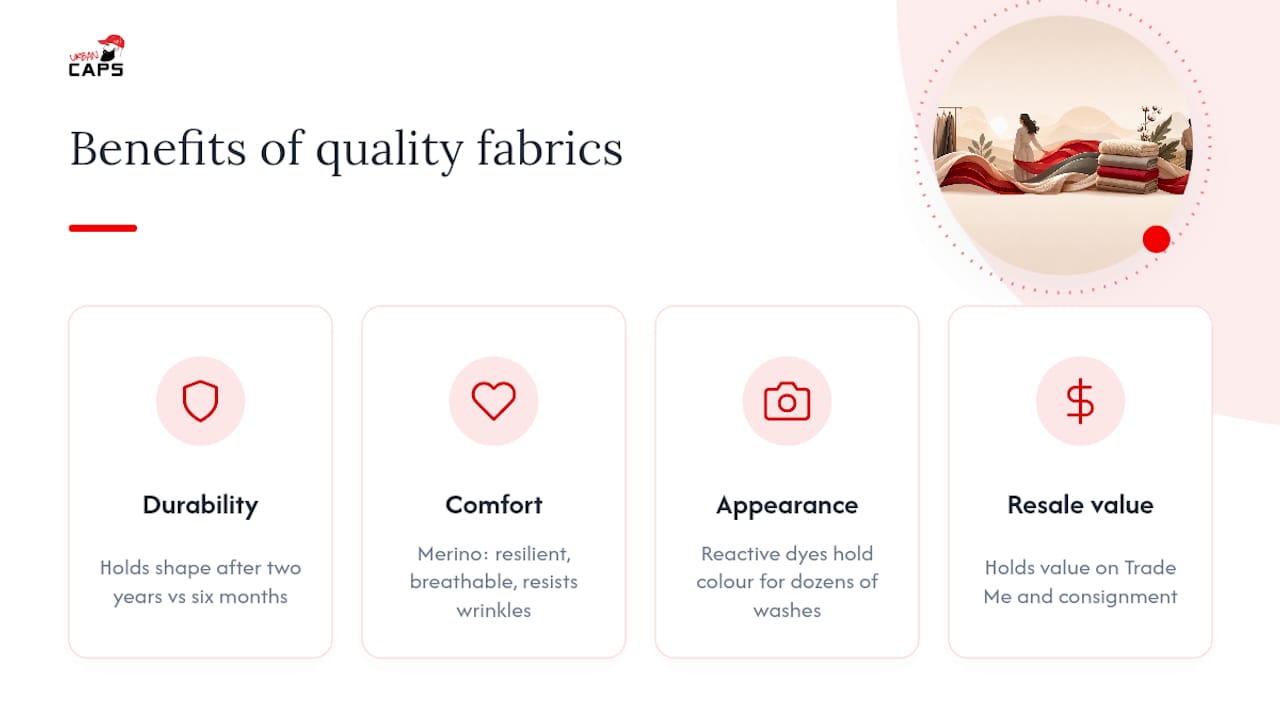
The benefits of quality fabrics are concrete and measurable across four dimensions.
Durability is the most obvious. Quality fibres and construction resist abrasion, pilling, and distortion through repeated wear and washing. A garment that holds its shape and surface after two years of regular use replaces one that pills and fades after six months. According to an LCA-focused study on apparel environmental impact, the use and end-of-life phases drive a large share of a garment’s total environmental footprint, and consumer care and disposal behaviours strongly influence that result. Wearing something longer is one of the most effective levers available.
Comfort and hand improve significantly with fibre quality. Merino wool offers resilience, breathability, and biodegradability, returns to shape after stretching, and resists wrinkles through long use. High-grade cotton breathes well and softens with washing rather than degrading. Synthetic fibres at lower grades can trap heat, pill, and lose their hand within months.
Appearance over time separates quality from cheap construction. Reactive dyes hold colour through dozens of washes; cheap pigment prints crack and fade within weeks. A well-constructed woven fabric keeps its drape; a poorly constructed knit bags and distorts. Seams stay flat. Hems stay even.
Stat to know: Only about 6.5% of consumed apparel in Aotearoa New Zealand is recovered for reuse or recycling, while approximately 76% goes to landfill. Garments that last longer and hold resale value are a direct counter to that figure.
Resale and second-hand value add another economic dimension. Mindful shopping and choosing higher-quality garments increases resellability and lowers effective cost-per-wear. A well-made wool coat or cotton canvas hat holds value on Trade Me or in a consignment shop; a pilled polyester equivalent does not.
How do you spot high-quality fabric when shopping?
Practical checks take less than two minutes and work in store or online.
Read the care label first. Fibre content is the single most reliable quality signal. Look for natural fibres (merino wool, organic cotton, linen, hemp) or high-percentage natural blends. Labels that list multiple fibres with small percentages often indicate cost-cutting blends.
Feel and drape checks tell you a lot quickly. Hold the fabric up: does it drape smoothly or hang stiffly? Stretch it gently and release: does it snap back or stay distorted? Rub it between your fingers: does it feel substantial or thin and papery? Quality fabrics have weight, recovery, and a consistent hand.
Inspect construction details. Stitch density matters: more stitches per centimetre means stronger seams. Check that seams are finished (overlocked or bound), not raw. Hems should be even and lie flat. In hats and caps, look at the brim stitching and sweatband attachment.
Check colour and dye quality. Even colour across the whole garment is a good sign. If you can, rub a damp cloth against an inconspicuous area: significant colour transfer suggests a low-quality dye.
Look for recognised certifications. GOTS and OEKO-TEX certifications help verify organic or low-impact textile claims and are practical signals when choosing higher-quality fabrics. GOTS covers the full supply chain from fibre to finished product; OEKO-TEX Standard 100 tests for harmful substances.
- Care label: natural fibres or high-percentage natural blends
- Drape and recovery: smooth hang, quick snap-back
- Stitch density: tight, even, finished seams
- Colour evenness: consistent across the whole piece
- Certifications: GOTS or OEKO-TEX as verification
Pro Tip: For online purchases, ask the retailer for a close-up photo of the weave or care label before buying. A seller who can provide this quickly is usually confident in their product.
What does the evidence show about fabrics and sustainability in New Zealand?
New Zealand’s textile waste picture is stark. Eunomia’s modelling for a Regulated Product Stewardship scheme finds that only about 6.5% of consumed apparel is recovered for reuse or recycling in Aotearoa, while roughly 76% goes to landfill. Cheap, low-quality imports and fast fashion contribute heavily to this: short-lifespan garments saturate reuse markets and reduce the viability of second-hand channels.
Higher-quality fabrics change end-of-life outcomes in two ways. First, they last long enough to be worth reselling or donating. Second, single-fibre natural items can be composted or recycled through wool and cotton recovery streams, whereas blended synthetics typically cannot.
Jacinta FitzGerald of Mindful Fashion NZ stresses that the most sustainable garment is one that is actually worn. Lisa McEwan from AUT has argued that extremely cheap clothing masks externalised environmental and labour costs and that treating clothing as disposable is a systemic problem, not just a consumer habit.
On the policy side, the Eunomia RPS modelling shows that schemes rewarding durability and reparability could deliver net economic benefits under several scenarios, though they would introduce producer compliance costs. Eco-modulation under a regulated product stewardship or extended producer responsibility framework would, in effect, price durability into the market.
- NZ recovers only ~6.5% of consumed apparel; ~76% goes to landfill
- Low-quality imports shorten garment lifespans and saturate reuse markets
- Quality fabrics improve resale viability and end-of-life recyclability
- RPS modelling suggests durability incentives could deliver net economic benefits
How do you care for high-quality fabrics so they last?
Care is where the investment in quality either pays off or gets wasted.
Follow the care label. Wash temperature, detergent type, and drying method are not suggestions. Hot water shrinks wool and degrades elastic. Tumble drying weakens fibres and sets creases. A cold, gentle machine wash with a mild detergent preserves both fibre integrity and dye quality. The MDPI lifecycle study confirms that consumer care behaviours strongly influence a garment’s total environmental impact.
Wash less, air more. Most garments do not need washing after every wear. Airing a wool jumper or cotton shirt overnight removes odour and refreshes the fabric without the mechanical stress of a wash cycle. Spot-clean small marks rather than running a full wash.
Repair early. A loose button replaced immediately costs nothing. Left until the button is lost, the repair becomes harder and the garment less wearable. Re-stitching a seam before it fully opens takes two minutes. Darning a small hole in a wool sock extends its life by years.
Store correctly. Wool items fold flat; hanging them stretches the shoulders. Cedar blocks or lavender sachets deter moths without the chemical residue of mothballs. Keep garments away from direct sunlight to prevent UV fading, particularly for darker colours.
- Cold, gentle wash with mild detergent for most quality fabrics
- Air between wears; spot-clean where possible
- Repair seams, buttons, and small holes promptly
- Store wool flat; use cedar or lavender for moth prevention
Pro Tip: Small maintenance actions, replacing a loose button, mending a small hole, re-stitching a hem, dramatically increase cost-per-wear by keeping a garment in active rotation rather than sitting unworn at the back of a wardrobe.
Cost-per-wear: does quality actually save you money?
Cost-per-wear is the purchase price divided by the number of times you wear something. It is the clearest way to compare a cheap garment with a quality one.
A simple example:
- Option A: a $30 fast-fashion cap worn 15 times before it pills and fades. Cost-per-wear: $2.00.
- Option B: a $90 quality cotton twill cap worn 150 times over three years. Cost-per-wear: $0.60.
Option B costs three times more upfront and roughly one-third as much per wear. Add resale value and the gap widens further. A well-maintained quality cap or hat can sell for $20–$40 on Trade Me; a pilled fast-fashion equivalent sells for nothing.
Jacinta FitzGerald (Mindful Fashion NZ) puts it plainly: the most sustainable garment is the one that is actually worn. Cost-per-wear is just the financial version of that same principle.
Quality garments also tend to outlast fast fashion by a significant margin in performance categories, where fabric integrity under repeated stress matters most.
- Cost-per-wear = purchase price ÷ number of wears
- A $90 item worn 150 times ($0.60/wear) beats a $30 item worn 15 times ($2.00/wear)
- Resale value reduces effective cost further
- Longer lifespan also reduces replacement frequency and total spend
Quick checklist for NZ shoppers at the point of purchase
Use this before you buy, whether in store or online.
Green lights:
- Care label shows natural fibres or a high-percentage natural blend (80%+)
- Single-fibre construction (100% wool, 100% cotton, 100% linen)
- GOTS or OEKO-TEX certification visible on label or product page
- Tight, even stitching with finished seams
- Smooth, even colour with no obvious variation
- Retailer can provide fibre origin or care details on request
Red flags:
- Fibre content label missing or vague (“fabric”, “textile”)
- High elastane content (above 5%) in a non-performance garment
- Excessive blends with four or more fibre types
- Thin, papery hand with poor drape recovery
- Colour that rubs off on a damp cloth
When a blend is justified: fitted activewear and performance garments genuinely benefit from elastane or nylon content for stretch and moisture management.
A New Zealander’s view on buying less and buying better
The cost-per-wear argument and the NZ textile waste figures point in the same direction: buy less, choose better, and keep what you have in use longer.
Practically, that means a few habits. Check consignment shops and Trade Me before buying new. Use local repair services for high-value items rather than discarding them at the first sign of wear. Choose fibres suited to New Zealand’s climate: merino wool for layering in variable weather, cotton canvas for everyday outdoor use, and sustainable headwear materials that hold up under UV and wind.
The Mindful Fashion NZ approach is not about spending more. It is about spending once on something that lasts, then caring for it so it stays in circulation. A garment repaired and reworn is always more sustainable than a new one bought to replace it.
Premium headwear that puts fabric quality into practice
Urbancaps stocks headwear built around the same principles this article covers: durable fabrics, tight construction, and materials chosen for longevity rather than price-point optics.

The Snapback Cap uses structured cotton twill with reinforced seams and a fitted sweatband, the kind of construction detail that separates a cap worn daily for two years from one that loses its shape in a season. For outdoor use, the Outdoor Travel Hat and the Outdoor Fishing Hiking Panama Fedora are built for NZ conditions: UV exposure, wind, and variable weather. The Visor Cap offers a lightweight option with care notes on the product page so you know exactly how to maintain it.
When buying headwear online, check the product page for fibre content and care instructions. If that information is not listed, ask before you order.
Pro Tip: Opt for hats with reinforced brim stitching and replaceable sweatbands. Those two construction details alone can double the wearable life of a cap.
Browse the full range at Urbancaps and choose headwear built to last.
Sources
- How to shop mindfully and save money | RNZ News
- Regulated Product Stewardship for Textiles in Aotearoa New Zealand
- Use and end-of-life phases significantly determine apparel environmental impact (MDPI study)
- The benefits of wool as a natural fibre
FAQ
What makes a fabric high quality?
High-quality fabric starts with long-staple natural fibres (merino wool, organic cotton, linen), tight yarn construction, and colourfast dyes. Certifications like GOTS and OEKO-TEX provide independent verification of fibre and process claims.
What are the benefits of wearing well-made clothes?
Better-quality garments last longer, feel more comfortable, hold their shape and colour through repeated washing, and carry resale value. Mindful Fashion NZ notes that wearing items longer and choosing quality over quantity is the most practical sustainability step available to shoppers.
What is the 3-3-3 rule in fashion?
The 3-3-3 rule is a capsule wardrobe approach where you rotate three outfits across three weeks using three items each. Definitions vary across sources, but the underlying principle aligns with cost-per-wear thinking: fewer, better pieces worn more often.
Why do many quality fabrics use a small percentage of synthetic fibre?
A 98% cotton, 2% elastane blend is a common example: it keeps cotton’s comfort while improving fit retention in structured garments.
How does fabric quality affect sustainability in New Zealand?
Choosing durable, natural-fibre items and caring for them properly keeps garments in circulation longer and reduces that waste stream.