

What is hat brim width, and how do you measure it?
Hat brim width is the distance from the outer edge of the brim to the base of the crown, measured horizontally across the flat part of the hat. To check it fast, lay the tape measure flat at the brim’s edge and pull it inward toward the crown, the same step-by-step approach retailers use when listing product specs. Oxford’s own dictionary confirms a brim is simply the projecting edge that sticks out around a hat, which is the part you’re measuring here.
Key Takeaways
Hat brim width, the distance from the brim’s outer edge to the crown base, determines how much sun and rain coverage a hat gives you and how much wind resistance it creates.
| Point | Details |
|---|---|
| Definition | Brim width runs from the outer brim edge to the base of the crown, not the crown itself. |
| Measurement method | Place the tape at the brim edge and pull it inward to the crown base, averaging several points on curved brims. |
| Width bands | Short sits under 2 inches (5cm), medium runs 2 to 3 inches (5 to 7.5cm), wide exceeds 3 inches (7.5cm). |
| Wind trade-off | Wider brims add coverage but catch more wind, so windy activities call for tighter crowns or chin straps. |
| Urbancaps examples | The Harrington fedora’s 10cm brim and the Wool Fedora Hat show what “wide” and “medium” look like in stock. |
Table of Contents
- What is hat brim width and why does it matter?
- How do you measure hat brim width?
- What are the standard hat brim widths and styles?
- How wide should your hat brim be?
- Small adjustments and quick brim conversions
- What retailers check before listing a brim width
- Find your brim width at Urbancaps
- Sources
- FAQ
What is hat brim width and why does it matter?
The crown is the part of the hat that sits on your head. The brim is everything that extends outward from its base, running the full circumference of the hat. On some styles you’ll hear the projecting front section called a bill or a visor, but on fedoras, sun hats, and cowboy hats, “brim” is the term you’ll see used consistently.
Brim width changes what the hat actually does for you, not just how it looks. A wider brim gives you:
- More shade across your face, ears, and neck
- Better rain runoff away from your collar
- A stronger visual statement, since a bigger brim shifts the whole proportion of the hat
- More coverage for outdoor work or long days in the sun
There’s a catch, though.
A hat brim’s projecting edge gives more protection the wider it gets, but that same surface area catches more wind, making broad-brimmed hats more likely to lift off in a gust.
That’s a real trade-off, not a footnote. It’s worth keeping in mind before you commit to a brim size, especially if you’re buying for a windy coastline rather than a garden party. Brim measurements are usually given in inches or centimetres, and you’ll see both used across product listings, so it helps to get comfortable converting between them early.
How do you measure hat brim width?
You can measure a brim two ways: off your head, or on it. Both take under a minute once you know where to place the tape.
What you’ll need:
- A flexible tape measure (a fabric one works better than metal for curved brims)
- A flat surface, if measuring the hat alone
- A soft marker or bobby pin, if measuring on your head
Method A: Measuring the hat flat
- Lay the hat crown-up on a flat surface.
- Find the point where the brim meets the base of the crown.
- Place the tape at the outer edge of the brim and pull it inward toward that crown base point.
- Read the measurement in inches or centimetres.
- Repeat at two or three points around the brim if it’s curved or asymmetric, then average the readings.
Method B: Measuring the hat on your head
- Put the hat on as you’d normally wear it.
- Mark the crown base line with a finger or bobby pin where the brim starts.
- Measure from that mark out to the brim’s edge.
- Check both sides, since some brims sit slightly uneven once worn.
The most common mistake is measuring to the brim’s curled lip rather than to the true crown base, which can inflate the number by a centimetre or more. Retail measurement guides recommend this same edge-to-crown method for exactly that reason. If you’re also checking overall fit, a step-by-step hat sizing guide covers circumference alongside brim measurements.
What are the standard hat brim widths and styles?
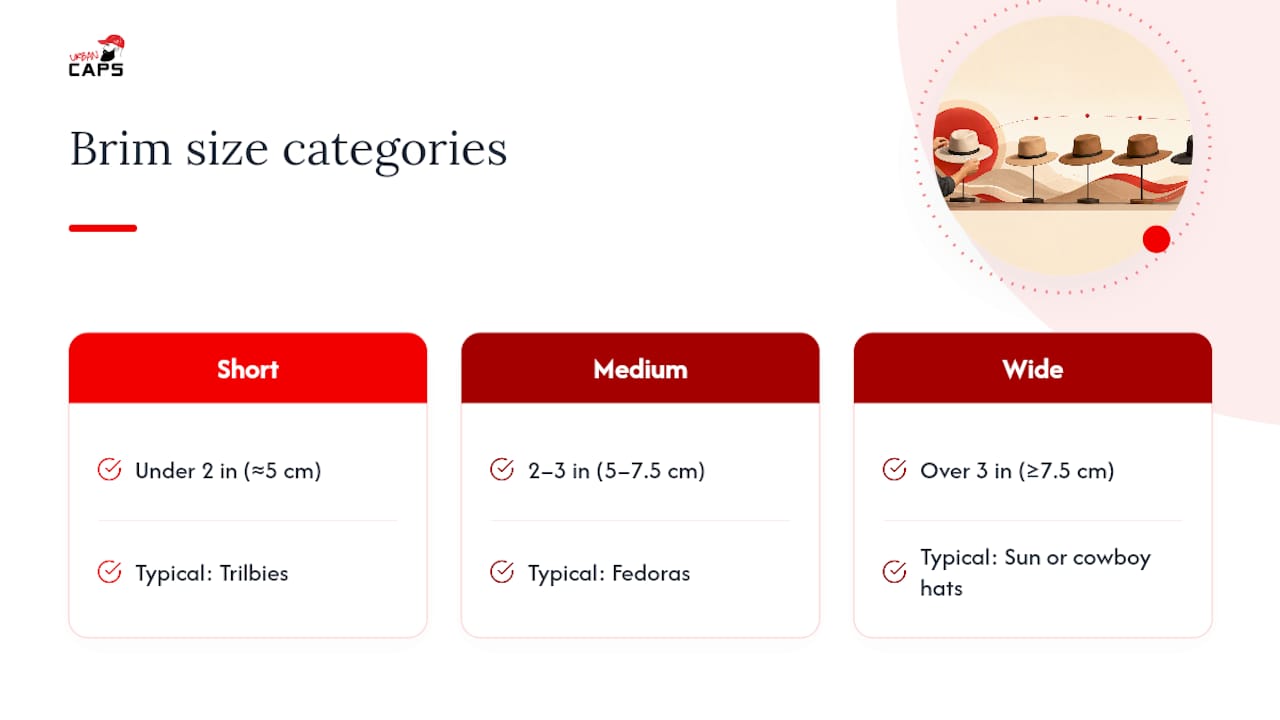
Once you’ve got a number, the next question is what it actually means. Brim widths generally fall into three bands: short (under 2 inches, or roughly under 5 centimetres), medium (2 to 3 inches, around 5 to 7.5 centimetres), and wide (over 3 inches, or beyond 7.5 centimetres).
- Short brims show up on trilbies and some flat caps. They frame the face without much shade, which suits city wear and everyday commuting.
- Medium brims are the classic fedora zone. Enough shade for a walk in the sun, without the visual weight of a wide brim.
- Wide brims cover sun hats, boater-style straw hats, and cowboy hats. They’re built for real outdoor coverage, and the extra fabric changes how the hat sits and moves in wind.
A few millimetres shift the whole look of a hat. The Harrington Wide Brim Fedora Brisa #3 lists a 10cm brim, well into wide territory, giving you a clear real-world benchmark for what “wide” looks like on the shelf. Compare that to a standard trilby brim of around 4 to 5 centimetres and the difference in coverage and silhouette is obvious.
Brim shape matters here too. A flat brim reads differently to a curved or snap brim of the same width, since the curve changes how much the edge actually projects outward from your face. When you’re scanning product pages, check whether the brim is described as flat, curved, or snapped, alongside the raw measurement in centimetres.

How wide should your hat brim be?
Match the brim to what you actually need it for, not just what looks good on the hanger.
- Sun protection first: go wide, over 3 inches or 7.5 centimetres, and look for styles built for all day outdoor coverage.
- Style and proportion first: medium brims (2 to 3 inches) suit most face shapes and don’t overwhelm shorter frames, while wider brims can balance a longer face nicely.
- Activity matters: cycling, boating, and hiking all influence brim width choice since larger brims can catch wind and become difficult to manage during active movement.
For anyone weighing brim width against face shape, a practical guide to choosing the right hat walks through proportion in more detail.
Pro Tip: If you’re active in wind, look for a chin strap or a slightly tighter crown rather than dropping brim width entirely. You can keep the coverage and lose the risk of it blowing off.
Wind isn’t only a hat problem. If you’re already thinking about wind exposure for an outdoor activity, windproof cycling sunglasses solve a related headache for anyone spending long stretches outdoors in gusty conditions.
Small adjustments and quick brim conversions
Accuracy comes down to a few habits. Measure at more than one point around the brim if it curves, and average the numbers rather than trusting a single reading. Account for the thickness of any binding or trim, since that can add a few extra millimetres to what you feel versus what’s on the label.
- 1 inch ≈ 2.5 centimetres, so a short brim (under 2 inches) sits under roughly 5 centimetres
- A medium brim (2 to 3 inches) runs about 5 to 7.5 centimetres
- A wide brim (over 3 inches) starts past roughly 7.5 centimetres
Manufacturers commonly build in tolerances of around 3 millimetres when shaping brim projection, so don’t panic if your tape measure and the listing differ slightly.
Pro Tip: Measure straw and leather hats indoors. Humidity and heat can flex natural fibres just enough to throw off a precise reading outdoors.
What retailers check before listing a brim width
A good retailer states exactly where the brim measurement was taken, whether the brim is flat or curved, and what tolerance applies. Those three details tell you more than the number alone.
Material changes the story too. Straw brims like the Flat Top Big Brim Straw Hat hold their shape rigidly, wool felt on the Wool Fedora Hat with Satin Lining can be steamed and reshaped, and leather brims soften with wear. Each behaves differently under the same tape measure.
- Check the listed measurement point (edge to crown base is standard)
- Note whether the brim is flat, curved, or snapped
- Ask about tolerance if buying for a precise fit
Pro Tip: Steam and reshape a felt brim occasionally to keep its width consistent. A brim that’s lost its shape measures smaller than it did new, even without any material loss.
A retailer’s note on getting this right
Numbers on a tape measure only tell half the story. A 10cm brim on a stiff felt fedora sits and behaves nothing like 10cm of floppy straw in a crosswind. Measure the hat, then try it on for the activity you actually plan to do in it, before you decide the number is right for you.
Find your brim width at Urbancaps
Urbancaps is the practical alternative to guessing your brim size from a photo online. Every product page lists the exact brim measurement in centimetres, along with the shape (flat, curved, or snap) and the material, so you know what you’re getting before it arrives at your door.
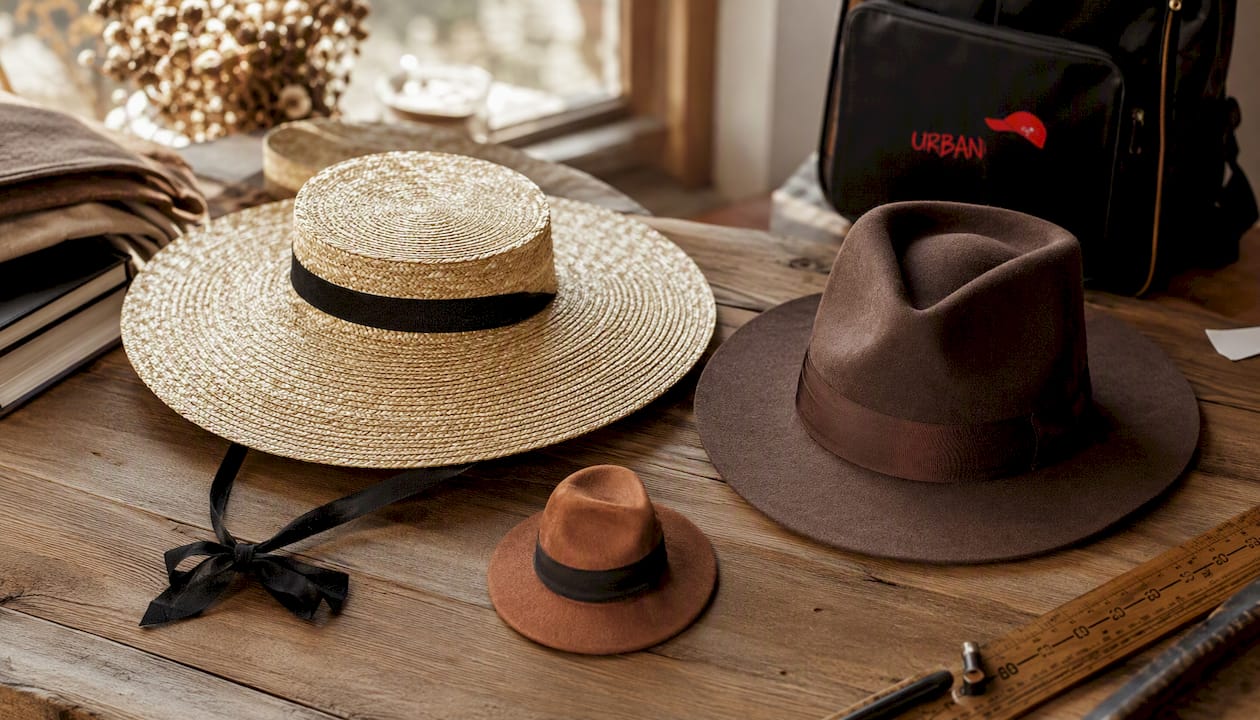
Whether you want the bold 10cm coverage of the Harrington Wide Brim Fedora, the natural shade of the Flat Top Big Brim Straw Hat, or the classic proportions of the Wool Fedora Hat with Satin Lining, you can compare the listed brim width against what you measured at home and know exactly what you’re ordering. Free shipping applies on all orders within NZ, and the team is proudly NZ owned and trusted by Kiwis nationwide. Head to the product pages, check the brim measurement against your own, and order the width that actually suits how you’ll wear it.
Sources
- Hat Brim Types: The Complete Guide to Brim Styles
- How to Measure a Hat?
- How to Measure a Hat ? - UP TREND CLOTHING
Browse Urbancaps’ fedora and straw hat pages to see listed brim widths in context before you buy.
FAQ
How wide should a hat brim be?
It depends on purpose: go wide (over 3 inches or 7.5cm) for maximum sun protection, medium (2 to 3 inches) for everyday style and balanced proportion, and short (under 2 inches) if you want minimal coverage and a neater silhouette.
What are the different brim sizes?
Brims are generally grouped as short (under 2 inches or roughly 5cm), medium (2 to 3 inches or about 5 to 7.5cm), and wide (over 3 inches or beyond 7.5cm), with trilbies, fedoras, and sun hats or cowboy hats typically sitting in each band respectively.
What does “wide brim hat” mean?
A wide brim hat has a brim measuring more than 3 inches (about 7.5cm) from the edge to the crown base, giving significantly more shade and rain coverage than a standard fedora or trilby.
What is the brim of a hat?
The brim is the projecting edge that extends outward from the base of the crown, running around the entire hat, and it’s distinct from the crown, which is the part that actually sits on your head.
Where can I see real examples of different brim widths?
Urbancaps lists exact brim measurements on every product page, including the 10cm brim on the Harrington Wide Brim Fedora, giving you a concrete reference point when comparing your own measurements.