

Why choose premium headwear: style, protection & value
TL;DR:
- Premium headwear uses superior materials for durability, UV protection, and style longevity.
- In New Zealand’s extreme UV and unpredictable weather, quality hats provide essential daily protection.
- Investing in durable, eco-friendly hats offers better value and sustainability over time.
Not all hats are created equal, and in New Zealand, that distinction really matters. The country’s intense UV index, unpredictable weather, and active outdoor lifestyle demand more than a basic cap from a bargain bin. Premium headwear uses superior materials and offers critical benefits like shape retention and UV protection that cheap alternatives simply cannot match. Whether you’re hiking the Coromandel, commuting through Auckland, or heading to a weekend market, the hat on your head is doing more work than you think. This guide breaks down exactly what makes premium headwear worth it, and how to choose the right one for your life.
Table of Contents
- What makes headwear ‘premium’?
- New Zealand’s climate: Why quality matters
- Cost, value, and sustainability: The economics of premium hats
- How to choose the right premium hat for style and activity
- The real reason premium headwear matters in New Zealand
- Explore premium headwear options for your lifestyle
- Frequently asked questions
Key Takeaways
| Point | Details |
|---|---|
| Premium materials | Quality fabrics like merino wool offer exceptional durability and climate-specific benefits. |
| UV and weather protection | Premium headwear ensures reliable UPF 50+ sun protection and breathability for New Zealand conditions. |
| Long-term value | Cost-per-wear and eco-friendly choices make premium hats a smart investment for style and sustainability. |
| Versatile style | There’s a premium style for every activity, blending fashion with everyday functionality. |
What makes headwear ‘premium’?
Now that you know why your choice of hat matters, let’s define what actually sets premium headwear apart from the rest.
The word “premium” gets thrown around a lot in retail. But when it comes to headwear, it has a specific meaning. It refers to the quality of materials, the standard of construction, and the thoughtfulness of design. A premium hat is built to perform, not just look good on a shelf.
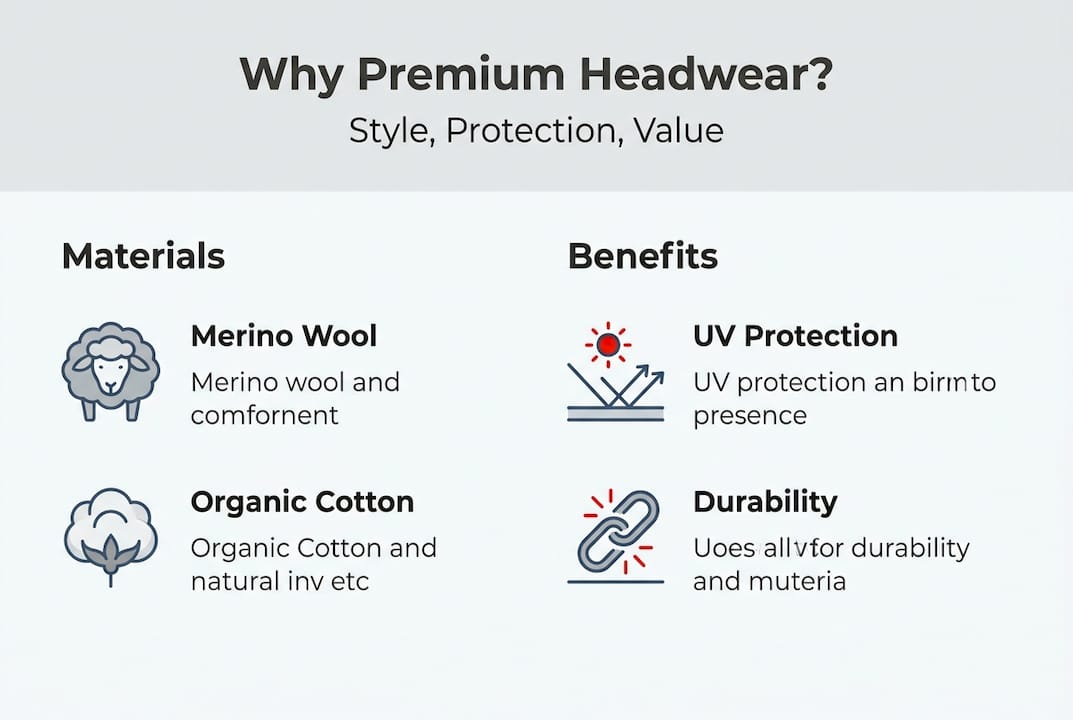
Materials are the starting point. Premium headwear uses materials like wool felt, merino wool, and technical fabrics that outperform cheap alternatives in every measurable way. Merino wool, for example, is naturally breathable, moisture-wicking, and temperature-regulating. Technical fabrics used in sports and outdoor caps often include UV-blocking weaves and quick-dry properties. These are not luxury extras. They are functional features that make a real difference in daily wear.
Construction quality is the next factor. Look for reinforced stitching at stress points, structured brims that hold their shape over time, and sweatbands with moisture-wicking linings. A well-built hat keeps its form after dozens of wears and washes. A cheap hat loses its shape after one rain shower.
You can also find premium options made from eco-friendly materials like recycled polyester and organic cotton. These choices align with the values of many New Zealand consumers who want their purchases to reflect care for the environment. Exploring premium headwear qualities can help you understand which features matter most for your needs.
Here’s a quick comparison to make the differences concrete:
| Feature | Premium headwear | Standard headwear |
|---|---|---|
| Materials | Merino wool, wool felt, technical fabrics | Polyester blends, basic cotton |
| Durability | Lasts years with proper care | Often degrades within one season |
| UV protection | UPF 30 to UPF 50+ ratings common | Minimal or no UV rating |
| Shape retention | Structured, reinforced construction | Loses shape quickly |
| Style longevity | Timeless designs that stay relevant | Trend-driven, disposable feel |
Key features to look for in a premium hat:
- Merino wool or wool felt construction for natural temperature regulation
- Reinforced stitching at the brim and crown for long-term durability
- Moisture-wicking sweatbands to keep you comfortable in warm conditions
- UPF-rated fabrics for sun protection on outdoor days
- Eco-friendly or recycled materials for a lower environmental footprint
New Zealand’s climate: Why quality matters
Understanding what makes a hat premium, let’s look at why this matters specifically for people living in New Zealand.
New Zealand sits in a part of the world where UV radiation is significantly stronger than in many Northern Hemisphere countries. The ozone layer over the Southern Ocean is thinner, meaning UV rays hit with greater intensity. On a clear summer day in Christchurch or Nelson, the UV index can reach 11 or higher, which is classified as “extreme” by the World Health Organization. That’s not a number to ignore.
For New Zealand’s high UV and quickly changing weather, premium hats offer vital benefits that basic headwear simply cannot provide. A UPF 50+ rating blocks 98% of UV rays, reducing your skin’s exposure to a level that makes a measurable difference in long-term skin health. That’s not marketing language. That’s physics.
Beyond UV, New Zealand weather is famously unpredictable. You can experience four seasons in a single afternoon in Wellington or the South Island. A hat that can handle light rain, strong wind, and sudden sunshine without falling apart or losing its shape is not a luxury. It’s a practical tool.
Here’s how common hat materials compare for UV protection:
| Material | UPF rating | Weather resistance | Breathability |
|---|---|---|---|
| Merino wool | UPF 20 to 30 | Good (natural water resistance) | Excellent |
| Wool felt | UPF 30 to 50 | Very good | Moderate |
| Technical fabric | UPF 50+ | Excellent (treated coatings) | High |
| Basic cotton | UPF 5 to 10 | Poor | Moderate |
| Polyester blend | UPF 10 to 20 | Moderate | Low to moderate |
UPF 50+ blocks 98% of UV rays, making it the gold standard for sun protection in New Zealand’s high-UV environment.
If you spend time outdoors, whether gardening, hiking, or simply walking to work, a hat with genuine UV protection is one of the simplest health investments you can make. Water resistance and breathability round out the package, keeping you comfortable no matter what the sky decides to do.
Cost, value, and sustainability: The economics of premium hats
Beyond weather protection, let’s consider why paying more upfront for premium headwear actually saves you money and benefits the environment.
The cost-per-wear framework is a simple but powerful way to think about any clothing purchase. Instead of looking at the sticker price, you divide the total cost by the number of times you actually wear the item. A $20 hat that falls apart after 10 wears costs $2 per wear. A $100 premium hat you wear 200 times over three years costs just $0.50 per wear. The math strongly favors quality.
Cost-per-wear logic consistently favors premium hats, and 75% of NZ consumers now prefer eco-friendly and durable options when shopping for headwear. That’s a clear signal that Kiwi buyers are thinking long-term.
Here’s how to calculate cost-per-wear for any hat you’re considering:
- Note the purchase price of the hat you’re considering.
- Estimate how often you’ll wear it per week based on your lifestyle.
- Project how long it will last based on material quality and construction.
- Multiply weekly wears by the number of weeks in your projected lifespan.
- Divide the purchase price by the total number of wears. Lower is better.
Sustainability adds another layer to this equation. Eco-friendly premium hats made from merino wool, recycled fabrics, or organic cotton have a lower environmental impact over their lifetime compared to cheap hats that end up in landfill after a single season. Buying one hat that lasts three years is always better for the planet than buying three hats that each last one year.
Pro Tip: Store your premium hat on a hat stand or stuff it lightly with tissue paper when not in use. This preserves the crown shape and extends the life of the brim, keeping it looking sharp for years longer.
“Choosing durability is the smart investment for Kiwi style and the planet.”
How to choose the right premium hat for style and activity
With an understanding of value and sustainability, it’s time to find the perfect premium hat that matches your unique fashion sense and lifestyle.
Not every premium hat suits every situation. The key is matching the hat’s design and material to the activities you actually do. A wide-brim fedora is ideal for beach days and outdoor events where maximum sun coverage matters. A structured cap works well for urban commuting and casual sport. A bucket hat offers relaxed coverage for hiking and travel. A trilby or flat cap adds a polished edge to city outfits.
Premium headwear offers style versatility and real performance for outdoor activities and everyday wear. The best choice is one that you’ll actually reach for every day, not one that sits on a shelf because it only works for one occasion.
Top criteria to evaluate before buying:
- Material: Match the fabric to your climate and activity level.
- Fit: Look for adjustable sizing or structured fits that suit your head shape.
- Protection: Prioritize UPF ratings for outdoor use.
- Versatility: Choose styles that work across multiple settings.
Most popular hat styles for New Zealand in 2026:
- Wide-brim fedoras: Maximum UV coverage, works for beach, garden, and casual outings.
- Structured caps and dad hats: Everyday urban wear, sports, and travel.
- Bucket hats: Lightweight and packable, great for hiking and festivals.
- Flat caps: Smart-casual city style with a heritage edge.
- Beanies: Essential for South Island winters and alpine adventures.
For more headwear style ideas and sports hat style tips, it’s worth exploring how different styles perform across real Kiwi lifestyles.
Pro Tip: Rotate between two or three hats rather than wearing the same one every single day. This gives each hat time to air out and regain its natural shape, dramatically extending how long each one lasts.
The real reason premium headwear matters in New Zealand
With all the facts on the table, let’s cut through the noise and share what most people miss.
Most conversations about hat quality focus on looks. But the real issue is lifestyle impact. New Zealand’s conditions are genuinely demanding. The UV is extreme, the weather shifts fast, and Kiwis spend a lot of time outdoors. A hat that fails under those conditions is not just an inconvenience. It’s a gap in your daily protection.
Here’s what people often overlook: the hidden cost of cheap hats. Buying a $15 hat every season sounds affordable. But over five years, that’s $75 spent on headwear that never really protected you and ended up in a landfill. One well-made hat at $90 to $120 covers the same period, performs better every single day, and still looks good at the end of it.
The Kiwi headwear reality is that quality pays for itself, not just financially, but in comfort, confidence, and actual skin protection. Style and function are not opposites. The best premium hats deliver both without compromise.
“The hat you wear every day should work as hard as you do.”
Investing in premium headwear is not about spending more. It’s about spending smarter, once, on something that genuinely serves you.
Explore premium headwear options for your lifestyle
Ready to take the next step? The right premium headwear is just a click away.
At Urban Caps, we carry a carefully selected range of premium hats built for New Zealand conditions. From wide-brim fedoras with serious UV coverage to refined woolen fedoras that bring warmth and style together, our collection covers every lifestyle need. Every hat in our range is chosen for quality materials, reliable construction, and timeless design. We offer fast NZ delivery and local support, so you can shop with confidence. Browse by style, material, or activity and find the hat that fits your life, not just your head.

Frequently asked questions
What materials make premium headwear better than cheaper options?
Premium hats use materials like merino wool, wool felt, and technical fabrics, which last longer and provide superior protection and comfort compared to basic polyester or thin cotton blends.
Is premium headwear really worth the extra cost?
Yes. Cost-per-wear logic strongly favors premium hats because they last much longer, offer better UV and weather protection, and typically cost less over time due to their durability.
How does a UPF 50+ rating benefit me in New Zealand?
A UPF 50+ hat blocks 98% of harmful UV rays, which is essential protection given New Zealand’s extreme UV index levels throughout summer.
Are premium hats more sustainable?
Most premium headwear incorporates eco-friendly materials and lasts significantly longer than budget options, making it a smarter and more sustainable choice for environmentally conscious Kiwi shoppers.