

Pay 3× More, Wear 5 Winters: When Merino Wool Beats Acrylic Beanies
For serious cold and active outdoor use, wool, especially fine merino, is usually the better choice; for easy care, budget and vibrant colours, acrylic is the practical option. Wool blends split the difference for most everyday buyers. Whichever you pick, construction and lining often matter as much as the fibre on the label, and both materials need different washing habits to last.
TL;DR:
- Wool provides superior insulation and moisture management in cold, damp conditions, especially for high-output outdoor activities like skiing and hiking.
- Acrylic offers easier care, brighter colors, and better affordability, making it suitable for casual wear, basic warmth, and sensitive skin with fleece-lined options.
- Wool-acrylic blends balance warmth, durability, and affordability, but construction and knit density significantly impact a beanie’s actual thermal performance.
- Proper care is crucial: wool needs gentle hand-washing and shaping, while acrylic is machine washable, but each ages differently with pilling or shrinkage.
- The true value depends on activity, durability, and care preferences, not just fiber type, as well-made acrylic can outperform poorly constructed wool beanies.
Table of Contents
- Wool vs acrylic beanie comparison at a glance
- Warmth and insulation: how the fibres actually perform
- Comfort and skin sensitivity: itch, fibre diameter and lining
- Breathability and moisture management for active wear
- Durability, pilling, shape retention and care
- Price, sustainability and value for money
- How to choose the right beanie for your use case
- Urbancaps’ take on wool, acrylic and everything in between
- Use cases: outdoor activity, everyday wear, kids and gifting
- Why the “wool always wins” advice misses the point
- Urbancaps’ beanie picks for every use case
- Sources
- FAQ
Wool vs acrylic beanie comparison at a glance
Wool is a natural protein fibre that traps air in its crimped structure, giving it a genuine edge in cold, damp conditions. Acrylic is a synthetic fibre spun to imitate wool’s look and feel at a fraction of the cost, and it dries fast because it barely absorbs moisture. Wool-acrylic blends, typically 50 to 80% wool with the rest acrylic, aim to keep most of wool’s warmth while adding acrylic’s washability and lower price.
- Warmth and insulation: wool wins in sustained cold and wet weather; acrylic is close enough for mild winters.
- Comfort: merino is soft against skin; coarser wool can itch; acrylic feels uniformly smooth but less breathable.
- Breathability: wool manages moisture vapour well; acrylic dries fast on the surface but traps heat and oils.
- Durability and care: acrylic resists shrinking and machine-washes easily; wool holds its shape but needs gentler handling.
- Price: acrylic is the cheapest option; merino wool sits at the premium end.
| Material | Best for | Watch out for |
|---|---|---|
| Acrylic | Budget buys, bold colours, sensitive skin, easy washing | Pilling, odour build-up with heavy wear |
| Standard wool | Cold commutes, everyday winter warmth | Itch for sensitive wearers, hand-wash needed |
| Merino wool | Skiing, snowboarding, all-day outdoor work | Higher price, still needs careful laundering |
| Wool-acrylic blend | Most everyday buyers wanting warmth without fuss | Slightly less insulation than pure wool |
Warmth and insulation: how the fibres actually perform
Wool fibres are naturally crimped, which means they don’t lie flat against each other. That crimp creates thousands of tiny air pockets throughout the yarn, and trapped air is what actually insulates your head, not the fibre itself. Merino wool takes this further with a finer, more tightly crimped fibre that packs more of those air pockets into the same thickness of fabric, which is why a merino beanie often feels warmer than a chunkier standard wool one.
Acrylic fibres are extruded as smooth, straight filaments, so they trap less air by comparison. Practical testing generally puts acrylic at around 70 to 80% of wool’s warmth for an equivalent thickness of knit, though the gap narrows in mild conditions and widens once temperatures drop hard.
Wool holds onto its insulating power even when it gets damp, because the crimped fibre structure keeps trapping air pockets rather than collapsing flat the way most synthetics do when wet. That’s the real reason ski instructors and tramping guides still lean on wool. Acrylic, once soaked through, loses much of its already-modest insulating value and stays wet longer against your scalp.
Where acrylic holds its own is everyday mild winter wear. For the kind of cold most commuters face, the practical difference is small, and a well-built acrylic beanie with a double-layer knit or fleece lining can outperform a thin, single-layer wool one.
That last point matters more than most buyers realise:
- A tightly knitted, double-layer acrylic beanie can beat a loose single-knit wool one for warmth.
- Fleece linings add real insulation regardless of the outer fibre.
- Knit density (how tightly the yarn is worked) often affects warmth more than the raw material choice.
Comfort and skin sensitivity: itch, fibre diameter and lining
Itch comes down to fibre diameter, not the word “wool” on the tag. Fine merino, typically under 20 microns, bends easily against skin and rarely triggers the prickle reaction people associate with wool. Coarser standard wool, often 25 to 35 microns, is stiffer and more likely to feel itchy on sensitive foreheads, especially for kids or anyone with eczema-prone skin.
Acrylic has one clear comfort advantage: it’s completely hypoallergenic. There’s no lanolin (the natural wool grease that some people react to) and no protein allergens, so it’s often the safer pick for anyone with wool sensitivities or very reactive skin. The trade-off is that acrylic can feel slightly plasticky against the skin compared with a good merino knit, and it doesn’t soften with wear the way wool does.
Linings change the equation for both materials. A fleece-lined acrylic beanie neutralises most of wool’s comfort advantage, and a cotton or synthetic lining stitched into a coarse wool beanie removes the itch factor almost entirely. Wool-acrylic blends achieve something similar by softening the coarser fibre’s feel while keeping some of its warmth.
- Check the fibre diameter or “micron count” on the product page if it’s listed.
- Look for “lined” or “fleece-lined” in the description if itch is a dealbreaker.
- Blends with above 60% acrylic tend to feel closest to a pure acrylic beanie.
Pro Tip: Rub the inside of any beanie against the inside of your wrist for five seconds before buying. If it feels rough there, it will feel rough on your forehead after an hour outdoors.
Breathability and moisture management for active wear
Wool absorbs moisture vapour into the fibre itself and releases it gradually, which is why your head doesn’t feel swampy under a wool beanie even after a solid uphill hike. Acrylic, by contrast, barely absorbs any moisture and relies on surface evaporation instead, so sweat sits on the fabric’s surface rather than being drawn away from your skin.
For low-intensity wear, that difference barely registers. But once you’re generating real heat, running, skiing, shovelling snow, acrylic’s poor breathability becomes a genuine problem. Heat and moisture get trapped against your scalp, and you end up peeling the beanie off mid-activity to cool down. Wool keeps working through that same exertion because it’s actively managing the vapour rather than just sitting on top of it.
There’s a knock-on effect too. Wool’s natural antimicrobial properties mean it resists picking up odour far longer than acrylic under repeated wear, which matters if you’re wearing the same beanie for a week of ski runs or daily commutes without a wash in between.
- Choose wool or a wool-heavy blend for skiing, running or any high-output outdoor activity.
- Acrylic is fine for short exposure: walking to the car, quick errands, casual wear.
- A lined acrylic beanie traps heat well but doesn’t manage sweat, so it can feel clammy during exertion.
- Blends with 60% or more wool content keep most of the moisture-handling benefit while adding some acrylic durability.
Durability, pilling, shape retention and care
Acrylic and wool age differently, and knowing how changes how you should wash and store each one.
- Acrylic resists shrinking but pills faster under friction, think backpack straps or scarves rubbing against it, and can stretch out of shape after repeated stuffing into pockets.
- Wool holds its shape well and resists abrasion better than most people expect, but it shrinks or felts permanently if washed in hot water or tumbled in a dryer.
- Blends split the difference, generally pilling less than pure acrylic while shrinking less easily than pure wool, which is part of why wholesale buyers favour blended beanies for retail ranges that need to survive repeated handling.
- Care routine matters more than fibre choice for lifespan: hand-wash in cool water, reshape while damp, and dry flat away from direct heat, regardless of what the beanie is made from.
Acrylic’s machine-washability is genuinely convenient for anyone who doesn’t want to fuss over headwear, but that convenience comes with a pilling tradeoff over a season or two of regular wear. Wool needs more careful handling, yet a well-cared-for merino beanie can outlast several acrylic ones. Urbancaps’ guide to cleaning beanies walks through the exact wash cycle and drying steps that prevent shrinkage on either material, and the dedicated wool hat care guide covers the extra steps merino and standard wool need to stay in shape.
Price, sustainability and value for money
Acrylic beanies typically sit at the cheapest end of the market, standard wool sits in the middle, and merino wool commands the premium price. That spread reflects processing cost more than anything else: acrylic is a petrochemical-derived fibre manufactured at scale, while wool is a farmed natural fibre that needs shearing, cleaning and spinning before it ever reaches a knitting machine.
Sustainability tips the other way. Wool is biodegradable and comes from a renewable source, while acrylic is essentially a plastic and doesn’t break down the same way once discarded. If environmental footprint factors into your buying decision, that’s worth weighing against the lower sticker price.
Lifetime cost is where the maths gets interesting. A merino beanie that costs three times more than an acrylic one but lasts five winters instead of one, and needs a gentle hand-wash instead of frequent machine cycles, can work out cheaper per year of wear. Blended options built with 50 to 80% wool often land in a sensible middle price band while keeping most of wool’s longevity.
- Acrylic: cheapest upfront, shortest realistic lifespan under regular wear.
- Standard wool: mid-price, decent lifespan with proper care.
- Merino wool: highest upfront cost, often the best cost-per-wear over several years.
How to choose the right beanie for your use case
Match the material to what you’re actually going to do in it, not just the season on the calendar.
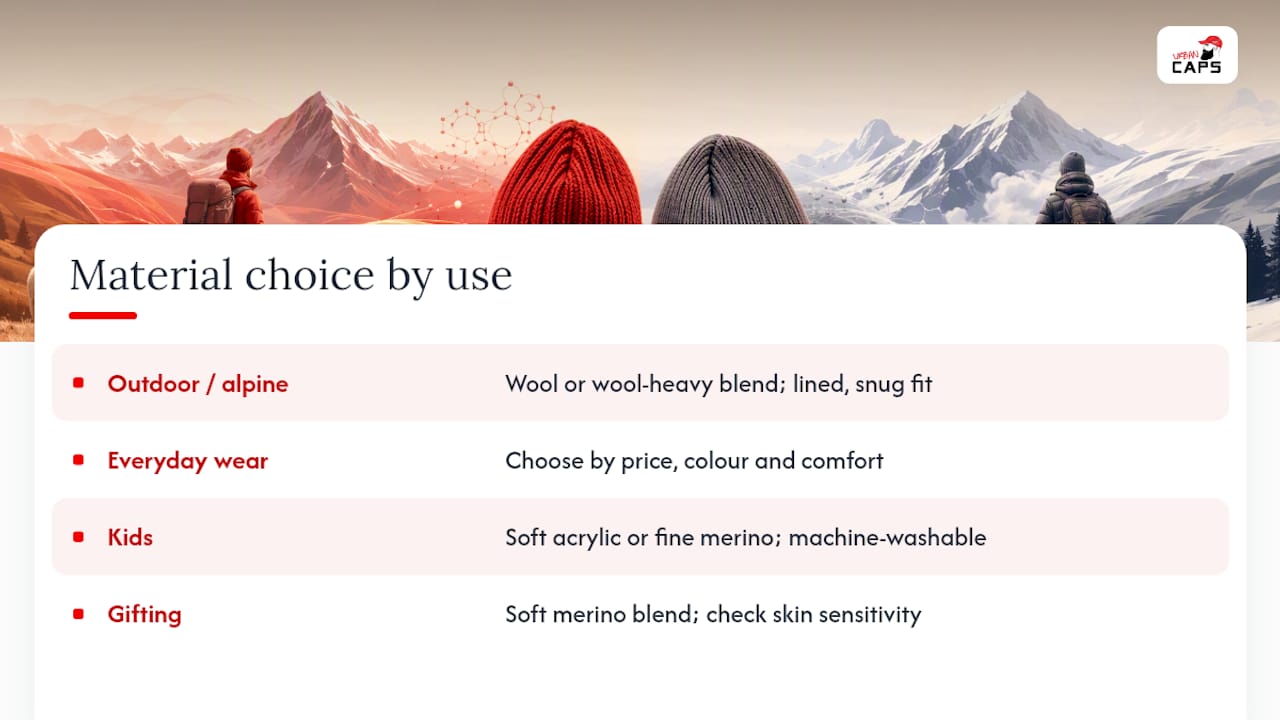
- Skiing, snowboarding or alpine work: go merino wool or a wool-heavy blend with a fleece lining and a snug cuff. Look for grams-per-square-metre (GSM) figures if listed. Higher GSM means denser, warmer knit.
- Daily commuting in a temperate climate: a wool-acrylic blend or a well-knitted acrylic beanie with double-layer construction covers most days without fuss.
- Kids’ beanies: prioritise acrylic or a soft merino blend. Coarse wool against a child’s sensitive skin is a common source of tantrums over “itchy hats.”
- Gifting: merino wool reads as the more premium gift and photographs well for online orders, but check the recipient’s known sensitivities first.
- Everyday fashion wear: acrylic wins on colour range and price, and dye takes more vividly on synthetic fibre than on natural wool.
Before buying, check the product page for fibre percentage, GSM or knit weight, lining material and washing instructions. Those four details tell you more about real-world performance than “wool” or “acrylic” alone ever will.
Urbancaps’ take on wool, acrylic and everything in between
Urbancaps has spent years building out headwear ranges across wool hat styles and everyday knits, and one pattern shows up constantly in customer feedback: construction complaints outnumber fibre complaints. People rarely write in saying “this wool was itchy.” They write in saying “this beanie stretched out after a month” or “this lining bunched up.” That’s a build quality issue, not a material one.
- Double-layer knits consistently outperform single-layer knits regardless of fibre, for warmth and shape retention alike.
- Fleece-lined constructions solve most itch complaints even when the outer yarn is coarser wool.
- Wool’s natural benefits around breathability and odour resistance hold up well across Urbancaps’ own product testing feedback, particularly for cold, active use.
- Terminology on product pages, “worsted,” “chunky knit,” “Merino blend,” genuinely changes what you’re buying, and the wool terminology guide is worth a quick read before you order.
Use cases: outdoor activity, everyday wear, kids and gifting
Outdoor and alpine activity is where the material choice matters most, because sustained cold and moisture expose every weakness in a cheap synthetic knit. Wool or a wool-heavy blend with a snug, lined fit is the safer bet for skiing, snowboarding or long winter hikes, and layering a beanie under a hood adds meaningful extra warmth without changing the fibre choice.
Everyday wear is more forgiving. A commute, a school run or a weekend walk rarely pushes either material to its limit, so this is where price, colour and comfort preference should drive the decision rather than raw insulation numbers.
Kids’ beanies deserve their own rule: comfort and washability beat warmth performance almost every time, since a beanie a child refuses to wear provides zero insulation. Soft acrylic or fine merino blends, machine-washable where possible, solve more real-world parenting problems than a technically warmer coarse wool option ever will.
Gifting sits somewhere between fashion and function. A well-made wool beanie reads as a more considered gift, but checking the recipient’s skin sensitivity, or defaulting to a soft merino blend, avoids the awkward “thanks, but it’s itchy” conversation. Urbancaps’ styling guide to beanies covers how to match a beanie to an outfit if style is the deciding factor over pure function.
Why the “wool always wins” advice misses the point
Most articles comparing wool and acrylic beanies treat it as a straight fibre contest, and wool usually wins on paper. That framing misleads more buyers than it helps. The research is clear that construction, lining and knit density change real-world warmth as much as fibre choice does, so a cheap wool beanie with a loose knit can lose to a well-built acrylic one every time.
The bigger blind spot is lifetime cost. Buyers fixate on the sticker price and miss that a beanie needing frequent replacement or constant careful washing has its own hidden cost in time and money. If someone genuinely won’t hand-wash a wool beanie, buying wool anyway just guarantees a shrunken, felted hat by winter’s end.
Prioritise honestly: how you’ll actually care for it, what activity you’ll wear it for, and whether itch tolerance is a real issue for you or your kids. Fibre choice comes fourth on that list, not first, no matter what the marketing copy says.
— Urban
Urbancaps’ beanie picks for every use case
Once you know which fibre suits your needs, the next step is finding a beanie built the right way, not just labelled the right way.
 For cold, active days on the slopes, the Thunderbolt Ski Hat adds ear protection to a warm, close-fitting build, and the Ski Skull Beanie covers snowboarding and general outdoor sport with a snug, insulating knit. For everyday city wear where colour and comfort matter more than technical performance, the Fashion Knit Beanie is an easy-care option that suits both casual commuting and gifting.
Unlike generic overseas retailers, Urbancaps stocks its beanie and hat range locally with fast NZ delivery, so you’re not guessing about fit or waiting weeks to find out a construction doesn’t suit your climate. Browse the full beanie and headwear range and check fibre content, GSM and lining details on each product page before you order.
Sources
- Insulation materials guidance — Ministry of Business, Innovation & Employment (New Zealand)
- Acrylic vs wool beanies — CapsCompany
- Acrylic vs Wool Beanies: Which is Better? — Foremost Hat shop blog
- Knitted beanie material guide — Hongyuecap
FAQ
What is the best material for a beanie hat?
Merino wool is generally the best all-round performer for warmth and moisture management, while acrylic suits budget-conscious buyers who want easy care and bold colours. Wool-acrylic blends work well for most everyday buyers who want a balance of both.
Is 100% wool better than acrylic?
Pure wool usually outperforms acrylic in sustained cold and wet conditions because its crimped fibres keep trapping air even when damp. For mild winter days, the practical difference narrows enough that comfort, price and care preferences matter more than raw warmth.
Is acrylic a good fabric for beanies?
Yes, acrylic is a solid choice for everyday mild-weather wear, sensitive skin and easy machine washing, and it holds vivid dye colours better than wool. It falls short of wool in sustained cold, damp conditions and high-output activity where breathability matters.
Why avoid acrylic yarn?
Acrylic isn’t worth avoiding outright, but it pills faster under friction, absorbs less moisture than wool, and can trap heat and odour during heavy exercise. For serious cold-weather or active use, a wool or wool-blend beanie generally performs better over time.