


Step by step hat sizing for knitters and shoppers
Measure the widest part of your head with a soft tape, record the circumference in centimetres, then match it to the chart below. That single number is all you need to pick the right hat size or calculate a finished hat circumference for knitting or crochet.
Quick example:
- 56 cm (22 in) → US 7 → UK 6⅞ → EU 56 → Medium
- 58 cm (22⅞ in) → US 7¼ → UK 7⅛ → EU 58 → Large
Measure 2–3 times and use the larger reading if you fall between two numbers. A slightly bigger hat is always easier to fix than one that’s too tight.
Key takeaways
Accurate hat sizing starts with one measurement: the widest circumference of your head in centimetres, taken with a soft tape, repeated at least twice, and matched to a conversion chart.
| Point | Details |
|---|---|
| Measure correctly first | Position tape just above the ear and mid-forehead; apply the one-finger rule for snugness. |
| Always measure twice | A 0.6 cm error can shift you into the next fitted-size fraction; use the largest reading. |
| Round up between sizes | Choose the larger size and use hat tape or foam inserts to adjust a slightly loose fit. |
| Apply negative ease for knit/crochet | Knitted hats use ~13% ease (head × 0.87); crochet makers often subtract ~6.5 cm instead. |
| Urbancaps for NZ shoppers | Browse sized-to-fit styles with free NZ shipping and straightforward returns at Urbancaps. |
Table of Contents
- How to size a hat step by step with a tape measure
- No tape measure? How to measure without one (and how to measure children)
- Hat size chart: centimetres, inches and US/UK/EU conversions
- Negative ease for knitted and crocheted hats
- Calculating hat height and crown diameter
- What to do when your size falls between two hat sizes
- Quick pre-measurement checklist
- What Urbancaps sees in NZ customers and fit patterns
- Hats ready to wear once you’ve got your size
- Sources
- FAQ
How to size a hat step by step with a tape measure
A reliable measurement takes under two minutes; for detailed techniques, see the hat size guide: how to measure and fit any cap. Gather these first:
- Soft tailor’s tape (a dressmaker’s tape or a flexible craft tape)
- A mirror, or a friend to check the tape sits level
- Pen and paper or your phone to record both cm and inches
Steps:
- Remove any hat, headband, or bulky hair accessory.
- Position the tape about 0.3 cm (⅛ in) above your ear, running across the mid-forehead and around the widest part of the back of your head.
- Keep the tape level all the way around. A tilted tape gives a shorter reading than your real circumference.
- Pull the tape snug but not tight. The one-finger rule: you should be able to slide one finger underneath without forcing it.
- Read the number where the tape overlaps. Record it in both centimetres and inches.
- Repeat the measurement twice more. If the readings differ, use the largest.
Pre-fitting checklist:
- Tape is soft and non-stretch
- Tape sits level front to back
- One finger fits under the tape
- You have recorded both cm and inches
- You have measured at least twice
Pro Tip: If you wear a hat with a thick liner in winter, measure with that liner on. A summer measurement can run 1–2 cm smaller than a winter one with a fleece-lined beanie underneath.
A very small error, as little as 0.6 cm, can shift you into the next fitted-size fraction. Using a mirror and repeating the reading keeps that risk low.
No tape measure? How to measure without one (and how to measure children)
The string method
- Cut or find a piece of non-stretch string, ribbon, or a shoelace.
- Wrap it around your head using the same position described above: just above the ear, across the mid-forehead.
- Pinch or mark the point where the string meets itself.
- Lay the string flat against a ruler or straight edge and read the length in centimetres.
- Repeat once and average the two readings if they differ by more than 0.5 cm.
Measuring babies and children
Children’s heads grow quickly, so measure close to when you plan to buy or make the hat. The Craft Yarn Council’s head circumference chart gives standard ranges by age that most sizing systems follow.
A few practical notes:
- Measure when the child is calm and still, ideally seated on a flat surface.
- Use a soft tape or the string method; avoid anything that could tighten unexpectedly.
- For infants, take extra care not to apply any pressure. A loose wrap and a careful mark on the string is safer than a snug tape.
- If you need hat height for a knitted or crocheted baby hat, measure from the crown of the head to just above the ear as a second measurement.
Hat size chart: centimetres, inches and US/UK/EU conversions
Your head circumference maps to a fitted hat size using a simple formula: divide your measurement in inches by π (3.14) to get the US fitted number. Most shoppers skip the maths and use a conversion chart instead.
| Head circumference (cm) | Head circumference (in) | EU size | US fitted | UK fitted | S–XXL band |
|---|---|---|---|---|---|
| 53 | 20⅞ | 53 | 6⅝ | 6½ | XS |
| 54 | 21¼ | 54 | 6¾ | 6⅝ | S |
| 55 | 21⅝ | 55 | 6⅞ | 6¾ | S |
| 56 | 22 | 56 | 7 | 6⅞ | M |
| 57 | 22½ | 57 | 7⅛ | 7 | M |
| 58 | 22⅞ | 58 | 7¼ | 7⅛ | L |
| 59 | 23¼ | 59 | 7⅜ | 7¼ | L |
| 60 | 23⅝ | 60 | 7½ | 7⅜ | XL |
| 61 | 24 | 61 | 7⅝ | 7½ | XL |
| 62 | 24⅜ | 62 | 7¾ | 7⅝ | XXL |
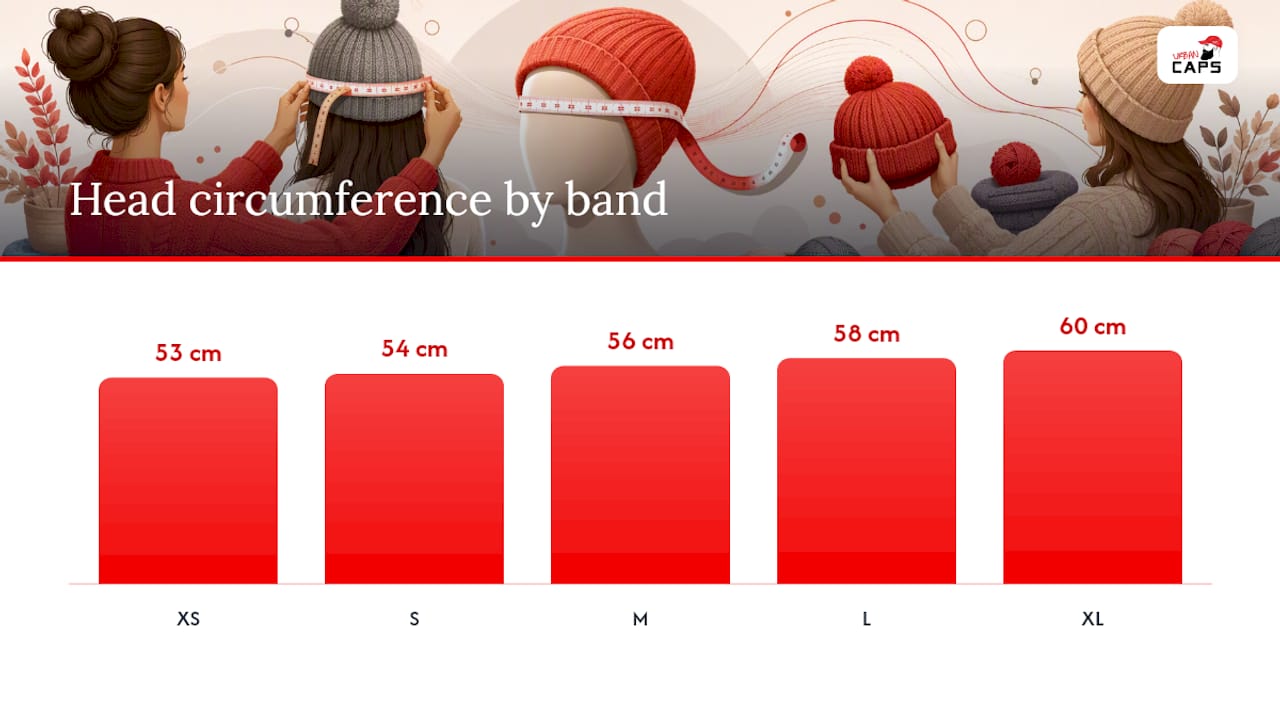
According to the Craft Yarn Council, women’s adult heads typically measure 53–58.5 cm and men’s 56–61 cm, which is why most S–L ranges sit in that band.
When you fall between two sizes, choose the larger one. A hat that runs slightly large is straightforward to adjust with sizing tape or a foam insert. A hat that’s too small cannot be stretched without risking the shape.
Negative ease for knitted and crocheted hats
What is negative ease?
A finished hat is intentionally smaller than the head it fits. That difference is called negative ease, and it is what makes a hat grip the head rather than slide around. For a knitted hat, a common benchmark is approximately 13% negative ease, meaning the finished circumference equals the head circumference multiplied by 0.87.
Applying the formula
- Measure your head circumference. Example: 56 cm.
- Multiply by 0.87 to get the target finished circumference: 56 × 0.87 = 48.7 cm.
- Use your gauge swatch to calculate how many stitches produce 48.7 cm.
- Cast on that stitch count.
For crochet, many makers prefer a fixed subtraction rather than a percentage. B.Hooked’s hat sizing guide recommends subtracting approximately 2.55 in (≈6.5 cm) from the head circumference to get the target finished size. For a 56 cm head: 56 − 6.5 = 49.5 cm.
Both approaches aim for a similar target size, with the choice depending on yarn elasticity and stitch pattern.
How yarn and stitch affect the number:
- Stretchy yarns (merino, superwash wool) tolerate more negative ease; you can push closer to 15%.
- Dense stitches or thick yarns need less; 8–10% keeps the hat wearable.
- Textured stitches like seed stitch or moss stitch have less stretch than stockinette, so reduce ease slightly.
Pro Tip: Always knit or crochet a gauge swatch in the round if your hat is worked in the round. Flat swatches often give a different stitch count per centimetre than circular ones.
For more on how material choice affects fit and stretch, the guide to choosing premium hats covers construction details worth knowing before you cast on.
Calculating hat height and crown diameter
Two measurements drive hat shape: circumference (around the head) and hat length (crown to brim). Once you have both, the Fibertools hat calculator guide gives these formulas:
- Crown diameter = target circumference ÷ π (3.14)
- Crown height = target circumference ÷ 6.28
Worked example using a 56 cm target circumference:
- Crown diameter: 56 ÷ 3.14 = 17.8 cm
- Crown height: 56 ÷ 6.28 = 8.9 cm
Allocating the hat sections:
- Band (ribbing or brim): typically 5–7 cm for an adult hat
- Body (straight section): total hat length minus band and crown height
- Crown (decrease section): use the crown height figure above
Notes for different styles:
- Fitted beanie: use the target circumference as calculated.
- Slouchy hat: add approximately 5 cm to the total hat length and 2–3 cm to the body section.
- Brimmed hat: the brim width is a separate measurement; plan it after the crown and body are set.
B.Hooked’s sizing guide also covers typical band and crown proportions for pattern planning if you need a reference for specific age sizes.
What to do when your size falls between two hat sizes
Choose the larger size. A hat that sits slightly loose is fixable in minutes; one that’s too tight causes headaches and distorts the brim.
Quick fixes for a loose hat:
- Hat sizing tape: self-adhesive foam tape that sticks inside the sweatband and reduces the inner circumference by 0.5–1 cm per strip.
- Foam inserts: thicker pads that sit at the back of the crown; good for structured caps.
- Sew-in elastic: a short length of elastic sewn into the inner band of a knitted or crocheted hat pulls the circumference in without altering the outside.
- Adjustable sweatband: some structured caps have a slider at the back; check the product listing before buying.
- Steam blocking: for wool or wool-blend knitted hats, light steam and reshaping on a hat block or balloon can reduce circumference by 1–2 cm.
Pro Tip: If you wear your hair in a bun or thick braid, measure with your hair up. A hat sized for flat hair will sit too high on a full updo. Allow an extra 1–2 cm in circumference for thick hairstyles or hats worn over a hood.
For a deeper look at how shape affects perceived fit, why hat shape matters is worth a read before you finalise your size.
Quick pre-measurement checklist
Run through this before you record any number:
- Remove hats, headbands, and bulky hair accessories
- Decide whether you are measuring with your usual hairstyle or with a liner; be consistent
- Use a soft tape or a non-stretch string
- Position the tape just above the ear and across the mid-forehead
- Keep the tape level all the way around
- Apply the one-finger rule: snug, not tight
- Measure at least twice; record both cm and inches
- Compare your reading against the brand’s own size chart before ordering
For more buying guidance once you have your number, the how to choose the right hat guide walks through style and fit decisions from there.
What Urbancaps sees in NZ customers and fit patterns
Most NZ shoppers who contact us about fit fall into two groups: those who measured once in a rush and landed between sizes, and those who measured correctly but ordered based on a generic S/M/L label without checking the centimetre range behind it. Both are easy to avoid.
From what we see across orders, the majority of adult Kiwi customers sit in the 56–60 cm range, which maps to Medium through Large in most systems. That said, head shapes vary considerably, and a hat that fits the circumference perfectly can still sit oddly if the crown is too shallow or the brim too wide for the wearer’s proportions. Checking how to select the perfect hat for your face shape alongside your measurement gives a more complete picture.
If a hat from Urbancaps doesn’t fit after following these steps, our returns and fit advice process is straightforward. Reach out before returning and we can often suggest a fit fix or an alternative style that works better.
Hats ready to wear once you’ve got your size
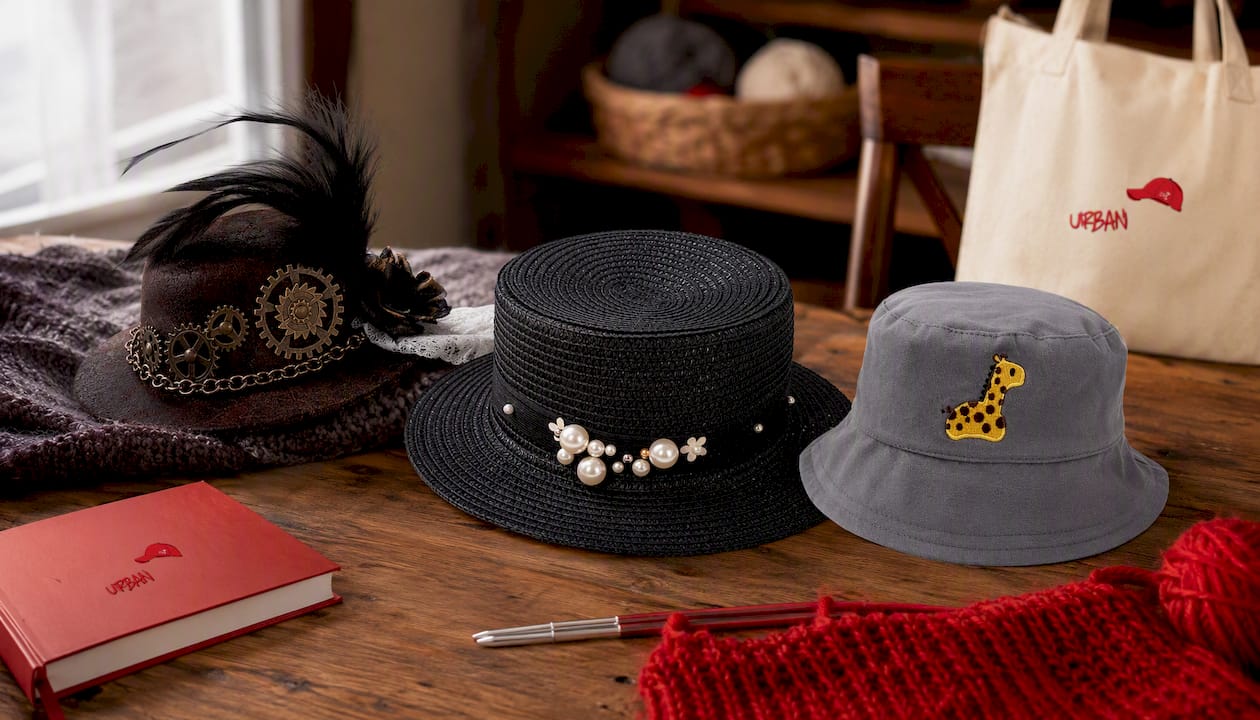
You have your measurement. Now find the hat. Urbancaps stocks a range of styles sized for real NZ heads, with local stock and free shipping on all NZ orders.
Three styles worth checking against your new measurement: the Halloween Gothic Mini Top Hat for a statement novelty piece, the Summer Shading Bowler Hat for sun protection with a warp-knit finish, and the Kids Classic Everyday Hat for ages 3–5 if you measured a little one. Every product page lists the head circumference range so you can match your number directly. Browse the full range at Urbancaps and check out with confidence knowing your size.
Sources
- Head circumference chart | Welcome to the Craft Yarn Council
- How to knit the right hat size, a complete guide
- How to measure head for hat size Size chart + 2 easy ways
- Size
- Knitting & Crochet hat size chart + complete hat sizing guide (B.Hooked)
- Hat calculator guide | Fibertools blog
Always swatch before casting on, and check the size notes in your specific pattern. Gauge varies by maker, yarn, and needle or hook size, and a pattern’s stated ease may differ from the general benchmarks above.
FAQ
How do I measure my head for a hat at home?
Wrap a soft tape measure just above your ear and across the mid-forehead, keep it snug with one finger fitting underneath, and record the circumference in centimetres. Repeat twice and use the largest reading.
What size is a 57 cm head circumference?
A 57 cm head maps to US 7⅛, UK 7, EU 57, and a Medium in most S–XXL systems.
How much negative ease should a knitted hat have?
Crochet makers often subtract approximately 6.5 cm instead.
What should I do if my measurement falls between two hat sizes?
Choose the larger size. A slightly loose hat is easy to adjust with hat sizing tape, foam inserts, or a sew-in elastic; a hat that’s too small cannot be comfortably stretched.
How do I measure a child’s head for a hat?
Use a soft tape or the string method, wrap it just above the ear and across the mid-forehead, and measure when the child is calm and still. Compare the result against an age-based chart such as the Craft Yarn Council’s head circumference guide.